Skills, Portfolios & Interviews
Explore 5 fascinating articles about skills, portfolios & interviews
Build the technical skills, portfolios, and interview confidence needed to stand out and land your dream space job.
All Articles (5)
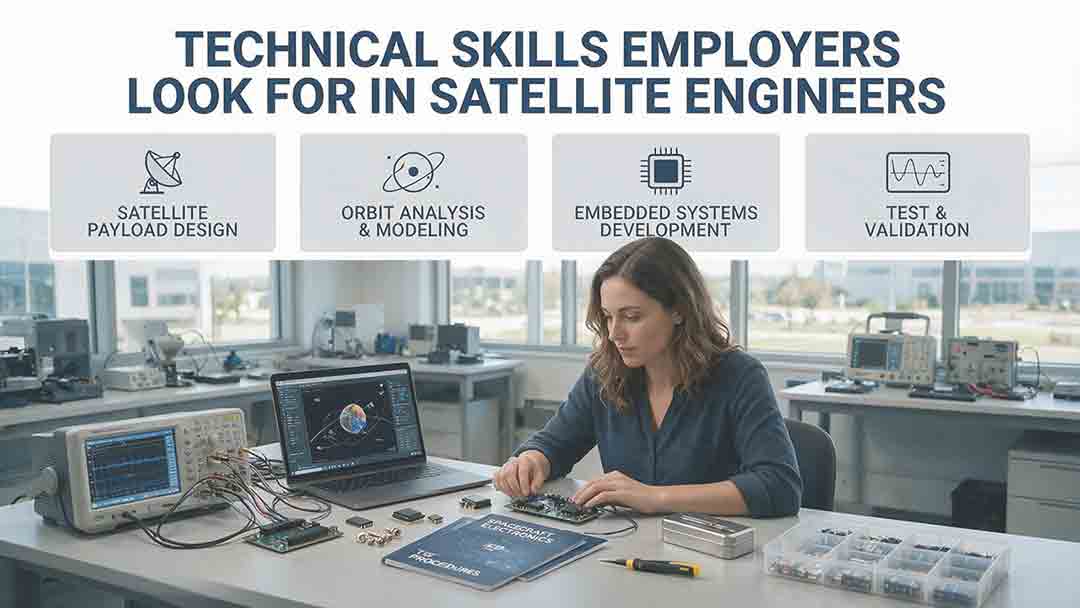
Technical Skills Employers Look for in Satellite Engineers
This guide explains the technical skills employers look for in satellite engineers and shows how those skills differ across systems, power, thermal, GNC, communications, avionics, software, structures, propulsion, ground systems, operations, and integration roles. It focuses on requirements, interfaces, engineering budgets, modeling, verification, testing, configuration control, anomaly reasoning, and technical communication rather than software-name lists. Original tools include the Interface Pairing Rule, which links each skill to inputs, outputs, and failure modes, and the Satellite Skill Proof Ladder, which measures how convincingly a project demonstrates competence. A worked downlink-capacity example illustrates compression, overhead, throughput, assumptions, and engineering limits. Readers also receive role comparisons, evidence chains, practical development steps, troubleshooting guidance, and a detailed checklist for turning technical work into credible résumé, portfolio, and interview evidence while respecting standards, licensing, confidentiality, and disclosure boundaries.
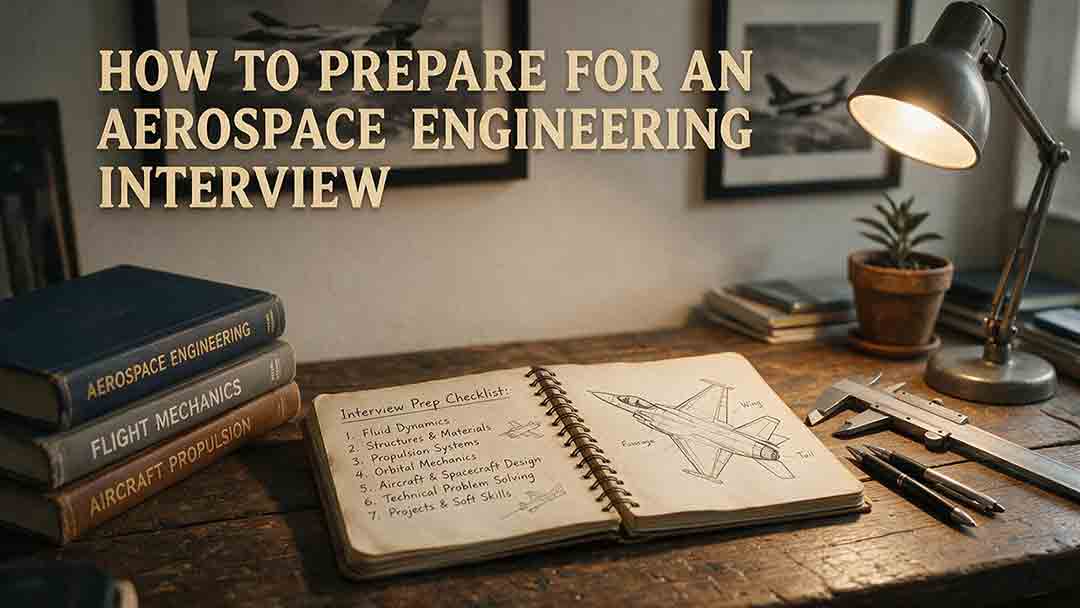
How to Prepare for an Aerospace Engineering Interview
This guide explains how to prepare for an aerospace engineering interview by turning a job description into a focused technical study plan and a set of evidence-backed project stories. It covers common interview formats, role-specific review areas, calculations, coding and data exercises, systems engineering, trade studies, failure discussions, interviewer questions, and disclosure safety. The article introduces original tools including the Aerospace Interview Readiness Matrix, the TRACE technical-answer framework, the STAR-V project structure, and a job-requirement evidence map. A worked energy calculation shows how to state assumptions, check units, and separate a preliminary estimate from a complete engineering conclusion. Readers also receive troubleshooting guidance, preparation priorities for different time windows, and a detailed checklist covering technical readiness, communication, logistics, and restricted information. The result is a practical method for building careful, defensible answers without memorizing scripts or overstating project results.
Python Projects That Can Strengthen a Space Industry Resume
This guide explains how to choose and build Python projects that provide credible evidence for space industry roles. It compares seven project directions, including telemetry decoding, JPL Horizons planning, GMAT automation, NOAA space-weather pipelines, Landsat analysis, Exoplanet Archive audits, and small-body mission tools. An original Project Signal Scorecard helps readers evaluate each idea by its domain question, data contract, engineering transformation, verification, failure behavior, and reproducibility. The article also shows how to define inputs and outputs, freeze test fixtures, document units and versions, handle abnormal data, structure a repository, and write honest resume bullets without overstating impact. A worked NOAA example demonstrates how a simple dashboard can become a reviewable engineering case study through boundary tests, provenance, state modeling, and reproducible evidence. Legal and professional guidance addresses API policies, licensing, attribution, credentials, restricted material, and agency endorsement.

How to Build an Aerospace Engineering Portfolio
This guide explains how to build an aerospace engineering portfolio that demonstrates engineering judgment rather than displaying isolated renders, plots, code, or tool names. It shows readers how to select role-relevant projects, document personal contributions, connect requirements to methods and verification, and present limitations honestly. Original tools include the Portfolio Proof Matrix for rating project evidence, an evidence spine for structuring case studies, a release-safety triage for identifying publication risks, and a worked OpenVSP example. The article also compares websites, PDFs, repositories, reports, and presentation decks; explains verification and validation; covers team-project attribution and reproducibility; and provides troubleshooting and publication checklists. Special attention is given to confidentiality, copyright, licensing, privacy, sponsor rules, and export-control restrictions, with links to NASA, ABET, MIT, and U.S. government sources. Readers finish with a practical process for turning one existing project into a clear, credible, evidence-backed portfolio case study.
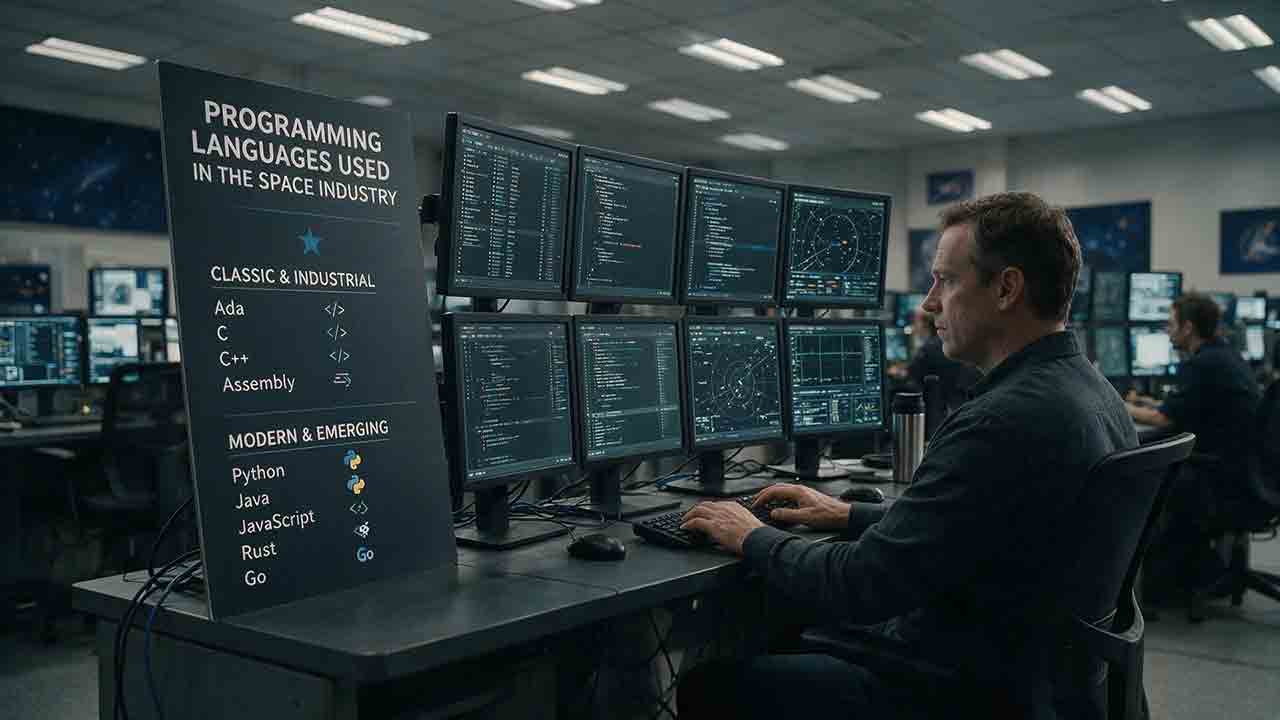
Programming Languages Used in the Space Industry
This guide explains how programming languages are used across flight software, embedded systems, mission operations, engineering analysis, data infrastructure, and mission-control interfaces. It connects C, C++, Python, JavaScript, Java, MATLAB, Simulink, Ada, Fortran, and Rust to documented NASA, JPL, ESA, and ECSS resources without presenting the examples as an industry-wide popularity survey. Readers receive an original six-gate language-selection worksheet, a compact decision tree, a worked small-satellite telemetry architecture, three portfolio project plans, a portfolio evidence ladder, a requirements-to-tests traceability example, troubleshooting guidance, and an interview framework. The article also explains important limits, including why public frameworks do not make a student project flight-ready and why Rust research does not prove broad operational adoption. It helps students and career changers select a practical learning path, build verifiable projects, document technical tradeoffs, and present stronger evidence of space-software ability.