Best College Majors for a Career in the Space Industry

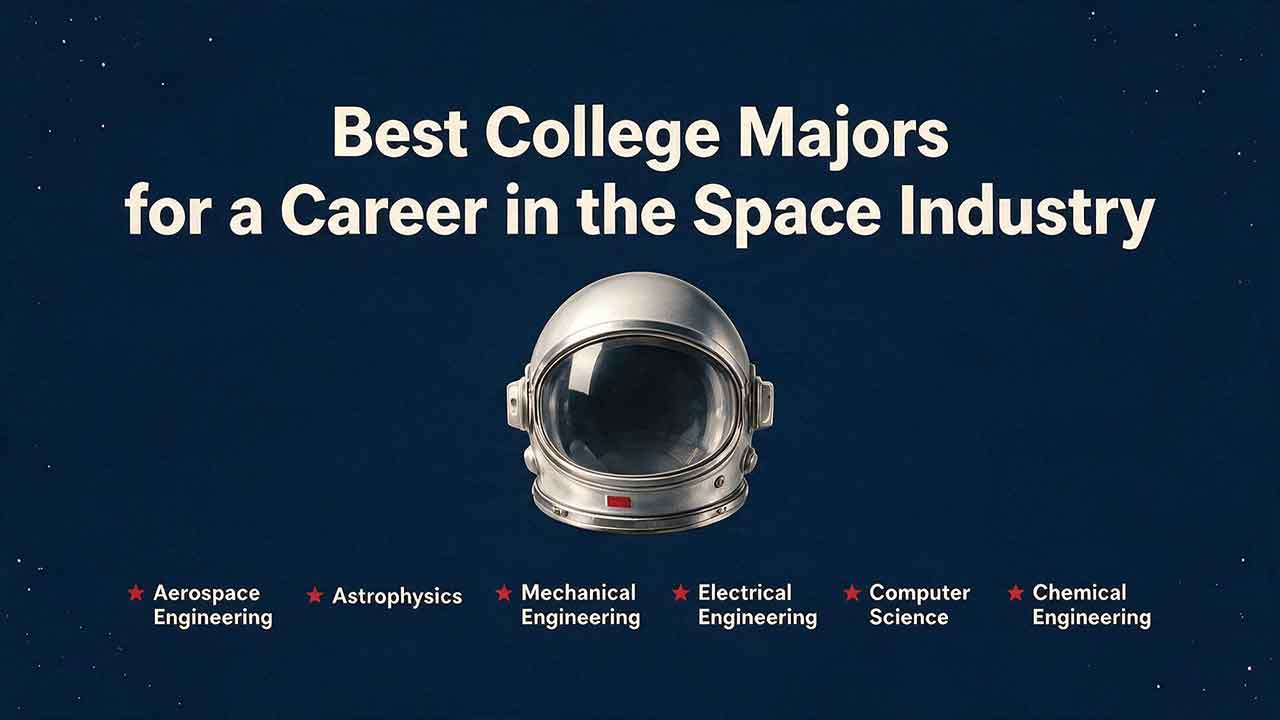
Best College Majors for a Career in the Space Industry
The best college major for a space-industry career depends on the mission work you want to perform. Aerospace, electrical, computer, mechanical, and software disciplines are direct routes into spacecraft systems; physics, astronomy, Earth science, mathematics, and data science support research and analysis; business, supply chain, communications, education, and policy support missions without engineering responsibility.
Key Takeaways
- There is no single best major for the entire space industry because spacecraft, software, science, production, operations, and business require different disciplines.
- Aerospace engineering is direct for flight-system work, but electrical engineering, computer engineering, mechanical engineering, and computer science may be better aligned with particular subsystems.
- Physics and astronomy are strong routes into scientific analysis and research, although independent research careers often require graduate education.
- Lawyer roles normally require post-baccalaureate legal education and jurisdiction-specific admission; “law” should not be treated as a standard undergraduate shortcut into legal practice.
- The strongest degree is the program that provides relevant courses, supervised experience, and work products you can show—not merely a space-related title.
This guide will help you match college majors to real space-industry outputs, compare technical and nontechnical routes, audit individual degree programs, estimate the cost of changing direction, and build an evidence plan before graduation.
Scope: This article focuses mainly on U.S. undergraduate education and career pathways. Degree requirements, accreditation, professional licensing, admission to legal practice, work authorization, export-control obligations, citizenship rules, and employer expectations vary by institution, employer, jurisdiction, and country. This article provides general educational information, not admissions, financial, legal, immigration, licensing, export-control, or employment advice.
Which College Majors Are Best for the Space Industry?
The most useful majors are those that prepare students to produce a specific mission output.
For many technical space careers, strong options include:
- Aerospace or astronautical engineering
- Electrical or electronics engineering
- Computer engineering
- Mechanical engineering
- Computer science or software engineering
- Physics
- Astronomy or astrophysics
- Atmospheric science or meteorology
- Earth science, geology, or geoscience
- Applied mathematics, statistics, or operations research
- Data science
- Industrial or manufacturing engineering
- Materials science and engineering
- Chemical engineering
For mission-support and commercial careers, useful undergraduate majors include:
- Accounting
- Finance
- Supply-chain management
- Logistics
- Business analytics
- Project management
- Technical communication
- Journalism or public relations
- Public policy
- Political science
- International relations
- Economics
- Human resources
- Education
- Legal studies or another rigorous pre-law major, followed by a J.D. for lawyer roles
- Paralegal studies for legal-support routes
The American Bar Association does not recommend one required undergraduate major for admission to legal education. Students enter law school from disciplines including history, English, economics, business, computer science, engineering, mathematics, and the sciences.
A U.S. undergraduate degree labeled legal studies or pre-law does not by itself qualify its holder to practice law. Lawyer roles normally require a professional law degree and satisfaction of the admission requirements in the applicable jurisdiction.
NASA’s current careers page reports more than 150 occupations and separately features engineering, science and research, data and information technology, cybersecurity, business services, internships, and other career families.
That breadth is why a single overall ranking would be misleading.
What Is the Best Major for Each Space Mission Role?
The following table identifies direct degree routes for common mission functions.
“Most direct” does not mean “required by every employer.” It means the curriculum commonly aligns with the work.
| Mission role or output | Most direct majors or education route | Other relevant majors | Typical student evidence |
|---|---|---|---|
| Spacecraft configuration and flight performance | Aerospace or astronautical engineering | Mechanical engineering, physics | Vehicle model, trajectory analysis, trade study |
| Structures and mechanisms | Mechanical or aerospace engineering | Materials science | Structural analysis, mechanism design, load test |
| Thermal control | Mechanical or aerospace engineering | Physics, chemical engineering | Thermal model, heat-transfer analysis, test report |
| Electrical power systems | Electrical engineering | Computer engineering, physics | Power budget, circuit design, tested electronics |
| Avionics and embedded systems | Electrical or computer engineering | Computer science | Embedded controller, interface test, fault-handling logic |
| Radio-frequency communications | Electrical engineering | Physics, computer engineering | Link budget, antenna analysis, signal-processing project |
| Flight software | Computer science, software engineering, or computer engineering | Aerospace engineering | Tested software, simulator, requirements traceability |
| Ground software and data systems | Computer science, information technology, data science | Computer engineering | Data pipeline, operator interface, automated test |
| Guidance, navigation, and control | Aerospace, electrical, mechanical, or computer engineering | Applied mathematics, physics | Control simulation, estimator, stability analysis |
| Propulsion | Aerospace, mechanical, or chemical engineering | Physics, materials science | Performance model, thermal analysis, test plan |
| Spacecraft materials and manufacturing | Materials science, mechanical, or manufacturing engineering | Chemical engineering | Material selection, process plan, inspection record |
| Systems engineering | Aerospace, electrical, mechanical, computer, or systems engineering | Physics, industrial engineering | Requirements matrix, interface model, trade study |
| Mission operations | Aerospace, physics, astronomy, computer science | Information technology | Operations procedure, telemetry monitor, anomaly exercise |
| Astrophysics research | Astronomy, astrophysics, or physics | Applied mathematics, computer science | Research project, data analysis, scientific paper |
| Planetary science | Geology, geophysics, chemistry, physics, astronomy | Environmental science | Mapping project, laboratory analysis, research report |
| Earth observation | Atmospheric science, Earth science, geography, environmental science | Data science, computer science | Remote-sensing analysis, validated geospatial dataset |
| Space weather | Atmospheric science or physics | Applied mathematics, computer science | Time-series analysis, forecasting model, research project |
| Mission planning and optimization | Operations research, applied mathematics, aerospace engineering | Data science, industrial engineering | Schedule optimizer, resource model, sensitivity analysis |
| Production and quality | Industrial, manufacturing, mechanical, or materials engineering | Engineering technology | Process map, quality plan, measurement study |
| Space business and procurement | Business, finance, supply chain, logistics | Engineering management | Supplier evaluation, budget, procurement analysis |
| Communications and public affairs | Communications, journalism, technical communication | Science communication | Sourced briefing, media package, correction workflow |
| Policy and international cooperation | Public policy, political science, international relations, economics | Science, engineering, business | Policy analysis, stakeholder map, regulatory brief |
| Lawyer or legal counsel | Any suitable bachelor’s degree, followed by a J.D. and jurisdiction-specific admission | Engineering, science, economics, public policy | Legal research and writing developed through authorized education and supervised experience |
| Paralegal or legal assistant | Associate degree or certificate in paralegal studies is common | Bachelor’s degree plus paralegal education | Supervised legal research, document organization, drafting support |
The correct major depends on the output you want to own.
A satellite contains structures, mechanisms, computers, sensors, antennas, power electronics, software, thermal hardware, and scientific instruments. “Working on satellites” is therefore not a sufficiently specific career objective.
Why Is There No Single Best Space Major?
The space industry is a network of occupations rather than one profession.
NASA states that it hires engineers across many disciplines. Its engineering careers page identifies aerospace, general, and computer engineering among its common engineering fields while also emphasizing systems thinking and teamwork.
NASA’s science workforce includes astrophysicists, geologists, biologists, chemists, project scientists, program scientists, and discipline scientists. NASA also employs software, data, cybersecurity, communications, accounting, procurement, human-resources, and program professionals.
Commercial space organizations add further roles in:
- Satellite manufacturing
- Launch services
- Ground communications
- Earth-observation products
- Telecommunications
- Mission software
- Robotics
- Semiconductor development
- Insurance
- Finance
- Market research
- Customer support
- Regulatory compliance
A degree can be valuable to the space sector even when the degree title does not contain “space,” “aerospace,” or “astronomy.”
The Mission Output Map
The Mission Output Map is an original framework developed for this guide. It organizes majors around six types of output that space organizations need.
1. Flight-System Output
This category includes:
- Vehicle architecture
- Structures
- Thermal systems
- Propulsion
- Flight dynamics
- Controls
- Mechanisms
- Verification
Strong majors include aerospace, mechanical, electrical, chemical, and materials engineering.
2. Embedded-Intelligence Output
This category includes:
- Flight computers
- Embedded software
- Sensors
- Communications
- Command and data handling
- Cybersecurity
- Autonomy
- Ground software
Strong majors include electrical engineering, computer engineering, computer science, software engineering, and information technology.
3. Scientific-Knowledge Output
This category includes:
- Research questions
- Observation plans
- Scientific models
- Instrument measurements
- Data interpretation
- Publications
- Science requirements
Strong majors include physics, astronomy, astrophysics, chemistry, biology, geology, planetary science, and atmospheric science.
4. Earth-and-Planetary-Data Output
This category includes:
- Remote-sensing products
- Geographic information
- Weather and climate analysis
- Surface classification
- Environmental monitoring
- Hazard assessment
- Space-weather interpretation
Strong majors include atmospheric science, meteorology, geography, geology, geophysics, environmental science, data science, statistics, and computer science.
5. Production-and-Operations Output
This category includes:
- Manufacturing processes
- Integration procedures
- Quality records
- Test operations
- Supply flow
- Mission procedures
- Scheduling
- Resource optimization
Strong majors include industrial engineering, manufacturing engineering, engineering technology, operations research, logistics, and systems engineering.
6. Organizational-and-Market Output
This category includes:
- Budgets
- Contracts
- Procurement
- Staffing
- Training
- Public communication
- Customer research
- Policy
- Legal support
Strong undergraduate majors include accounting, finance, supply-chain management, business analytics, communications, human resources, education, public policy, political science, international relations, economics, and paralegal studies.
For lawyer roles, the route is different: complete a suitable bachelor’s degree, earn a J.D. or other qualifying professional law degree, and satisfy the applicable jurisdiction’s admission requirements.
How to Use the Map
Select the output you would most like to create every week.
Then ask:
- Which majors teach the required foundations?
- Which programs require relevant projects?
- Which program provides access to laboratories, research, internships, or design teams?
- What additional education does the target occupation normally require?
- Which alternative industries could use the same degree?
This sequence is more reliable than choosing a major because its name sounds connected to space.
Is Aerospace Engineering the Best Overall Space Major?
Aerospace engineering is one of the most direct majors for aircraft, spacecraft, launch vehicles, and flight systems. It is not automatically the best choice for every spacecraft subsystem or every student.
An aerospace curriculum commonly covers:
- Aerodynamics
- Fluid mechanics
- Structures
- Propulsion
- Flight dynamics
- Orbital mechanics
- Stability and control
- Modeling and simulation
- Testing
- Capstone design
Under the ABET 2026–2027 engineering criteria, aerospace and similarly named programs must include modeling, simulation, computing, and testing applied to aerospace systems or subsystems.
ABET also distinguishes among program titles:
- Aeronautical programs cover atmospheric flight.
- Astronautical programs cover spaceflight and the means of reaching space.
- Aerospace programs cover both atmospheric and spaceflight topics.
Aerospace Engineering Is a Strong Fit When You Want To
- Analyze flight or orbital performance
- Design vehicles or major subsystems
- Work in aerodynamics, propulsion, structures, or controls
- Integrate multiple spacecraft disciplines
- Enter a named engineering occupation after a bachelor’s degree
Aerospace Engineering May Be a Weaker Fit When You Want To
- Design spacecraft electronics
- Develop embedded computing hardware
- Specialize in radio-frequency communications
- Build large software systems
- Conduct astronomy research
- Focus exclusively on Earth-observation data
- Pursue a nontechnical commercial role
A student who wants to design a satellite power system may be better served by electrical engineering. A student who wants to build flight software may be better served by computer science or computer engineering.
Why Is Electrical Engineering One of the Most Versatile Space Majors?
Electrical engineering supports nearly every modern spacecraft and ground system.
Electrical engineers may work with:
- Power generation and distribution
- Batteries and power electronics
- Radio-frequency communications
- Antennas
- Sensors
- Instrument electronics
- Signal processing
- Motor control
- Avionics
- Electromagnetic compatibility
- Ground support equipment
The U.S. Bureau of Labor Statistics reports a bachelor’s degree as the typical entry education for electrical and electronics engineers.
Electrical engineering is particularly versatile because its applications extend beyond space into energy, telecommunications, electronics, semiconductor manufacturing, transportation, automation, and medical devices.
Electrical Engineering Is a Strong Fit When You Enjoy
- Circuits
- Signals
- Electronics
- Electromagnetism
- Communications
- Sensors
- Laboratory measurement
- Hardware troubleshooting
The degree can be demanding for students who dislike circuit analysis, laboratory work, or abstract mathematical models.
When Is Computer Engineering Better Than Computer Science?
Computer engineering is often the more direct choice for embedded spacecraft computing. Computer science is often the more direct choice for larger software systems, algorithms, and data infrastructure.
Computer Engineering Commonly Emphasizes
- Digital logic
- Computer architecture
- Embedded processors
- Electronics
- Firmware
- Hardware interfaces
- Real-time systems
- Hardware-software integration
Computer Science Commonly Emphasizes
- Algorithms
- Data structures
- Operating systems
- Software architecture
- Databases
- Networks
- Artificial intelligence
- Security
- Large-scale application development
The boundary varies by university.
A computer science program may offer excellent embedded-systems courses. A computer engineering program may emphasize hardware more than software. Inspect the required curriculum.
Choose Computer Engineering When You Want To
- Build flight computers
- Develop firmware
- Interface with sensors and actuators
- Work close to avionics hardware
- Debug timing and communications problems
Choose Computer Science When You Want To
- Develop flight or ground software
- Build mission-planning tools
- Process telemetry
- Create scientific-data systems
- Work in simulation, cybersecurity, or automation
- Preserve broad software-industry flexibility
A generic programming portfolio may not demonstrate readiness for safety-conscious or mission-critical work. Stronger evidence includes tests, requirements, error handling, configuration control, and documented interfaces.
When Is Mechanical Engineering Better Than Aerospace Engineering?
Mechanical engineering can be a better choice when you want broad preparation in physical systems while preserving career options outside aviation and space.
Mechanical engineers may contribute to:
- Structures
- Mechanisms
- Thermal systems
- Test fixtures
- Ground equipment
- Manufacturing
- Vibration analysis
- Materials selection
- Robotics
- Fluid systems
Mechanical engineering often provides more general industrial flexibility than a highly specialized aerospace degree.
Mechanical Engineering Is a Strong Fit When You Want To
- Design physical components
- Analyze loads and motion
- Work with thermal systems
- Build mechanisms or test hardware
- Preserve options in energy, robotics, manufacturing, automotive, or industrial equipment
A mechanical curriculum may contain little orbital mechanics, spacecraft systems, or radio-frequency content. Space-specific projects, electives, or internships may be needed.
Is Computer Science a Good Major for the Space Industry?
Yes. Modern missions depend on software at every stage.
Software supports:
- Flight control
- Command and data handling
- Mission planning
- Ground stations
- Telemetry
- Simulation
- Test automation
- Data processing
- Cybersecurity
- Customer platforms
- Scientific archives
NASA’s Data Science, Cyber, and IT careers page describes software, applications, infrastructure, cybersecurity, mission systems, and scientific-data work across the agency.
Computer science is also highly transferable outside the space industry.
A Strong Space-Focused Computer Science Plan Includes
- Data structures and algorithms
- Operating systems
- Computer networks
- Software engineering
- Testing
- Cybersecurity
- Databases
- Numerical computing
- Embedded or real-time systems when available
- A domain project involving telemetry, simulation, remote sensing, or scientific data
The degree title alone is insufficient. Employers need evidence that you can build reliable software and collaborate with engineers, scientists, operators, or customers.
Is Physics a Good Major for Space Careers?
Physics is a strong analytical foundation for research, instrumentation, modeling, optics, data analysis, and some engineering-adjacent roles.
Physics students commonly study:
- Classical mechanics
- Electricity and magnetism
- Quantum mechanics
- Thermodynamics
- Laboratory methods
- Mathematics
- Computation
Physics can support careers in:
- Scientific research
- Mission analysis
- Instrumentation
- Remote sensing
- Software
- Data science
- Technical operations
- Engineering support
- Graduate study
Physics is less direct than an accredited engineering degree for many design positions.
A physics graduate may understand the underlying science while lacking formal preparation in:
- Engineering design
- Standards
- Manufacturing
- Requirements
- Verification
- Capstone engineering work
Students who want industry roles after a physics bachelor’s degree should deliberately build software, laboratory, electronics, data, or systems evidence.
When Should You Major in Astronomy or Astrophysics?
Astronomy or astrophysics is the strongest choice when your primary goal is to study celestial phenomena and you accept the education path associated with research.
Possible areas include:
- Stellar astrophysics
- Galaxies
- Cosmology
- Planetary systems
- Observational astronomy
- Scientific computing
- Telescope data
- Instrument science
The BLS profile for physicists and astronomers states that research and academic positions typically require a PhD.
An astronomy bachelor’s degree may also support:
- Scientific software
- Data analysis
- Observatory support
- Education
- Instrumentation support
- Research assistance
- Mission operations
- Technical communication
Astronomy Is Not the Most Direct Choice for
- Spacecraft structural design
- Avionics
- Propulsion
- Power electronics
- Manufacturing engineering
- Flight-software architecture
The degree studies the universe rather than teaching the complete engineering process used to build spacecraft.
Which Earth and Environmental Majors Support Space Careers?
Space systems are widely used to observe Earth, weather, oceans, land, ice, ecosystems, hazards, and human activity.
Relevant majors include:
- Atmospheric science
- Meteorology
- Earth science
- Geology
- Geophysics
- Geography
- Geographic information science
- Environmental science
- Oceanography
- Remote sensing
NASA’s science careers page identifies Earth science as one of its major scientific areas, alongside planetary science, heliophysics, and astrophysics.
Atmospheric-science programs may prepare students for:
- Weather analysis
- Satellite meteorology
- Launch-weather support
- Climate data
- Space-weather-related work
- Scientific research
BLS reports a bachelor’s degree as the typical entry education for atmospheric scientists, although research positions commonly require a master’s degree or PhD.
Check the Program for
- Calculus
- Physics
- Statistics
- Programming
- Geographic information systems
- Remote sensing
- Data visualization
- Field or laboratory methods
- Research experience
A program focused primarily on policy or general environmental studies may not provide the quantitative preparation expected for scientific remote-sensing roles.
Are Mathematics, Statistics, Data Science, and Operations Research Good Majors?
These majors are strong choices for mission planning, estimation, optimization, scientific analysis, and decision support.
Applications may include:
- Trajectory optimization
- Constellation planning
- Resource allocation
- Ground-station scheduling
- Orbit determination
- Sensor-data analysis
- Reliability
- Risk analysis
- Forecasting
- Logistics
- Manufacturing analytics
BLS reports a bachelor’s degree as the typical entry education for operations research analysts. Some mathematics and statistics occupations commonly use graduate-level preparation, although bachelor’s-level roles also exist.
Applied Mathematics Is Strongest When Paired With
- Programming
- Numerical methods
- Probability and statistics
- Optimization
- A physical or operational domain
- A documented modeling project
Data Science Is Strongest When Paired With
- Rigorous statistics
- Software engineering
- Data quality controls
- Domain knowledge
- Reproducible analysis
- Clear uncertainty reporting
A data-science label does not guarantee mathematical depth. Review the required calculus, linear algebra, probability, statistics, computing, and capstone work.
Which Majors Support Space Manufacturing and Production?
Spacecraft and launch systems must be manufactured, inspected, integrated, tested, transported, and documented.
Useful majors include:
- Industrial engineering
- Manufacturing engineering
- Mechanical engineering
- Materials science and engineering
- Quality engineering
- Engineering technology
- Supply-chain management
- Logistics
Industrial Engineering May Cover
- Production systems
- Quality
- Optimization
- Human factors
- Facility layout
- Scheduling
- Statistics
- Process improvement
Materials Science May Cover
- Metals
- Polymers
- Ceramics
- Composites
- Coatings
- Failure analysis
- Processing
- Material performance
Manufacturing Engineering May Cover
- Machining
- Tooling
- Automation
- Production planning
- Metrology
- Process control
- Design for manufacturing
These majors can be highly relevant even when they are less visible than aerospace engineering.
Which Business, Communication, Policy, and Legal Routes Work in Space?
Space organizations need professionals who manage money, contracts, suppliers, customers, people, institutions, and public information.
NASA’s Business Services careers page identifies human resources, accounting, writing, contracts, and media relations among its business functions.
Useful undergraduate majors include:
- Accounting
- Finance
- Supply-chain management
- Logistics
- Business analytics
- Human resources
- Technical communication
- Journalism
- Public relations
- Marketing
- Public policy
- Political science
- International relations
- Economics
- Education
- Paralegal studies
Examples of Mission-Support Outputs
| Major or education route | Possible output |
|---|---|
| Accounting | Financial record, cost report, audit support |
| Finance | Budget forecast, funding analysis |
| Supply chain | Supplier plan, inventory model, delivery analysis |
| Business analytics | Performance dashboard, customer analysis |
| Technical communication | Controlled procedure, user guide, technical report |
| Public relations | Sourced public statement, media briefing |
| Human resources | Staffing plan, structured hiring process |
| Public policy or political science | Policy analysis, stakeholder map |
| Education | Training module, curriculum, public program |
| Paralegal studies | Lawyer-supervised legal research, filing, and document support |
| Bachelor’s degree followed by a J.D. | Preparation for lawyer roles after applicable admission requirements are met |
These roles are not substitute engineering positions. A contract specialist does not approve a spacecraft design, and a technical writer should not independently invent engineering instructions.
How Does the U.S. Lawyer Path Differ From an Undergraduate Major?
The American Bar Association states that it does not recommend a particular undergraduate major or required set of pre-law courses.
A prospective lawyer may complete a bachelor’s degree in:
- Engineering
- Computer science
- Physics
- Economics
- History
- English
- Political science
- Business
- Mathematics
- Another academically rigorous field
The typical lawyer route then includes:
- Completing a bachelor’s degree
- Earning a J.D. or another qualifying professional law degree
- Satisfying the character, examination, and admission rules of the relevant jurisdiction
- Maintaining any continuing obligations imposed by that jurisdiction
The precise rules differ by jurisdiction. A bachelor’s degree in legal studies, political science, or pre-law does not itself authorize legal practice.
A technical undergraduate major may be useful in certain legal areas, but no major guarantees admission to law school, bar admission, or employment in space law.
How Does the Paralegal Route Differ?
Paralegals and legal assistants support lawyers rather than independently practicing law.
BLS identifies an associate degree as the typical entry education for the occupation and explains that common routes include:
- An associate degree in paralegal studies
- A certificate in paralegal studies
- A bachelor’s degree combined with relevant paralegal preparation
- In some cases, employer-provided training
Employer preferences and state rules can vary. Paralegal education or certification does not grant authority to provide independent legal advice.
Engineering, Science, Computing, Business, or Law: Which Is Better?
None is universally better. Each owns a different part of mission execution.
| Degree or education family | Primary strength | Main limitation | Typical additional education pressure |
|---|---|---|---|
| Engineering | Design, analysis, testing, physical systems | Structured curriculum; specialization may limit electives | Low to moderate for entry-level work |
| Computer science and computing | Software, data systems, automation, cybersecurity | Domain knowledge must be added deliberately | Low to moderate |
| Physical science | Research, theory, measurement, scientific analysis | Less direct for engineering-design roles | Moderate to high for research careers |
| Earth and environmental science | Earth observation, atmosphere, surfaces, hazards | Program quantitative depth varies | Moderate for research |
| Mathematics and data | Modeling, optimization, estimation, analytics | Needs a clear application domain | Low to moderate; higher for some research roles |
| Industrial and production disciplines | Manufacturing, quality, operations, logistics | Less focus on spacecraft theory | Low to moderate |
| Business and communication | Resources, contracts, people, customers, public trust | Limited authority over technical decisions | Usually low; role-specific exceptions apply |
| Public policy and international relations | Institutions, regulation, governance, cooperation | Does not authorize legal practice | Graduate study may help but is not universal |
| Paralegal studies | Lawyer-supervised legal support | Does not authorize independent legal practice | Associate degree or certificate is common |
| Lawyer pathway | Legal advice, transactions, disputes, regulation | Requires post-baccalaureate legal education and admission | J.D. or qualifying professional degree plus jurisdictional requirements |
The best choice is the family whose daily work you would still value even if the employer were not famous.
How Should You Compare Salary and Employment Data?
Do not rank majors by placing unrelated occupational salaries in one column.
A major is an educational program. An occupation is paid work. One major may lead to several occupations, and one occupation may accept several majors.
The following BLS figures are representative occupational benchmarks, not degree outcomes or entry-level space-industry offers.
| BLS occupation | Typical entry education | May 2024 median pay | Relevant majors or route |
|---|---|---|---|
| Aerospace Engineers | Bachelor’s degree | $134,830 | Aerospace, mechanical, related engineering |
| Electrical and Electronics Engineers | Bachelor’s degree | $118,780 combined | Electrical, electronics engineering |
| Mechanical Engineers | Bachelor’s degree | $102,320 | Mechanical engineering |
| Computer Hardware Engineers | Bachelor’s degree | $155,020 | Computer or electrical engineering |
| Software Developers | Bachelor’s degree | $133,080 | Computer science, software engineering |
| Atmospheric Scientists, Including Meteorologists | Bachelor’s degree | $97,450 | Meteorology, atmospheric science |
| Operations Research Analysts | Bachelor’s degree | $91,290 | Operations research, applied mathematics |
| Technical Writers | Bachelor’s degree | $91,670 | Technical communication, English, technical fields |
| Project Management Specialists | Bachelor’s degree | $100,750 | Business, project management, technical disciplines |
| Astronomers | Doctoral or professional degree is typical for research and academic entry | $132,170 | Astronomy, astrophysics, physics |
| Aerospace Engineering and Operations Technologists and Technicians | Associate degree | $79,830 | Aerospace engineering technology |
| Paralegals and Legal Assistants | Associate degree | $61,010 | Paralegal studies, certificate, or related preparation |
| Lawyers | Doctoral or professional degree | $151,160 | Bachelor’s degree followed by professional legal education |
What the Table Does Not Tell You
It does not show:
- Starting salary for a graduate
- Salary at a specific space company
- Employment rate for a particular college
- Probability of receiving an offer
- Bonuses, equity, overtime, or benefits
- Local cost of living
- Whether the occupation requires citizenship or a clearance
- Whether a graduate’s work will involve space
- Whether a law graduate will be admitted in a particular jurisdiction
- Whether a paralegal program satisfies a specific employer’s preference
Use salary only after identifying the occupation, career stage, location, industry, required education, and any professional admission requirements.
The Major-to-Mission Fit Score
The Major-to-Mission Fit Score is an original decision framework developed for this guide.
It compares a major against a defined role rather than against the entire space industry.
Score each factor from 1 to 5.
| Factor | Weight | Question |
|---|---|---|
| Output match | 30% | Does the curriculum prepare you to create the target role’s main work product? |
| Required-course coverage | 25% | Are the essential subjects required rather than merely optional? |
| Evidence access | 20% | Can you complete relevant laboratories, research, design, internships, or team projects? |
| Credential directness | 15% | Does the degree satisfy the normal educational route for the occupation? |
| Financial practicality | 10% | Is the program affordable and realistically completable on schedule? |
Calculate:
[
\text{Major-to-Mission Fit Score}
0.30O + 0.25C + 0.20E + 0.15D + 0.10F
]
Where:
- (O) = output-match score
- (C) = required-course-coverage score
- (E) = evidence-access score
- (D) = credential-directness score
- (F) = financial-practicality score
The result remains on a 1-to-5 scale.
It is not an admissions model, employment probability, salary forecast, or psychological assessment.
Worked Example: Choosing a Major for Satellite Avionics
Consider a fictional student who wants to design satellite power and embedded avionics.
The student is comparing aerospace engineering, electrical engineering, and computer science at the same university.
| Factor | Weight | Aerospace | Electrical | Computer science |
|---|---|---|---|---|
| Output match | 30% | 4 | 5 | 3 |
| Required-course coverage | 25% | 3 | 5 | 3 |
| Evidence access | 20% | 4 | 4 | 5 |
| Credential directness | 15% | 5 | 5 | 4 |
| Financial practicality | 10% | 4 | 4 | 5 |
Aerospace Engineering
[
(0.30\times4)+(0.25\times3)+(0.20\times4)+(0.15\times5)+(0.10\times4)
=3.90
]
Electrical Engineering
[
(0.30\times5)+(0.25\times5)+(0.20\times4)+(0.15\times5)+(0.10\times4)
=4.70
]
Computer Science
[
(0.30\times3)+(0.25\times3)+(0.20\times5)+(0.15\times4)+(0.10\times5)
=3.75
]
For this fictional role, electrical engineering is the strongest match because power electronics, circuits, signals, and hardware interfaces are central to the desired output.
That conclusion would change if the student wanted to develop ground software, perform flight-dynamics analysis, or conduct astrophysics research.
The Graduation Evidence Inventory
A degree should help you graduate with inspectable evidence, not only completed course titles.
The Graduation Evidence Inventory is an original audit for identifying what a program enables you to show.
Mark each category as:
- Required: Every student completes relevant evidence.
- Accessible: Available through electives, research, clubs, or competitive programs.
- Missing: No clear path appears in official program information.
| Evidence category | Example |
|---|---|
| Analytical evidence | Model, calculation, optimization, uncertainty analysis |
| Software evidence | Tested program, simulation, data pipeline, embedded code |
| Hardware evidence | Circuit, mechanism, instrument, prototype |
| Test evidence | Procedure, measurements, calibration, verification report |
| Scientific evidence | Research question, dataset, inference, paper |
| Design evidence | Requirements, alternatives, selected design, review package |
| Operations evidence | Procedure, schedule, anomaly response, resource plan |
| Team evidence | Defined contribution, interface work, documented handoff |
| Communication evidence | Technical report, presentation, user documentation |
| Policy evidence | Stakeholder map, sourced policy analysis, implementation options |
| Legal-support evidence | Lawyer-supervised research, document organization, filing support |
| Boundary evidence | Assumptions, limitations, safety and authority statement |
A program with an impressive course list but few opportunities to create evidence may require substantial extracurricular work.
A program with strong laboratories, research, capstone design, and industry partnerships may create a clearer transition into employment or graduate school.
The Bridge Load Test
The Bridge Load Test estimates how difficult it would be to move from one major into a target role.
List three kinds of missing preparation:
- Course-sequence gaps
- Evidence gaps
- Credential gaps
Calculate:
[
\text{Bridge Load}
\text{Course-sequence gaps}
+
\text{Evidence gaps}
+
2(\text{additional credential stages})
]
An additional credential stage receives double weight because a new degree, professional program, or licensing step may require more time and money than one course or project.
Example: Physics Major to Spacecraft Structural Engineer
Possible gaps:
- Mechanics of materials sequence: 1
- Structural design sequence: 1
- Engineering capstone: 1
- Verified structural project: 1
- Engineering degree or formal bridge program: 1 credential stage
[
1+1+1+1+2(1)=6
]
Example: Mechanical Engineering Major to Spacecraft Structural Engineer
Possible gaps:
- Spacecraft-specific structures elective: 1
- Space-focused structural project: 1
- Additional credential stage: 0
[
1+1+2(0)=2
]
Example: Public Policy Major to Lawyer Role
Possible gaps:
- J.D. or qualifying professional law degree: 1 credential stage
- Jurisdiction-specific admission process: 1 credential stage
[
0+0+2(2)=4
]
This simplified score does not measure the difficulty of law school or predict admission. It makes clear that a public-policy bachelor’s degree is not the terminal professional credential for practicing law.
The result is not a universal threshold. It makes hidden transition requirements visible before you commit to a degree.
How Do You Audit an Actual College Program?
Use official documents rather than promotional summaries.
Step 1: Define One Target Output
Examples:
- Tested flight software
- Spacecraft power-system design
- Remote-sensing analysis
- Astronomy research paper
- Manufacturing quality plan
- Mission schedule
- Public communications package
- Policy analysis
- Lawyer-supervised legal research
Step 2: Download the Required Curriculum
Identify:
- Mathematics sequence
- Science requirements
- Programming
- Core major courses
- Laboratories
- Design or research requirements
- Capstone
- Elective limits
- Prerequisite chains
Step 3: Check Program-Level Accreditation or Approval
ABET accredits individual technical programs, not entire universities or students.
Use the official ABET Accredited Program Search to verify:
- Exact program name
- Degree level
- Campus
- Accreditation commission
- Accreditation status
ABET describes accreditation as a review process used to determine whether an educational program meets defined quality standards.
ABET also states that accreditation may:
- Enhance employment opportunities with employers that seek accredited preparation
- Support entry into licensure, registration, or certification pathways where accredited education is required or preferred
- Improve professional mobility through international recognition agreements
These are general benefits described by ABET. They do not mean that every employer requires accreditation, every accredited graduate will be hired, or every licensing board uses identical rules.
For legal education, use the relevant law-school and jurisdictional authorities. The ABA Council approves U.S. programs leading to the J.D.; it does not turn an undergraduate pre-law or legal-studies major into a professional law degree.
Step 4: Audit Evidence Access
Check for:
- Undergraduate research
- Capstone design
- CubeSat teams
- Robotics
- Rocket or aircraft teams
- Observatory access
- Electronics laboratories
- Machine shops
- Remote-sensing projects
- Moot court or legal-writing opportunities for future law students
- Supervised paralegal experience
- Co-ops
- Internships
- Faculty-supervised independent study
Determine whether access is guaranteed, open to all majors, competitive, or available only after prerequisites.
Step 5: Check Course Frequency
A course listed in the catalog may not be offered every year.
Ask:
- When was it last offered?
- Is it required or elective?
- Does one faculty member teach it?
- Are prerequisites offered in the correct sequence?
- Could cancellation delay graduation?
Step 6: Examine Published Outcomes Carefully
Useful outcome evidence may include:
- Graduate-school destinations
- Employers
- Internship participation
- Licensure-exam information
- Bar-admission disclosures for law schools
- Capstone examples
- Research presentations
Avoid interpreting selected success stories as a complete placement rate.
Step 7: Calculate the Total Cost
Include:
- Tuition
- Fees
- Housing
- Transportation
- Equipment
- Unpaid internship costs
- Additional semesters
- Lost earnings
- Graduate-school plans
- Professional-school tuition where relevant
- Examination and licensing costs where relevant
The cheapest annual tuition is not necessarily the lowest total cost if the program delays graduation or provides weak access to required experiences.
Why Does ABET Accreditation Matter for Engineering Programs?
ABET accreditation provides an external review of an individual technical program against applicable standards.
ABET states that accreditation can matter because it:
- Verifies that a program meets recognized technical-education standards
- Can enhance employment opportunities where employers seek accredited graduates
- Supports licensure, registration, and certification pathways that use accredited education as a qualification
- Helps professional mobility through international recognition arrangements
- Requires assessment and continuous improvement within the program
ABET also explains that engineering licensure is regulated at the state level in the United States. Accredited education commonly supports the educational portion of that process, but individual boards determine their own requirements.
Therefore:
- ABET does not license engineers.
- ABET does not certify individual graduates.
- Accreditation does not guarantee employment.
- Accreditation does not guarantee admission to an examination.
- Accreditation does not guarantee licensure.
- Accreditation does not prove that a program is best for every specialization.
- Not every computing, science, business, policy, or space-industry role requires an ABET-accredited degree.
Use these official references when evaluating a claim about accreditation:
- What Is Accreditation?
- Why ABET Accreditation Matters
- Licensure, Registration and Certification
- ABET Accredited Program Search
Should You Choose a Specialized or Broad Major?
A specialized major can provide a direct route to a particular role. A broad major can preserve more alternatives.
Specialized-Major Advantages
- Clear professional identity
- Directly relevant courses
- Stronger domain vocabulary
- Specialized laboratories or faculty
- Easier explanation to recruiters
Specialized-Major Tradeoffs
- Fewer electives
- Greater dependence on one industry
- Harder transitions if interests change
- Course availability may depend on a small department
Broad-Major Advantages
- More industries and occupations
- Easier career redirection
- Larger departments and course selection
- Broad graduate-program options
Broad-Major Tradeoffs
- Space relevance must be built through projects
- Recruiters may not immediately see the connection
- Important domain courses may be optional
Electrical engineering, mechanical engineering, computer science, physics, applied mathematics, economics, and public policy are examples of broad degrees that can support space work when paired with relevant evidence.
Is a Double Major Worth It?
A double major is worthwhile only when the second major fills a defined preparation gap without creating disproportionate cost or delay.
Potential combinations include:
- Physics and astronomy
- Physics and mathematics
- Computer science and mathematics
- Electrical engineering and computer engineering
- Aerospace engineering and physics
- Geography and data science
- Business and supply-chain management
- Engineering and public policy
- Economics and international relations
Before committing, check:
- Duplicate-credit rules
- Upper-level credit requirements
- Laboratory schedules
- Capstone requirements
- Financial-aid limits
- Expected graduation date
- Time available for internships and projects
Two majors with no substantial work evidence may be less useful than one major with strong research, design, software, policy, or operational experience.
Is a Minor or Certificate Enough?
A minor or certificate can strengthen a major when it adds specific missing courses.
Examples:
- Aerospace major plus computer science minor
- Mechanical major plus controls certificate
- Astronomy major plus data science minor
- Geography major plus remote-sensing certificate
- Business major plus supply-chain minor
- Communications major plus technical-writing certificate
- Bachelor’s degree plus paralegal certificate for some legal-support routes
A minor does not normally replace the core preparation of a professional degree.
An engineering minor may not provide:
- Full design sequences
- Required laboratories
- Engineering capstone
- Programmatic accreditation
- Employer-recognized preparation for engineering practice
A pre-law minor does not replace a J.D. or grant authority to practice law.
Judge the minor or certificate by the courses, supervised experience, and artifacts it adds—not by its label.
Which Degree Is Best for Different Students?
| Student goal or preference | Majors or education routes to investigate first |
|---|---|
| Design spacecraft as a whole | Aerospace or astronautical engineering |
| Build spacecraft electronics | Electrical or computer engineering |
| Write flight and ground software | Computer science, software engineering, computer engineering |
| Design structures and mechanisms | Mechanical or aerospace engineering |
| Work on propulsion | Aerospace, mechanical, chemical engineering |
| Study stars and galaxies | Astronomy, astrophysics, physics |
| Study planetary surfaces | Geology, geophysics, planetary science |
| Analyze Earth-observation data | Atmospheric science, geography, Earth science, data science |
| Optimize missions and schedules | Operations research, applied mathematics, industrial engineering |
| Manufacture and inspect hardware | Manufacturing, industrial, mechanical, materials engineering |
| Manage suppliers and logistics | Supply chain, logistics, business analytics |
| Write technical procedures | Technical communication plus technical coursework |
| Work in space policy | Public policy, political science, international relations, economics |
| Become a lawyer working on space matters | Any rigorous bachelor’s degree, followed by a J.D. and jurisdiction-specific admission |
| Support legal teams without practicing law | Paralegal studies, certificate, or related legal-support education |
| Keep broad technical options open | Electrical engineering, mechanical engineering, computer science, physics |
| Enter technical work through a two-year program | Aerospace, electronics, mechatronics, or engineering technology |
What Common Mistakes Should You Avoid?
Choosing a Major Because Its Name Contains “Space”
The title may sound relevant while the curriculum lacks the courses you need.
Review requirements, laboratories, faculty, and capstone work.
Assuming Aerospace Engineering Covers Every Spacecraft Job
Aerospace engineering does not replace electrical, software, computer, materials, manufacturing, or scientific expertise.
Choosing Astronomy to Design Spacecraft
Astronomy studies celestial phenomena. It is not normally a substitute for engineering-design education.
Treating Law as a Standard Undergraduate Professional Major
In the United States, students generally complete a bachelor’s degree before entering a J.D. program.
The ABA does not require or recommend one undergraduate major for law school. A pre-law or legal-studies bachelor’s degree does not independently authorize legal practice.
Confusing Lawyers With Paralegals
Lawyers provide legal advice and representation within their licensed authority.
Paralegals and legal assistants perform support work, commonly under lawyer supervision. Their education and authority are different.
Choosing a Major Only by Median Salary
Salary figures describe occupations and populations, not guaranteed outcomes for everyone with the degree.
Ignoring Program Emphasis
One aerospace program may focus heavily on aircraft. Another may offer extensive spacecraft and orbital coursework.
Treating Electives as Guaranteed
A course may be unavailable, restricted, canceled, or blocked by prerequisites.
Overloading on Credentials
A double major, three minors, and several certificates may reduce time for research, internships, design teams, or paid work.
Ignoring Software
Even hardware, science, and operations roles increasingly rely on computation, data, automation, or digital tools.
Ignoring Communication
Engineers and scientists must still document decisions, explain uncertainty, and work across disciplines.
Assuming a Major Guarantees NASA Employment
NASA, commercial space companies, suppliers, universities, and contractors use different hiring processes and qualifications.
Treating ABET Accreditation as an Employment Guarantee
ABET describes educational quality, employer recognition, mobility, and licensure benefits. It does not promise that a graduate will obtain a job, license, salary, or particular assignment.
Treating Eligibility Restrictions as Academic Requirements
Citizenship, work authorization, export controls, and security clearances are separate from whether a degree is academically relevant.
What Should International Students Know?
A technically relevant major does not automatically determine whether a student may accept a particular internship or job.
Separate these questions:
- Is the major relevant?
- Is the student authorized to work?
- Will the employer provide sponsorship?
- Does the role require U.S. citizenship?
- Does the role involve export-controlled technology?
- Does the role require a security clearance?
The U.S. Bureau of Industry and Security explains that releasing certain controlled technology or source code to a foreign person in the United States may constitute a deemed export.
This does not mean every space position is limited to U.S. citizens.
The Defense Counterintelligence and Security Agency states that security-clearance requirements are job-based. Individuals cannot apply for a clearance independently; the employing organization initiates the process when a position requires access.
USCIS states that F-1 students may work only under applicable authorization and conditions. Students should use official USCIS employment guidance and consult their designated school official regarding individual procedures.
Work authorization, citizenship, export authorization, and security-clearance eligibility are not interchangeable.
How Can You Troubleshoot a Difficult Major Decision?
| Problem | Likely cause | Practical response |
|---|---|---|
| Every space-related major sounds interesting | You are comparing subjects rather than outputs | Select the artifact you want to create every week |
| You want to build satellites but dislike engineering design | The target role is unclear | Explore software, operations, science, policy, or business roles |
| You enjoy astronomy but do not want a PhD | Research astronomer may not be the target occupation | Compare data, software, education, observatory, and mission-support roles |
| You enjoy coding but dislike electronics | Computer engineering may be too hardware-focused | Compare computer science and software engineering |
| You want hardware work but dislike fluid mechanics | Aerospace may not be the best fit | Compare electrical, mechanical, materials, or manufacturing engineering |
| Your preferred college lacks aerospace engineering | The degree label is limiting your search | Compare mechanical, electrical, computer engineering, and physics |
| A degree has many electives but few required projects | Evidence access is uncertain | Complete the Graduation Evidence Inventory |
| A double major adds an extra year | Credential load may exceed its value | Compare a minor, research project, or focused graduate bridge |
| You want a space-law career but are choosing among bachelor’s majors | Undergraduate study and professional legal education are being combined | Choose a rigorous bachelor’s program, then separately evaluate J.D. and admission requirements |
| Your family wants the highest-paying major | Occupation and degree are being confused | Compare actual roles, career stage, debt, and work preferences |
| You are worried about choosing permanently | Transition requirements are unknown | Calculate the Bridge Load in both directions |
A Two-Semester Major Validation Plan
This plan helps students test a degree choice before becoming deeply committed. It does not guarantee admission, graduation, or employment.
Semester 1: Test the Work
Complete one project related to each serious option.
Examples:
- Aerospace: flight-dynamics or structural trade study
- Electrical: sensor or power circuit
- Computer science: telemetry-processing application
- Physics: laboratory or computational model
- Astronomy: public-data research analysis
- Earth science: remote-sensing project
- Business: supplier or budget analysis
- Communications: sourced technical briefing
- Policy: stakeholder and implementation analysis
- Pre-law interest: sourced legal-policy research exercise that does not claim to provide legal advice
Record:
- What you enjoyed
- What frustrated you
- Which skills you wanted to improve
- Which work product you were proud to explain
- Whether you enjoyed the process or only the topic
Semester 1: Audit the Curriculum
Collect:
- Required courses
- Prerequisite map
- Accreditation or program-approval status
- Research and design access
- Internship information
- Total cost
- Likely graduation date
- Additional professional education required after the bachelor’s degree
Complete the Mission Output Map and Graduation Evidence Inventory.
Semester 2: Test the Environment
Join one relevant setting:
- Laboratory
- Design team
- Research group
- Software project
- Observatory
- Manufacturing laboratory
- Student organization
- Internship
- Community science project
- Policy clinic or research center
- Lawyer-supervised legal or paralegal setting where permitted
Observe the work rather than only the mission branding.
Semester 2: Make a Reversible Plan
Document:
- Primary major
- Backup major
- Three essential electives
- One technical or professional project
- One internship target
- Bridge courses for the backup path
- Any post-baccalaureate professional degree required
- Maximum acceptable cost and graduation delay
Review the plan after completing foundational mathematics, physics, computing, business, writing, or social-science courses.
College Major Selection Checklist
Mission Fit
- I can name the mission output I want to create.
- I know who uses that output.
- I understand which occupations normally own it.
- I would still consider the occupation outside the space industry.
Curriculum
- I have reviewed the official required courses.
- I understand the prerequisite sequence.
- I have checked mathematics, programming, laboratory, and design requirements.
- I know which important subjects are optional.
- I have checked how frequently specialized courses are offered.
Program Quality
- I have verified program-level accreditation or professional approval where relevant.
- I have reviewed research, capstone, and internship access.
- I know whether laboratories and design teams are open to my major.
- I have identified at least one faculty or program area relevant to my goal.
- I have not relied only on rankings or promotional language.
Evidence
- I can identify a realistic graduation work product.
- I know how I will gain software or data experience.
- I have a plan for research, design, testing, policy, legal-support, or operational work.
- I can explain how my work will be checked.
- I will document assumptions, limitations, authority, and my individual contribution.
Cost and Flexibility
- I know the estimated total cost.
- I understand the likely time to graduation.
- I have considered the cost of a double major or transfer.
- I know the graduate or professional education expected for my target occupation.
- I have calculated the Bridge Load for one alternative route.
Professional-Path Accuracy
- I understand that an undergraduate pre-law major is not required for law school.
- I understand that a bachelor’s degree alone does not normally authorize legal practice.
- I have distinguished lawyer, paralegal, policy, contracting, and compliance roles.
- I will verify admission or licensing requirements with the relevant jurisdiction.
- I will not represent a student project as legal advice or professional authorization.
Eligibility and Safety
- I have checked work-authorization requirements separately from academic fit.
- I have checked citizenship, export, and clearance language separately.
- I will not publish confidential, proprietary, export-controlled, or classified work.
- I will not claim that a student project is flight-qualified or officially approved.
- I understand that no major guarantees employment or authorization.
Which Major Should You Choose?
Choose aerospace or astronautical engineering when you want to work on vehicle-level flight systems, aerodynamics, propulsion, structures, orbital mechanics, or controls.
Choose electrical or computer engineering when you want to build avionics, power systems, sensors, communications, embedded computers, or hardware-software interfaces.
Choose mechanical engineering when you want broad preparation in structures, mechanisms, thermal systems, testing, and physical product design.
Choose computer science or software engineering when you want to develop flight software, ground systems, simulations, data platforms, cybersecurity, or automation.
Choose physics, astronomy, or another physical science when you want scientific analysis, research, instruments, or mission science and accept the graduate-education requirements associated with your target occupation.
Choose Earth, atmospheric, geographic, or environmental science when you want to work with weather, climate, remote sensing, planetary surfaces, or Earth-observation data.
Choose mathematics, statistics, data science, or operations research when you want to model, optimize, estimate, schedule, or extract decisions from complex data.
Choose industrial, manufacturing, or materials engineering when you want to improve production, quality, processes, hardware reliability, and physical integration.
Choose business, supply chain, communications, public policy, education, or international relations when you want to manage the resources, institutions, customers, information, and public trust that make missions possible.
Choose paralegal studies or related legal-support preparation when you want to support lawyers through supervised research, records, filings, and document work without independently practicing law.
For a lawyer role, choose a rigorous undergraduate field that develops research, writing, analysis, and subject knowledge. Then separately evaluate J.D. programs and the admission requirements of the jurisdiction where you intend to practice.
The best college major for a space-industry career is not the degree with the most impressive name. It is the program that aligns with a real mission output, provides the required academic foundation, gives you access to credible evidence, and remains financially and professionally workable.
Frequently Asked Questions
What Is the Best Major for Working at NASA?
NASA hires across engineering, science, computing, data, cybersecurity, business, communications, procurement, human resources, and other fields. The best major depends on the NASA occupation you are targeting, not the agency name alone.
Is Aerospace Engineering Better Than Mechanical Engineering for Space?
Aerospace engineering is more direct for flight mechanics, orbital systems, aerodynamics, and propulsion. Mechanical engineering may offer broader preparation for structures, mechanisms, thermal systems, manufacturing, and careers outside aerospace. The better choice depends on the exact curriculum and target role.
Can a Computer Science Major Work in the Space Industry?
Yes. Computer science graduates can work on flight software, mission planning, ground systems, telemetry, simulations, cybersecurity, test automation, scientific data, and commercial space platforms. Relevant projects and reliable software practices strengthen the connection.
Is Physics or Astronomy Better for a Space Career?
Physics generally preserves broader routes into scientific, technical, software, and engineering-adjacent work. Astronomy is more directly focused on celestial science. Research astronomy usually requires a PhD, so students should compare curricula and credential paths carefully.
What Undergraduate Major Is Best for Space Law?
The ABA does not recommend one required pre-law major. Engineering, science, economics, political science, history, English, business, and other rigorous majors may all provide useful preparation. Practicing law normally requires professional legal education and jurisdiction-specific admission after the bachelor’s degree.
Does an ABET-Accredited Degree Guarantee an Engineering Job?
No. ABET accreditation evaluates an academic program against applicable criteria. ABET states that accreditation may support employment opportunities, mobility, and professional-recognition pathways, but it does not guarantee employment, salary, licensure, or suitability for a particular specialty.
Sources
NASA. Careers at NASA. Current career families, occupation count, workforce information, and links to NASA career disciplines. Accessed August 1, 2026.
NASA. Careers in Engineering. Engineering disciplines, systems perspective, and engineering career context. Accessed August 1, 2026.
NASA. Careers in Science and Research. Earth science, planetary science, heliophysics, astrophysics, and scientific career context. Accessed August 1, 2026.
NASA. Careers in Data Science, Cyber, and IT. Software, data, cybersecurity, infrastructure, applications, and mission-support computing. Accessed August 1, 2026.
NASA. Careers in Business Services. Human resources, accounting, writing, contracts, media relations, and business-support functions. Accessed August 1, 2026.
NASA. Pathways Internships. Current internship disciplines, eligibility requirements, and application information. Page updated June 23, 2026. Accessed August 1, 2026.
U.S. Bureau of Labor Statistics. Aerospace Engineers. Typical entry education, May 2024 median wage, and occupational outlook. Accessed August 1, 2026.
U.S. Bureau of Labor Statistics. Electrical and Electronics Engineers. Education, duties, wage data, and industry information. Accessed August 1, 2026.
U.S. Bureau of Labor Statistics. Mechanical Engineers. Education, duties, and May 2024 wage data. Accessed August 1, 2026.
U.S. Bureau of Labor Statistics. Computer Hardware Engineers. Education, duties, and May 2024 wage data. Accessed August 1, 2026.
U.S. Bureau of Labor Statistics. Software Developers, Quality Assurance Analysts, and Testers. Education, duties, May 2024 wages, and outlook. Accessed August 1, 2026.
U.S. Bureau of Labor Statistics. Physicists and Astronomers. Research-education expectations, occupational duties, and May 2024 wage data. Accessed August 1, 2026.
U.S. Bureau of Labor Statistics. Atmospheric Scientists, Including Meteorologists. Education, research-degree context, duties, and May 2024 wage data. Accessed August 1, 2026.
U.S. Bureau of Labor Statistics. Operations Research Analysts. Entry education, duties, May 2024 wage data, and employment outlook. Accessed August 1, 2026.
U.S. Bureau of Labor Statistics. Technical Writers. Education, duties, technical-subject knowledge, and May 2024 wage data. Accessed August 1, 2026.
U.S. Bureau of Labor Statistics. Project Management Specialists. Education, coordination responsibilities, and May 2024 wage data. Accessed August 1, 2026.
U.S. Bureau of Labor Statistics. Aerospace Engineering and Operations Technologists and Technicians. Associate-degree route, duties, and May 2024 wage data. Accessed August 1, 2026.
U.S. Bureau of Labor Statistics. Lawyers. Professional education, licensing context, duties, and May 2024 wage data. Accessed August 1, 2026.
U.S. Bureau of Labor Statistics. Paralegals and Legal Assistants. Associate-degree and certificate pathways, supervised legal-support duties, and May 2024 wage data. Accessed August 1, 2026.
American Bar Association. Pre-Law. Official guidance explaining that the ABA does not recommend a specific undergraduate major for legal education. Accessed August 1, 2026.
American Bar Association. Legal Education Frequently Asked Questions. Role of the ABA Council in approving U.S. programs leading to the J.D. degree. Accessed August 1, 2026.
American Bar Association. ABA-Approved Law Schools. Official list and explanation of Council-approved J.D. programs. Accessed August 1, 2026.
ABET. Criteria for Accrediting Engineering Programs, 2026–2027. General engineering criteria and discipline-specific program criteria. Accessed August 1, 2026.
ABET. Accredited Program Search. Official program-level accreditation database. Accessed August 1, 2026.
ABET. What Is Accreditation?. Scope, periodic review, and purpose of programmatic accreditation. Accessed August 1, 2026.
ABET. Why ABET Accreditation Matters. Official claims concerning educational standards, employer recognition, global mobility, and professional pathways. Accessed August 1, 2026.
ABET. Licensure, Registration and Certification. ABET’s relationship to professional recognition and state-regulated engineering licensure. Accessed August 1, 2026.
Defense Counterintelligence and Security Agency. Trust Decision Adjudications FAQs. Job-based clearance requirements, employer initiation, eligibility, access, and need-to-know. Accessed August 1, 2026.
U.S. Bureau of Industry and Security. What Is a Deemed Export?. General guidance regarding releases of controlled technology or source code to foreign persons. Accessed August 1, 2026.
U.S. Citizenship and Immigration Services. Policy Manual, Chapter 6: Employment. General rules concerning authorized student employment. Accessed August 1, 2026.
More from Degrees, Courses & Certifications
What Certifications Are Useful for Aerospace and Satellite Jobs?
This guide helps students and professionals identify which certifications are genuinely useful for aerospace and satellite jobs. It maps INCOSE, IPC, ASQ, PMI, ISC2, AWS, NCEES, FAA, AS9100-related training, and IAQG auditor authentication to specific work such as systems engineering, electronics assembly, quality, reliability, project leadership, cybersecurity, cloud infrastructure, licensure, and regulated aviation activities. The article clearly distinguishes professional certification, course completion, organizational AS9100 certification, auditor training, IAQG authentication, government certificates, licenses, and security clearances. Original tools—including the Credential Gate Test, Certification Utility Score, One-Gate Rule, Credential Commitment Ledger, employer-demand audit, and a 30-day decision plan—help readers compare role alignment, eligibility, evidence value, portability, maintenance, and rule-change exposure. It also explains the 2026 IAQG transition, PMI’s announced PMP training-provider change, renewal burdens, accurate résumé wording, and why no credential guarantees employment, salary, professional authority, or access.

Online Courses That Can Help You Prepare for a Space Career
This guide helps students and career changers choose online courses that support a specific space-career goal rather than collecting unrelated certificates. It compares NASA, MIT OpenCourseWare, Harvard CS50, University of Colorado Boulder, EPFLx, and other official resources across programming, remote sensing, spacecraft dynamics, mission design, systems engineering, signal processing, and research practice. The article clearly separates free course materials, completion certificates, CS50 Certificates, edX verified certificates, Coursera Career Certificates, university credit, professional certification, and professional licenses. Original tools—including the Role-to-Course Evidence Chain, Course Utility Score, Four-Layer Learning Stack, Evidence Conversion Protocol, and a 12-week study plan—show readers how to identify a skill gap, select a suitable course, build an inspectable project, verify results, and state limitations honestly. It also explains ARSET certificate eligibility, course-age limits, academic-integrity rules, publication safety, and why coursework cannot replace required degrees, supervised experience, work authorization, or professional authority.

Do You Need a Master’s Degree to Work in Space Technology?
This guide explains when a master’s degree is required, preferred, optional, or unnecessary for space-technology careers. It compares bachelor’s-, associate-, master’s-, and doctoral-level entry routes across engineering, software, hardware, analysis, research, project work, writing, and technical operations. Readers learn how to distinguish an absolute degree requirement from a stated preference or an education-and-experience substitution. Original tools—including the Master’s Necessity Ladder, Master’s Pressure Index, Role-Gap Ledger, Replacement Test, and Graduate Commitment Ledger—help applicants audit job postings, identify whether their real gap is knowledge, evidence, experience, or credentials, and make hidden costs visible. A fictional spacecraft thermal-analysis example demonstrates the calculation process without presenting it as a hiring probability. The article also compares graduate-program formats, explains NASA and astronaut exceptions, addresses accreditation and licensure, and separates education from work authorization, export controls, and security-clearance requirements.
Explore More Topics
A Guide to Space Industry Employers and the Roles They Hire For
This guide maps the main types of space industry employers to the roles, outputs, customers, and constraints that define their work. It covers government agencies, intergovernmental organizations, research centers, space-relevant national laboratories, prime manufacturers, suppliers, launch providers, satellite operators, data companies, ground-system firms, contractors, universities, and professional-service organizations. Original tools include the Space Employer Output Map, ORBIT Employer Fit Test, Employer-Role Search Coverage calculation, and a worked geospatial career example. Readers learn why the same job title can mean different responsibilities across employer models, how to verify the legal employer, how to evaluate decision authority and contract conditions, and how to build a focused target list. The article also includes role comparisons, employer-type tradeoffs, eligibility guidance, troubleshooting advice, and a detailed research checklist.

How to Get a Space Industry Job With No Previous Aerospace Experience
This guide explains how to enter the space industry without previous aerospace employment by identifying transferable tasks, choosing realistic entry roles, and building evidence for the constraints that are genuinely new. It introduces the Aerospace Entry Distance Ladder, CLEAR Transfer Test, and Five-Part Bridge Project Standard to help readers distinguish direct task transfer, domain learning, evidence gaps, and formal eligibility barriers. A detailed industrial-automation example shows how test, software, instrumentation, and failure-analysis experience can be translated into spacecraft integration and test without exaggerating authority. The article also covers federal qualifications, contractors, internships, public data, NASA software release categories, résumé wording, interviews, networking, education choices, citizenship, clearance, export controls, and disclosure safety. Readers receive a decision tree, troubleshooting table, candidate-specific recommendations, and a final checklist for planning an accurate, legally safer career transition.
Government vs Commercial Space Careers
This guide compares government, contractor, and commercial space careers through the factors that most affect real career decisions: mission, legal employer, decision authority, technical work, pay structure, benefits, continuity risk, eligibility, publication rights, and long-term mobility. Original tools include the Three-Lane Space Career Model, Decision-Authority Test, Continuity Stack, SPACE Career Fit Matrix, and an offer-normalization worksheet. Worked examples show how to compare federal and commercial compensation while keeping guaranteed cash, target bonuses, estimated benefits, and equity separate. The article also explains contractor authority limits, citizenship, security clearance, export-control access, intellectual property, post-government ethics, and sector-to-sector skill translation. Readers receive interview questions, troubleshooting guidance, candidate-specific recommendations, and a detailed checklist for evaluating actual roles instead of relying on stereotypes about government stability or commercial speed.