What Certifications Are Useful for Aerospace and Satellite Jobs?

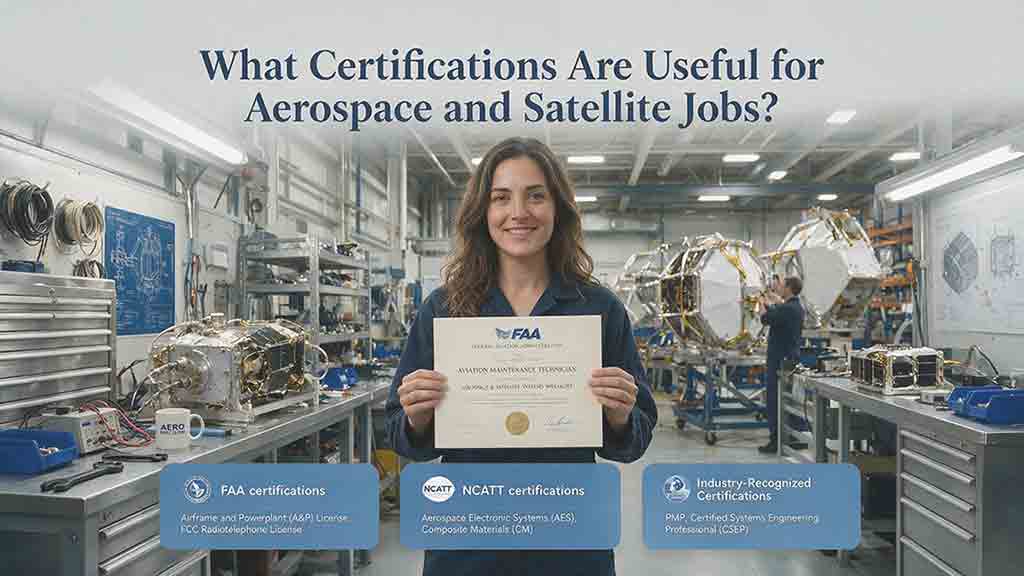
What Certifications Are Useful for Aerospace and Satellite Jobs?
Useful certifications depend on the job. INCOSE credentials can support systems engineering; IPC credentials fit electronics assembly and inspection; ASQ credentials suit experienced quality and reliability professionals; CAPM or PMP may support project work; and cybersecurity or cloud certifications help only when those skills appear in the role. None is a universal substitute for a degree, experience, license, or clearance.
Key Takeaways
- There is no single certification required across aerospace and satellite employment.
- The strongest credential is one that an employer requests or that validates a core task you already perform.
- AS9100 normally certifies an organization’s aerospace quality-management system; individual training and auditor authentication are separate statuses.
- Entry-level, experienced, standards-based, vendor-specific, and government-issued credentials should not be treated as interchangeable.
- A certification should add evidence to your profile, not replace projects, technical judgment, supervised practice, or occupational eligibility.
This guide will help you identify role-aligned credentials, distinguish certifications from course certificates, organizational certifications, licenses, and clearances, compare eligibility and renewal burdens, and decide whether a certification is worth pursuing before you pay for preparation or an exam.
Method and scope: This guide is based on official certification requirements, government licensing information, standards-body documentation, and practical selection criteria rather than hands-on testing of every credential. Requirements, fees, exam outlines, standards revisions, authentication systems, and renewal rules can change. Information was reviewed on August 1, 2026 and should be confirmed with the issuing organization before applying.
Which Certifications Are Most Useful for Aerospace and Satellite Jobs?
The most useful certification is the one that matches your actual work.
A credential associated with systems engineering may be valuable for requirements and interface roles but nearly irrelevant to an electronics-assembly technician. A soldering and workmanship credential may be important on a production floor but add little to an orbital-analysis application.
The following table is a role-matching guide, not a ranking.
| Credential or pathway | Most relevant to | Typical career stage | Important limitation |
|---|---|---|---|
| INCOSE ASEP | Requirements, systems thinking, verification, lifecycle processes | Student, graduate, or early-career systems candidate | Validates systems-engineering knowledge, not substantial professional experience |
| INCOSE CSEP | Practicing systems engineers, technical integration, architecture | Experienced professional | Requires documented systems-engineering experience and references |
| AS9100 awareness, internal-auditor, or lead-auditor training | Aerospace quality systems, supplier quality, internal auditing | Quality professional or auditor; level depends on the course and experience | Training completion is not the same as an organization’s AS9100 certification or IAQG third-party auditor authentication |
| IPC J-STD-001 endorsement | Soldered electronics assembly, process control, workmanship | Technician, assembler, manufacturing or quality professional | Useful when the employer applies the standard; not a general engineering credential |
| IPC-A-610 endorsement | Electronics inspection and acceptance criteria | Inspector, technician, manufacturing-quality professional | Focuses on assembly acceptability rather than circuit design |
| IPC-7711/7721 endorsement | Electronic rework and repair | Experienced technician or repair specialist | Not intended as an introduction to basic hand soldering |
| ASQ Certified Quality Engineer | Quality systems, statistics, process control, product quality | Experienced quality professional | Has substantial work-experience requirements |
| ASQ Certified Reliability Engineer | Reliability, maintainability, risk, failure analysis | Experienced reliability or quality professional | Does not replace role-specific reliability work |
| ASQ Certified Supplier Quality Professional | Supplier development, procurement quality, process control | Experienced supplier-quality professional | Requires qualifying experience; not designed as an entry-level certificate |
| PMI CAPM | Project coordination and project-management foundations | Student, graduate, or early-career professional | Does not prove experience leading major aerospace programs |
| PMI PMP | Project leadership, delivery, stakeholders, risk, resources | Experienced project leader | Requires documented project-leadership experience and qualifying training |
| ISC2 Certified in Cybersecurity | Foundational cybersecurity knowledge | Entry level or career transition | Does not prove aerospace, satellite, embedded, or operational-security experience |
| ISC2 SSCP | Hands-on security administration and operations | Early- to mid-career cybersecurity practitioner | Requires qualifying experience or an accepted education pathway |
| ISC2 CISSP | Security architecture, risk, leadership, security programs | Experienced cybersecurity professional | Normally inappropriate as a first credential for someone without relevant experience |
| AWS Certified Cloud Practitioner | Foundational cloud literacy | Entry-level cloud learner or nontechnical stakeholder | Broad and vendor-specific; does not prove system-building ability |
| AWS Certified Solutions Architect – Associate | Cloud architecture for ground systems, data platforms, or mission applications using AWS | Practitioner with hands-on AWS exposure | Valuable only when AWS is relevant to the target environment |
| NCEES FE and P.E. pathway | Engineering licensure and public-practice authority | Engineering student through experienced engineer | A license pathway, not an aerospace certification; jurisdictional rules control |
| FAA Aviation Mechanic Certificate | Aircraft airframe and powerplant maintenance | Aviation-maintenance professional | Applies to regulated aircraft maintenance, not ordinary satellite engineering |
| FAA Remote Pilot Certificate | Commercial small-UAS operations under Part 107 | Drone operator or aerospace field professional | Does not qualify a person for satellite operations, spacecraft design, or piloted aviation |
A certification can be credible and still be irrelevant to your target job.
What Is the Difference Between a Certification, Certificate, Organization Certification, License, and Clearance?
These terms describe different kinds of evidence or authority.
| Term | General meaning | Example | What it does not automatically provide |
|---|---|---|---|
| Course certificate | Records completion of a learning activity | Online course-completion certificate | Independent professional certification |
| Professional certification | Confirms that an issuing body’s stated knowledge, examination, experience, or ethics requirements were met | ASEP, PMP, CQE, CISSP | Legal authority to practice a regulated profession |
| Standards-based certification or endorsement | Confirms knowledge or demonstrated workmanship related to a named technical standard | IPC J-STD-001 CIS | Authority beyond the named standard and program scope |
| Organization certification | Confirms that an organization’s management system was audited against a defined standard | An organization certified to AS9100 | Personal competence or an individual auditor qualification |
| Auditor training certificate | Records completion of awareness, internal-auditor, or lead-auditor training | AS9100 internal-auditor course certificate | Organizational certification or IAQG third-party auditor authentication |
| Auditor authentication | Confirms that an auditor met the scheme’s defined training, experience, audit, and application requirements | IAQG Authentication Level 1 or Level 2 | Certification of the auditor’s employer |
| Government certificate | Credential created under government rules for a regulated activity | FAA Aviation Mechanic or Remote Pilot Certificate | Competence in unrelated engineering or satellite roles |
| Professional license | Legal authorization within a jurisdiction and scope | Professional Engineer license | Expertise in every engineering specialty |
| Security clearance | Government determination related to eligibility for classified access when a position requires it | Confidential, Secret, or Top Secret eligibility | A certification that an individual can purchase or independently request |
A security clearance is not a professional certification.
The Defense Counterintelligence and Security Agency explains that clearance requirements are position-based and that the employing or sponsoring organization initiates the process. An individual does not independently apply for a clearance simply to improve a résumé.
Likewise, passing the Fundamentals of Engineering examination is not the same as holding a Professional Engineer license. Engineer-in-Training or Engineer Intern recognition is handled by the applicable licensing board.
Which Systems Engineering Certification Is Most Useful?
INCOSE’s Systems Engineering Professional program is one of the most directly relevant certification families for systems-oriented aerospace and satellite roles.
The program has three levels:
- Associate Systems Engineering Professional
- Certified Systems Engineering Professional
- Expert Systems Engineering Professional
When Is ASEP Useful?
ASEP is designed for people who can demonstrate systems-engineering knowledge but do not yet have substantial systems-engineering experience.
INCOSE currently states that ASEP has no mandatory degree or work-experience prerequisite. Applicants must satisfy a knowledge requirement through the INCOSE examination, an approved academic-equivalency route, or another accepted pathway.
ASEP may be relevant when you are targeting work involving:
- Requirements
- Functional analysis
- System architecture
- Interfaces
- Verification
- Validation
- Risk
- Lifecycle processes
- Technical integration
ASEP is not proof that you have led a spacecraft development program or performed independent systems-engineering work.
When Is CSEP More Appropriate?
CSEP is designed for practicing systems engineers.
The current INCOSE application page describes at least 60 months of direct systems-engineering experience, including experience across multiple systems-engineering areas. References must confirm the required experience.
Education and experience rules can affect the detailed eligibility pathway, so applicants should review the current controlled requirements rather than relying on a résumé coach’s summary.
CSEP may be useful for:
- Satellite systems engineers
- Requirements engineers
- Verification and validation engineers
- Mission architects
- Interface managers
- Technical leads
- Integration engineers
An experienced electrical, software, or mechanical engineer should not pursue CSEP merely because the role involves a complex product. The applicant should be able to document actual systems-engineering work.
Who Is ESEP For?
ESEP is intended for senior, recognized systems-engineering leaders.
Current INCOSE materials describe a minimum of 25 years of systems-engineering experience, or 20 years for an existing CSEP, together with breadth, depth, leadership evidence, references, and an interview process.
ESEP is not an appropriate early-career goal simply because the title sounds prestigious.
What Are the Renewal Requirements?
ASEP and CSEP require renewal and professional-development documentation.
INCOSE currently lists:
- ASEP validity on a five-year cycle
- CSEP validity on a three-year cycle
- A minimum of 120 documented Professional Development Units for ASEP or CSEP renewal
- Submission of a professional-development log
- Possible supporting-document review or audit
Professional-development units must generally be earned during the applicable certification period. INCOSE currently allows a limited number of excess PDUs to carry into the next period, subject to its rules.
Review the current renewal page before applying because membership status, fees, documentation, qualifying activities, and reinstatement rules may change.
Is AS9100 a Personal Certification?
Usually not.
AS9100D specifies quality-management-system requirements for aviation, space, and defense organizations. It incorporates ISO 9001 requirements and adds industry-specific requirements.
Under the IAQG Certification Scheme, an organization may seek certification of its applicable aerospace quality-management system through an accredited Certification Body participating in the scheme.
The Certification Body audits the organization’s management system. The resulting certification applies to the organization and the defined certification scope—not automatically to every employee.
Individuals may complete courses such as:
- AS9100 awareness training
- Internal-auditor training
- Lead-auditor training
- Supplier-auditor training
- IAQG-sanctioned auditor training
These are not interchangeable.
A course-completion certificate does not make the learner’s employer AS9100 certified. It also does not automatically authorize the learner to conduct third-party certification audits within the IAQG Certification Scheme.
Internal Auditor, Lead Auditor, or IAQG-Authenticated Auditor?
An internal auditor typically evaluates the organization’s own quality-management system or supports first-party audit activities within an authorized role.
A lead-auditor course may teach planning, conducting, reporting, and following up on management-system audits. Completing the course does not, by itself, establish that the learner has the aerospace work experience, audit experience, or scheme authentication required for IAQG third-party certification audits.
Third-party auditors working within the IAQG scheme must satisfy the current IAQG Authentication requirements for the applicable standard and auditor level.
The current centralized system uses:
- Level 1: Authenticated ASD Third-Party Lead Auditor or Audit Team Leader
- Level 2: Authenticated ASD Third-Party Audit Team Member
New applicants may need to document approved training, aerospace and defense industry knowledge, relevant work experience, audit experience, and other application requirements.
A training provider’s certificate is evidence of training. It is not the same as successful IAQG Authentication.
How Should You List AS9100-Related Training?
Use precise résumé language such as:
- “Completed AS9100 internal-auditor training”
- “Completed AS9100 awareness training”
- “Completed an approved aerospace lead-auditor course”
- “Conducted supervised internal audits against the organization’s AS9100 procedures”
- “IAQG-authenticated Level 1 auditor,” only when the current authentication requirements have actually been satisfied
- “IAQG-authenticated Level 2 auditor,” only when the current authentication requirements have actually been satisfied
Do not use “AS9100 certified” for an individual unless the exact issuing program officially uses that term and the scope is stated clearly.
Current IAQG Authentication Transition
Current transition note: As of August 1, 2026, IAQG is transitioning from the previous regional auditor-authentication structure to the centrally managed IAQG Authentication program. The OASIS freeze period began on June 18, 2026. Existing Auditor Recognition opened on June 24 and is scheduled to close on August 27, 2026. The freeze period is scheduled to end on September 3, 2026, when recognized auditors are expected to appear under the new system.
Existing auditors who were actively authenticated in OASIS at the start of the freeze period must complete the recognition process within the published window to preserve eligibility through the transition.
After the freeze period, IAQG states that only auditors recognized through IAQG Authentication will remain eligible to conduct third-party audits under the scheme.
Older terms such as Aerospace Auditor, Aerospace Experienced Auditor, and Auditor Authentication Body may still appear in historical documents and transition material. Applicants and employers should verify the current Level 1 and Level 2 requirements rather than relying on an old training-provider summary.
Lead-auditor training does not automatically make someone an IAQG-authenticated auditor. The current IAQG process separately evaluates training, work experience, audit experience, application evidence, and the requested authentication level.
Which Certifications Help With Aerospace and Satellite Electronics?
IPC credentials can be useful for technicians, inspectors, assemblers, trainers, manufacturing engineers, and quality professionals who work with electronic assemblies.
They are most valuable when the employer, customer, contract, or manufacturing process uses the corresponding IPC standard.
IPC J-STD-001
IPC J-STD-001 addresses requirements for soldered electrical and electronic assemblies.
The certification program can include:
- General workmanship requirements
- Safety and electrostatic-discharge concepts
- Wire and terminal assembly
- Through-hole technology
- Surface-mount technology
- Soldered-connection acceptance
- Process control
- Workmanship demonstrations
This can be relevant to:
- Electronics assemblers
- Soldering technicians
- Manufacturing technicians
- Process engineers
- Quality inspectors
- Training personnel
The exact role matters. A circuit-design engineer who never performs or evaluates assembly work may gain less from the credential than a production technician.
IPC-A-610
IPC-A-610 focuses on acceptability criteria for electronic assemblies.
It is especially relevant to:
- Visual inspection
- Quality assurance
- Manufacturing acceptance
- Defect classification
- Supplier communication
- Production documentation
IPC-A-610 does not teach complete electronic design, circuit analysis, or spacecraft avionics engineering.
IPC-7711/7721
IPC-7711/7721 addresses rework, modification, and repair of electronic assemblies.
IPC states that this program is not intended as basic introductory soldering training. Candidates should already possess relevant rework or repair knowledge and hand skills.
This makes it more appropriate for:
- Repair technicians
- Rework specialists
- Manufacturing support
- Quality personnel
- Experienced assembly staff
Which IPC Certification Level Should You Choose?
IPC programs distinguish among roles such as:
- Certified IPC Specialist
- Certified IPC Trainer
- Certified Standards Expert
A Certified IPC Trainer credential is intended for people authorized within the IPC program to deliver applicable training. It should not be pursued merely to make a résumé look more advanced.
Use the current IPC certification policies and procedures to verify:
- Candidate prerequisites
- Required modules
- Examination rules
- Workmanship demonstrations
- Authorized training centers
- Expiration and recertification
- Permitted use of the credential title
A course called “IPC awareness” or “IPC for operators” is not necessarily the same as a Certified IPC Specialist program.
Which Quality and Reliability Certifications Are Useful?
Quality and reliability credentials can be valuable in aerospace and satellite organizations because products are often developed under strict configuration, supplier, verification, inspection, and risk controls.
However, the strongest ASQ credentials are experience-based. They are usually not entry-level shortcuts.
ASQ Certified Quality Engineer
The Certified Quality Engineer body of knowledge covers areas such as:
- Quality systems
- Product and process design
- Statistical methods
- Process control
- Measurement
- Continuous improvement
- Risk
- Corrective action
ASQ currently requires eight years of qualifying full-time paid experience for CQE, including three years in a decision-making position. Education can waive part of the eight-year total; for example, a bachelor’s degree currently waives four years.
A new graduate with no relevant professional experience would therefore not qualify simply by holding an engineering degree.
ASQ Certified Reliability Engineer
CRE is relevant to work involving:
- Reliability prediction
- Maintainability
- Failure analysis
- Risk
- Lifecycle performance
- Reliability testing
- Data analysis
- Safety-related reliability methods
ASQ currently applies a similar eight-year experience structure, with three years in a decision-making position and education waivers.
CRE is not a substitute for having actually performed reliability analyses or supported verification and test work.
ASQ Certified Supplier Quality Professional
CSQP is relevant to:
- Supplier evaluation
- Supplier performance
- Quality planning
- Process control
- Corrective action
- Procurement quality
- Cross-functional supplier improvement
This can be especially useful in organizations that depend on complex aerospace or satellite supply chains.
ASQ currently requires eight years of qualifying experience, including three years in a decision-making role, with possible education waivers.
How Are These ASQ Certifications Maintained?
ASQ currently applies a three-year recertification cycle to CQE, CRE, CSQP, and other named renewable credentials.
Credential holders generally maintain an eligible certification by either:
- Documenting at least 18 recertification units during the three-year period
- Retaking the certification examination under ASQ’s current rules
ASQ also publishes grace-period, synchronization, evidence, audit, and expiration rules.
Do not assume that passing the original exam creates a permanent active credential.
What About Six Sigma Certifications?
Six Sigma credentials may be useful for manufacturing, operations, quality, and process-improvement roles.
However, “Six Sigma certification” is not one uniform credential. Providers use different:
- Bodies of knowledge
- Experience requirements
- Project requirements
- Examination methods
- Renewal rules
- Belt definitions
Before paying, determine whether the employer recognizes:
- ASQ certification
- An internal employer program
- A named university program
- Another specific certifying body
A generic low-cost “Black Belt certificate” with no project, proctored assessment, or recognizable issuing standard may carry little weight.
Are CAPM and PMP Useful in Aerospace?
They can be useful for project-oriented roles, but they do not replace technical qualifications.
When Is CAPM Useful?
PMI’s Certified Associate in Project Management is designed for foundational project-management knowledge.
Current CAPM eligibility includes:
- A secondary degree or equivalent
- At least 23 hours of project-management education before the exam
CAPM can be relevant to:
- Project coordinators
- Program support
- Junior schedulers
- Operations coordinators
- Early-career engineers moving toward project work
- Students who want structured project vocabulary
It does not prove that the holder has led a satellite program, controlled a launch schedule, or managed aerospace suppliers.
CAPM holders currently need 15 Professional Development Units during each three-year maintenance cycle.
When Is PMP Useful?
PMP is intended for people with documented project-leadership experience.
As of August 1, 2026, PMI lists multiple eligibility pathways. Examples include:
- Bachelor’s degree or higher plus three years of project-leadership experience
- Associate degree or vocational diploma plus four years
- Secondary diploma plus five years
- A qualifying PMI-accredited academic route with a reduced experience requirement
Applicants also need 35 hours of qualifying project-professional training or an accepted alternative such as an active CAPM.
PMI launched an updated PMP examination on July 9, 2026. Candidates should use the current exam content outline rather than older preparation material.
PMP holders currently need 60 PDUs in each three-year maintenance cycle.
Check the 2026 PMP Training-Provider Transition
As of August 1, 2026, PMP applicants still need 35 hours of qualifying project-management training unless they use an accepted alternative such as an active CAPM.
PMI has also announced a planned rule change for late Q4 2026.
After the change takes effect, live instructor-led PMP training—whether delivered virtually or in person—will qualify only when it comes through an approved provider pathway, including:
- A PMI Authorized Training Partner
- A China Registered Education Provider
- An eligible accredited academic program, including applicable PMI Global Accreditation Center programs
PMI has not yet published the final effective date.
Self-paced or on-demand training follows a different rule under the announced plan. PMI currently states that self-paced training may come from any organization.
Training completed before the final effective date will remain eligible under the current requirements, according to PMI’s published transition notice.
Candidates should verify the current rule before purchasing a live class, particularly if the class will take place near or after late Q4 2026.
CAPM or PMP: Which Is Better?
| Situation | More appropriate starting point |
|---|---|
| Student with no professional project leadership | CAPM or project coursework |
| Entry-level project coordinator | CAPM may be relevant |
| Engineer who helps with schedules but does not lead projects | Gain real project responsibility first |
| Professional with verified project-leadership experience | Evaluate PMP eligibility |
| Senior program leader managing related projects | PMP may help, but broader program-management experience still matters |
| Candidate applying only to technical analysis roles | Neither may be the highest-value credential |
Do not claim PMP experience that does not satisfy PMI’s definitions or documentation rules.
Which Cybersecurity Certifications Help With Satellite Jobs?
Cybersecurity certifications can be useful for satellite ground systems, networks, mission software, cloud platforms, security operations, and information-assurance roles.
They are less useful for jobs that do not involve security responsibilities.
ISC2 Certified in Cybersecurity
ISC2 Certified in Cybersecurity is an entry-level credential with no work-experience requirement.
Its exam covers:
- Security principles
- Business continuity and disaster recovery concepts
- Access control
- Network security
- Security operations
ISC2 states that a new CC exam outline becomes effective September 1, 2026. Candidates testing after that date should prepare from the new outline.
CC may be useful for:
- Students exploring cybersecurity
- IT professionals moving toward security
- Entry-level ground-system candidates
- Career changers
It does not prove secure spacecraft-software design, penetration-testing ability, embedded security, or satellite-command protection.
ISC2 SSCP
SSCP is designed for hands-on security administration and operations.
ISC2 currently requires one year of relevant experience in one or more SSCP domains. An accepted bachelor’s or master’s degree in a relevant field may satisfy the experience requirement under the current pathway.
SSCP can be relevant to:
- System administrators
- Security analysts
- Network-security staff
- Ground-infrastructure security
- Access-control administration
- Incident response
ISC2 CISSP
CISSP is an experienced-professional credential.
ISC2 currently requires five years of cumulative work experience in at least two CISSP domains. A relevant degree or an accepted credential can waive up to one year, but the waivers cannot be stacked beyond the stated limit.
Candidates who pass the examination without the required experience may use the Associate of ISC2 route while completing the experience requirement.
CISSP is most relevant to:
- Security architecture
- Cybersecurity leadership
- Security risk
- Enterprise security programs
- Senior security engineering
- Governance and security operations
It is not an entry-level satellite certification.
Does a Cybersecurity Certification Grant a Clearance?
No.
A certification may satisfy or support an employer’s workforce-qualification framework, but it does not grant:
- Citizenship
- Work authorization
- Export authorization
- Access to classified information
- Security-clearance eligibility
- A specific job assignment
Those conditions are handled separately.
Are Cloud Certifications Useful for Satellite Ground Systems?
Cloud certifications can be useful when mission data, ground software, analytics, customer platforms, or operational tools use the named cloud provider.
They are not inherently space certifications.
AWS Certified Cloud Practitioner
AWS Certified Cloud Practitioner validates foundational knowledge of AWS Cloud services, terminology, security concepts, and billing.
It can be useful for:
- Nontechnical project staff
- Product managers
- Business analysts
- New cloud learners
- Technical writers
- Entry-level candidates who need cloud vocabulary
It does not demonstrate that a candidate can architect or operate a mission system.
AWS Certified Solutions Architect – Associate
The current AWS exam guide describes this credential as intended for people who design solutions using AWS services.
AWS identifies a target candidate with approximately one year of hands-on experience designing cloud solutions.
This credential may be useful for:
- Satellite-data platforms
- Ground-system applications
- Mission-planning services
- Customer-delivery platforms
- Cloud infrastructure
- Resilient distributed systems
It is less useful when:
- The employer uses a different cloud platform
- The work is entirely embedded or onboard
- The role does not involve architecture
- The candidate has no practical cloud experience
AWS certifications are currently valid for three years, with current recertification and maintenance options described by AWS.
A cloud credential should be paired with evidence such as:
- Infrastructure design
- Security controls
- Monitoring
- Failure recovery
- Cost assumptions
- Data-flow documentation
- A deployed non-sensitive project
Is the FE Exam or P.E. License Useful in Aerospace?
Potentially, but the FE/P.E. pathway is not a professional certification program.
It is part of U.S. engineering licensure.
NCEES describes the commonly accepted route as:
- Qualifying engineering education
- Passing the Fundamentals of Engineering exam
- Completing acceptable progressive engineering experience
- Passing the Principles and Practice of Engineering exam
- Applying to the relevant state or territorial board
Actual requirements vary by jurisdiction.
When Might the FE Exam Be Useful?
The FE exam may be useful when:
- You want to preserve a future licensure path
- You work near regulated engineering practice
- You may enter consulting
- You may work on public infrastructure or facilities
- Employers in your target area value Engineer-in-Training status
The FE exam is designed mainly for recent graduates and students near completion of an engineering degree.
Passing the FE exam alone does not automatically authorize engineering practice. State or territorial board requirements determine EIT or EI recognition.
When Might a P.E. License Matter?
A P.E. license can matter for:
- Offering engineering services to the public
- Signing or sealing certain engineering documents
- Consulting
- Government or infrastructure contracts
- Expert-witness work
- Firm ownership where regulated
- Engineering responsibilities governed by state law
Many internal aerospace product-development positions may not state a P.E. requirement, while certain facilities, infrastructure, safety, consulting, or public-practice roles may.
Do not assume that licensure is either universally necessary or universally irrelevant.
Which Government Certificates Apply to Specialized Aerospace Work?
Government-issued certificates may be essential for regulated activities, but their scope is narrow.
FAA Aviation Mechanic Certificate
The FAA issues an Aviation Mechanic certificate with:
- Airframe rating
- Powerplant rating
- Both ratings, commonly called A&P
Current eligibility routes include:
- Required practical experience
- Graduation from an FAA-approved Aviation Maintenance Technician School
- Certain qualifying military pathways
Applicants must pass knowledge, oral, and practical tests.
The FAA currently describes:
- 18 months of relevant practical experience for one rating
- 30 months for combined Airframe and Powerplant experience
This certificate is useful for regulated aircraft-maintenance work. It is not a satellite-technician certification and does not qualify a holder to design spacecraft electronics or approve satellite hardware.
FAA Remote Pilot Certificate
A Remote Pilot Certificate is required to act as remote pilot in command under the FAA’s Small UAS Rule, Part 107.
First-time applicants generally must:
- Be at least 16
- Meet the FAA’s language and fitness conditions
- Pass the applicable aeronautical-knowledge exam
- Complete the FAA application process
Remote pilots must complete recurrent training within the required 24-calendar-month period to maintain aeronautical-knowledge recency for Part 107 operations.
This certificate may be useful for:
- Drone operations
- Aerial mapping
- Field inspection
- Test support
- Some remote-sensing projects
It does not qualify someone for orbital satellite control, spacecraft engineering, or general aviation maintenance.
How Much Renewal Work Do These Credentials Require?
Maintenance burden should be evaluated before the initial application.
| Credential | Current maintenance summary |
|---|---|
| INCOSE ASEP | Five-year validity cycle; renewal currently requires a professional-development log documenting at least 120 PDUs |
| INCOSE CSEP | Three-year validity cycle; renewal currently requires a professional-development log documenting at least 120 PDUs |
| ASQ CQE, CRE, and CSQP | Three-year recertification cycle; generally requires 18 recertification units or retaking the exam |
| CAPM | 15 PDUs during each three-year maintenance cycle |
| PMP | 60 PDUs during each three-year maintenance cycle |
| AWS certifications | Three-year validity; use a current AWS recertification route |
| FAA Remote Pilot | Recurrent training must have been completed within the preceding 24 calendar months to exercise Part 107 privileges |
| IPC credentials | Expiration and recertification depend on the specific program, credential role, and standard revision |
| ISC2 credentials | Continuing education, maintenance fees, and cycle requirements depend on the credential |
| IAQG auditor authentication | Ongoing authentication includes current IAQG requirements such as applicable fees, conduct rules, training, audit experience, and continuing professional development |
This table is a planning summary, not a substitute for the issuer’s current maintenance policy.
A credential may become poor value when:
- You will not use it during the active period
- Your employer does not recognize it
- Renewal requires work you cannot document
- You cannot justify continuing fees
- The governing standard is changing
- A more relevant credential would compete for the same time
The Credential Gate Test
The Credential Gate Test is an original decision framework developed for this guide.
Before pursuing a certification, evaluate five gates.
Gate 1: Employer Demand
Does the credential appear in real job postings?
Classify each mention as:
- Required
- Preferred
- Accepted alternative
- Not mentioned
A certification listed in one unrelated posting is weak evidence.
Gate 2: Task Alignment
Does the credential cover work you would actually perform?
Examples:
- ASEP aligns with requirements and lifecycle processes.
- J-STD-001 aligns with soldered-assembly workmanship.
- CRE aligns with reliability analysis.
- PMP aligns with project leadership.
- CISSP aligns with experienced security work.
- AS9100 internal-auditor training aligns with internal quality-system auditing, not organizational certification.
Gate 3: Career Timing
Are you eligible, and does the credential match your experience level?
A student may qualify for ASEP, CAPM, or ISC2 CC.
The same student normally will not qualify for CSEP, PMP, CQE, CRE, CSQP, or CISSP without the required experience.
An AS9100 lead-auditor course may be available to a learner before the learner qualifies for IAQG third-party auditor authentication. Course access and scheme authentication are separate questions.
Gate 4: Evidence Support
Can you pair the credential with evidence?
Examples:
- ASEP plus a requirements and verification project
- IPC certification plus supervised workmanship records
- AS9100 internal-auditor training plus authorized internal-audit evidence
- CAPM plus a project schedule and risk register
- AWS certification plus a deployed architecture
- CC plus a secure system-administration lab
Gate 5: Maintenance Practicality
Can you keep the credential active?
Check:
- Renewal cycle
- Continuing education
- Professional-development units
- Annual fees
- Recertification exams
- Membership obligations
- Employer reimbursement
- Recordkeeping
- Transition dates
- Changes to standards or training-provider rules
A certification that expires before you use it may provide little value.
The Certification Utility Score
The Certification Utility Score is an original comparison tool.
Score each factor from 1 to 5.
| Factor | Weight | Question |
|---|---|---|
| Employer demand | 35% | Is the credential requested in comparable target postings? |
| Task alignment | 25% | Does it validate knowledge or skill central to the work? |
| Experience timing | 15% | Does it match your current experience and eligibility? |
| Portability | 15% | Is it useful across several realistic employers or roles? |
| Maintenance practicality | 10% | Can you manage renewal, fees, continuing education, and known rule changes? |
Calculate:
Certification Utility Score = 0.35D + 0.25T + 0.15E + 0.15P + 0.10M
Where:
D= employer-demand scoreT= task-alignment scoreE= experience-timing scoreP= portability scoreM= maintenance-practicality score
The result remains on a 1-to-5 scale.
The score is not:
- A hiring probability
- A salary forecast
- A certification ranking
- A psychometric assessment
- A guarantee that an employer accepts the credential
- A substitute for official eligibility review
Worked Example: Entry-Level Satellite Systems Candidate
Consider a fictional aerospace-engineering graduate targeting junior satellite systems and requirements roles.
The candidate compares ASEP, CAPM, and AWS Certified Cloud Practitioner.
| Factor | Weight | ASEP | CAPM | AWS Cloud Practitioner |
|---|---|---|---|---|
| Employer demand | 35% | 4 | 3 | 2 |
| Task alignment | 25% | 5 | 3 | 2 |
| Experience timing | 15% | 5 | 5 | 5 |
| Portability | 15% | 4 | 5 | 4 |
| Maintenance practicality | 10% | 3 | 4 | 4 |
ASEP
(0.35 × 4) + (0.25 × 5) + (0.15 × 5) + (0.15 × 4) + (0.10 × 3) = 4.30
CAPM
(0.35 × 3) + (0.25 × 3) + (0.15 × 5) + (0.15 × 5) + (0.10 × 4) = 3.70
AWS Certified Cloud Practitioner
(0.35 × 2) + (0.25 × 2) + (0.15 × 5) + (0.15 × 4) + (0.10 × 4) = 2.95
ASEP ranks highest for this fictional role because the target work centers on requirements, interfaces, verification, and systems thinking.
The result would change for:
- A ground-cloud position
- A project-coordination position
- An electronics-production position
- A cybersecurity role
- An aerospace quality-auditing position
The scores are illustrative editorial judgments, not measured employer outcomes.
The One-Gate Rule
The One-Gate Rule is a practical editorial standard for avoiding credential collection.
Pursue a certification only when at least one of these conditions is true:
- It is required for the work.
- It appears repeatedly as preferred in comparable postings.
- It validates a central task that you already perform or can demonstrate.
- It preserves a regulated professional pathway you are likely to use.
- Your employer has identified it as part of a documented development plan.
A credential should not be purchased only because:
- It contains the word “aerospace”
- It has an impressive badge
- It is discounted
- It is popular on social media
- A training provider promises job readiness
- You have no other portfolio evidence
- The course title includes AS9100 without defining the resulting credential
How Do You Audit Employer Demand?
Use a focused posting audit.
Step 1: Select One Role Family
Examples:
- Satellite systems engineer
- Electronics assembler
- Aerospace quality engineer
- Internal quality auditor
- Supplier quality engineer
- Reliability engineer
- Project coordinator
- Cybersecurity analyst
- Ground-software engineer
- Aircraft mechanic
Step 2: Collect Comparable Postings
Use postings with similar:
- Career level
- Location
- Technical focus
- Employer type
- Work-authorization context
Do not mix an entry-level manufacturing technician posting with a principal mission architect posting.
Step 3: Record Credential Language
Use a table such as:
| Posting | Credential | Language | Related task |
|---|---|---|---|
| Employer A | ASEP | Preferred | Requirements and verification |
| Employer B | None | Not mentioned | Systems integration |
| Employer C | IPC J-STD-001 | Required | Soldered assembly |
| Employer D | PMP | Preferred | Project leadership |
| Employer E | AS9100 internal-auditor training | Preferred | Internal quality-system auditing |
| Employer F | IAQG Authentication Level 1 | Required | Third-party certification audit leadership |
Do not combine AS9100 training and IAQG Authentication into one generic credential.
Step 4: Separate Credential Demand From Skill Demand
A posting may not name a certification but may repeatedly require the underlying skill.
Examples:
- Requirements management without ASEP
- Project scheduling without CAPM
- Reliability analysis without CRE
- AWS architecture without requiring an AWS certification
- Internal auditing without naming a particular AS9100 course
- Supplier-quality experience without requiring an individual “AS9100 certification”
The underlying skill may be more important than the credential.
Step 5: Check Expired Postings Carefully
Archived postings can show historical practice but may not reflect current hiring rules.
Record the posting date and prioritize current openings.
The Credential Commitment Ledger
A certification costs more than the examination fee.
Record:
| Commitment category | Examples |
|---|---|
| Eligibility | Experience documentation, references, education review |
| Preparation | Books, courses, practice exams, laboratory time |
| Examination | Application fee, exam fee, retake fee |
| Logistics | Travel, test-center costs, time away from work |
| Maintenance | Membership, annual fees, PDUs, CPEs, recertification |
| Evidence | Project, portfolio, supervised practice |
| Opportunity cost | Time not spent on work experience, applications, or technical projects |
| Rule-change exposure | Standards revisions, exam updates, authentication transitions, provider-rule changes |
Do not calculate a guaranteed salary return.
A useful comparison question is:
What concrete opportunity would this credential unlock that I cannot access through a smaller course, project, or job assignment?
If the answer is unclear, delay the purchase.
Which Certifications Fit Different Career Goals?
| Career goal | Credentials or pathways to investigate first |
|---|---|
| Entry-level satellite systems work | INCOSE ASEP |
| Experienced systems engineering | INCOSE CSEP |
| Aerospace quality-system awareness | AS9100 awareness training |
| Internal aerospace quality auditing | AS9100 internal-auditor training plus authorized internal-audit experience |
| Third-party AQMS certification auditing | Current IAQG Authentication route for the applicable level and standard |
| Electronics assembly | IPC J-STD-001 CIS |
| Electronics inspection | IPC-A-610 CIS |
| Electronics rework and repair | IPC-7711/7721 |
| Quality engineering | ASQ CQE |
| Reliability engineering | ASQ CRE |
| Supplier quality | ASQ CSQP |
| Entry-level project coordination | PMI CAPM |
| Experienced project leadership | PMI PMP |
| Entry-level cybersecurity | ISC2 CC |
| Security operations | ISC2 SSCP |
| Senior cybersecurity leadership or architecture | ISC2 CISSP |
| Foundational AWS cloud literacy | AWS Cloud Practitioner |
| AWS solution architecture | AWS Solutions Architect – Associate |
| Future engineering licensure | FE exam and jurisdictional EIT pathway |
| Regulated aircraft maintenance | FAA Aviation Mechanic Certificate |
| Commercial small-UAS operation | FAA Remote Pilot Certificate |
This table identifies starting points, not automatic recommendations.
What Common Certification Mistakes Should You Avoid?
Searching for One Universal Aerospace Certification
Aerospace contains many occupations.
Systems engineering, assembly, cloud architecture, project management, reliability, quality auditing, and aviation maintenance require different evidence.
Confusing a Course Certificate With Certification
A certificate of completion may document attendance or coursework.
It may not include independent examination, experience verification, ethics rules, or renewal.
Calling an Individual “AS9100 Certified”
AS9100 certification normally applies to an organization’s aerospace quality-management system.
An individual may hold an awareness, internal-auditor, or lead-auditor training certificate, or may hold IAQG auditor authentication. These statuses must be listed using their exact titles.
Internal-auditor training, lead-auditor training, organization certification, and IAQG auditor authentication are different.
Assuming Lead-Auditor Training Grants IAQG Authentication
Completing a lead-auditor course is not the same as satisfying IAQG’s work-experience, audit-experience, application, and authentication requirements.
Do not claim eligibility to conduct third-party certification audits solely from a training certificate.
Using Obsolete IAQG Auditor Labels Without a Date
The 2026 transition replaces the earlier regional authentication approach with the centrally managed IAQG Authentication program.
Older AA, AEA, and AAB terminology may be relevant to historical or transition records but should not be presented as a timeless current structure.
Pursuing an Experienced Credential Too Early
A certification that requires years of experience is not an entry-level study badge.
Do not invent, stretch, or misclassify experience.
Choosing PMP Without Leading Projects
Participating in a project is not necessarily the same as leading one under PMI’s eligibility definitions.
Buying Live PMP Training Without Checking the Provider Rule
PMI has announced a late-Q4 2026 change to eligible providers of live instructor-led PMP training.
Verify the final effective date and provider status before paying for a class scheduled near or after the transition.
Choosing CISSP as a Beginner Credential
CISSP requires substantial experience. Passing an exam does not remove the certification’s experience requirements.
Assuming IPC Certification Is Universal to All Hardware Jobs
IPC credentials are valuable when the work applies the relevant standard.
They may be unnecessary for analysis, software, mission design, or non-manufacturing roles.
Calling the FE Exam a Certification
The FE exam is part of a licensure pathway.
Engineer-in-Training recognition depends on the applicable board.
Calling a Security Clearance a Certification
A clearance is tied to a position, government need, and sponsorship process.
It is not a résumé credential that a person buys independently.
Choosing a Vendor Certification Without Checking the Platform
An AWS certification is weak evidence for a role built entirely on another cloud or on isolated embedded hardware.
Ignoring Renewal
Expired credentials may no longer be represented as active.
Review continuing-education, fee, and renewal obligations before applying.
Listing a Credential Without Its Status
Use accurate descriptions such as:
- Active
- Expired
- In progress
- Exam passed, experience pending
- Associate status
- Training completed
- IAQG authentication recognized
- Organizational certification within a defined scope
Do not imply that an application, course, exam registration, or employer certification is your personal professional certification.
Expecting Certification to Replace a Portfolio
A certification can validate a body of knowledge.
It does not show your specific design decisions, code quality, workmanship, analysis, communication, or judgment.
How Should You List Certifications on a Résumé?
Use the exact credential name.
A useful format is:
Credential name — Issuing organization — Date earned — Expiration date or active status
Examples:
- Associate Systems Engineering Professional — INCOSE — Active through [date]
- Certified Associate in Project Management — PMI — Active
- IPC J-STD-001 Certified IPC Specialist — [revision or endorsement details, if appropriate] — Active
- AWS Certified Solutions Architect – Associate — Active through [date]
- Completed AS9100 internal-auditor training — [training provider] — [date]
- IAQG Authentication Level 1, 9100 — Active, only when verified under the current scheme
Do not:
- Shorten a course certificate into a professional-certification title
- Describe yourself as “AS9100 certified” when you completed only individual training
- Omit an expiration when the credential is inactive
- Describe examination preparation as certification
- Add credentials you are merely considering
- Claim a trainer credential when you hold a specialist credential
- Imply that the issuing body endorses your employer or work product
- List your employer’s organizational AS9100 certification as your personal credential
If a certification registry or digital badge is publicly verifiable, include the verification link only when appropriate and permitted.
How Can You Troubleshoot a Certification Decision?
| Problem | Likely cause | Practical response |
|---|---|---|
| Every certification looks useful | The target role is too broad | Select one role family and one recurring work product |
| A credential never appears in postings | Employer demand may be weak | Focus on the underlying skill or project |
| You do not meet the experience requirement | The credential is mistimed | Choose an entry-level credential or gain qualifying experience |
| You have certificates but few interviews | Evidence or role fit may be weak | Build one job-relevant artifact and revise positioning |
| A provider advertises “AS9100 certification” for individuals | Organization certification and training are being blurred | Ask for the exact credential title, issuer, scope, and recognition status |
| You want to conduct third-party AS9100 audits | Training and authentication are being confused | Review the current IAQG Authentication level, experience, training, and audit requirements |
| The employer uses IPC but you do not know which program | The standard and role are unclear | Ask whether the work requires assembly, inspection, rework, or training |
| You are choosing between CAPM and PMP | Project experience has not been classified | Compare your documented leadership against PMI’s current eligibility rules |
| A live PMP course starts near late Q4 2026 | Provider eligibility may change | Verify the final PMI effective date and approved-provider pathway |
| You want cybersecurity work but have no experience | Advanced credential is premature | Begin with foundations, labs, and an entry-level credential |
| You want a cloud certification for spacecraft work | The deployment environment is unknown | Verify the employer’s platform and architecture |
| The credential has expensive renewal | Maintenance was ignored | Complete the Credential Commitment Ledger |
| A training provider promises guaranteed employment | Marketing exceeds what the credential can establish | Use issuer documentation and employer evidence instead |
| You need legal authority to practice | Certification is being confused with licensure | Check the governing agency or licensing board |
| You think a clearance will improve applications | Clearance sponsorship is misunderstood | Review the position’s eligibility and sponsorship process |
A 30-Day Certification Decision Plan
This plan helps you decide what to pursue. It does not guarantee certification or employment.
Days 1–5: Define the Work
Choose one role.
Write down:
- Main work products
- Required tools
- Technical standards
- Career level
- Eligibility conditions
Days 6–10: Audit Job Postings
Collect 15 comparable postings.
Record:
- Required credentials
- Preferred credentials
- Experience substitutions
- Underlying skills
- Renewal-sensitive requirements
- Whether an AS9100 reference describes an organization, internal audit, training, or IAQG authentication
Days 11–14: Check Official Eligibility
Use only the issuing body’s current documentation.
Confirm:
- Education
- Experience
- References
- Examination
- Ethics agreement
- Application audit
- Training-provider restrictions
- Renewal cycle
- Announced transition dates
Days 15–18: Complete the Credential Gate Test
Score:
- Employer demand
- Task alignment
- Career timing
- Evidence support
- Maintenance practicality
Days 19–22: Compare Alternatives
Compare the certification with:
- One targeted course
- One supervised project
- One additional work assignment
- One internship
- One employer-sponsored training program
Days 23–26: Calculate the Commitment
Record:
- Direct fees
- Preparation time
- Retake exposure
- Membership costs
- Renewal work
- Time away from portfolio development
- Risk that a current rule or standard will change
Days 27–30: Set a Decision Rule
Examples:
- Pursue ASEP only if systems work remains my target after reviewing postings.
- Pursue IPC certification only after confirming the employer’s standard and role.
- Complete AS9100 internal-auditor training only when internal auditing is part of my role or development plan.
- Pursue IAQG Authentication only after verifying the current level, experience, audit, and training requirements.
- Pursue PMP after verifying qualifying leadership experience and the current training-provider rules.
- Pursue a cloud credential only when the target platform is known.
- Delay certification if a project would solve the more important evidence gap.
Certification Selection Checklist
Role Alignment
- I have selected one target role family.
- I know the work product the role creates.
- The certification covers a central task.
- I reviewed current postings rather than general career lists.
- I know whether the credential is required, preferred, or merely related.
Eligibility
- I reviewed the issuer’s official requirements.
- I meet the education rules.
- I meet the experience rules.
- I can document references or work history honestly.
- I understand any examination, interview, audit, or workmanship demonstration.
- I checked whether a planned transition changes the application path.
Credential Type
- I know whether this is a course certificate, professional certification, standards endorsement, organization certification, auditor authentication, government certificate, or license.
- I will use the issuer’s exact title.
- I will not describe AS9100 organizational certification as my personal certification.
- I will not describe auditor training as IAQG Authentication.
- I will not describe a security clearance as a certification.
- I will not describe an exam pass as a completed license.
- I understand the credential’s scope.
Evidence
- I can pair the certification with a relevant project or work record.
- I can explain how the credential applies to the role.
- I will not claim professional authority beyond the credential’s scope.
- I will not publish confidential, proprietary, export-controlled, or classified evidence.
- I can distinguish supervised work from independent work.
Maintenance
- I checked the validity period.
- I checked PDU, CPE, RU, or continuing-education rules.
- I checked renewal and membership costs.
- I know when I must stop describing the credential as active.
- I have a system for preserving verification records.
- I checked whether an exam, authentication, or provider rule is changing during 2026.
Practical Value
- The certification satisfies at least one condition in the One-Gate Rule.
- I compared it with a course, project, or job assignment.
- I completed the Credential Commitment Ledger.
- I am not pursuing it only for prestige.
- I understand that certification does not guarantee employment or salary.
Which Certification Should You Pursue First?
Choose INCOSE ASEP when you are targeting systems-engineering work and need a knowledge-based credential that does not require prior experience.
Choose INCOSE CSEP when you have documented systems-engineering experience and references that satisfy the current requirements.
Choose AS9100 awareness training when you need a basic understanding of the standard and your organization’s aerospace quality-management system.
Choose AS9100 internal-auditor training when you are expected to participate in authorized internal audits and can apply the training within the organization’s audit program.
Pursue IAQG Authentication only when you intend to work within the third-party AQMS certification scheme and can meet the current training, industry experience, audit experience, application, and level requirements.
Choose an appropriate IPC Certified IPC Specialist endorsement when your electronics-assembly, inspection, or repair role uses the corresponding IPC standard.
Choose ASQ CQE, CRE, or CSQP only when your experience fits the named quality, reliability, or supplier-quality body of knowledge and meets the eligibility requirements.
Choose CAPM when you need project-management foundations but do not yet have the leadership experience required for PMP.
Choose PMP when you can document qualifying project leadership, the credential appears in the roles you want, and your training satisfies the rule in effect when you apply.
Choose ISC2 CC when you need an entry-level cybersecurity credential. Consider SSCP for hands-on security operations and CISSP for experienced security architecture or leadership.
Choose an AWS certification only when AWS appears in the target environment and you can support the credential with practical cloud work.
Choose the FE/P.E. pathway when you want to preserve or obtain engineering licensure rather than a résumé certification.
Choose an FAA certificate when you intend to perform the regulated aviation or UAS activity covered by that certificate.
The useful credential is not the one with the most recognizable logo. It is the one that matches the work, fits your career stage, appears in credible employer evidence, and remains maintainable after you earn it.
Frequently Asked Questions
Do Aerospace Engineers Need Certifications?
Not universally. Many aerospace-engineering roles emphasize an engineering degree, technical experience, and project evidence rather than one required professional certification. Systems, quality, project, cloud, or security credentials may help when they match the role.
Can a Person Become AS9100 Certified?
AS9100 certification normally applies to an organization’s quality-management system and defined scope. Individuals may complete AS9100 training or, if they meet the applicable requirements, obtain IAQG auditor authentication. Those statuses should be named precisely.
Is INCOSE ASEP Worth It for a Student?
It can be useful for a student targeting systems-engineering work because INCOSE currently does not require prior education or work experience for ASEP. Its value is stronger when paired with requirements, interface, verification, or lifecycle project evidence.
Which Certification Is Best for Satellite Technicians?
The answer depends on the technician’s work. IPC J-STD-001 may align with soldered assembly, IPC-A-610 with inspection and acceptance, and IPC-7711/7721 with rework and repair. The employer’s actual standards should determine the choice.
Is PMP Useful in the Space Industry?
PMP can be useful for experienced professionals leading projects, resources, risks, schedules, and stakeholders. It is not a substitute for aerospace technical qualifications, and applicants must meet PMI’s current experience and training requirements.
Can a Certification Replace an Aerospace Degree?
Usually not when a position requires an engineering, computing, science, or other formal degree. Certifications validate narrower bodies of knowledge or practice and should be treated as supplements unless the employer or regulator states otherwise.
Sources
International Council on Systems Engineering. Start Your Certification. ASEP, CSEP, and ESEP experience and knowledge levels. Accessed August 1, 2026.
International Council on Systems Engineering. Applying for ASEP. Knowledge pathways, absence of mandatory education or experience, and five-year certification period. Accessed August 1, 2026.
International Council on Systems Engineering. Applying for CSEP. Experience, references, application process, and three-year validity. Accessed August 1, 2026.
International Council on Systems Engineering. Applying for ESEP. Application, references, leadership review, and interview process. Accessed August 1, 2026.
International Council on Systems Engineering. Documenting Experience. Systems-engineering experience areas and ESEP experience structure. Accessed August 1, 2026.
International Council on Systems Engineering. Renewing Certification. Five- and three-year renewal cycles, 120-PDU documentation, carry-forward rules, audits, and reinstatement requirements. Accessed August 1, 2026.
International Aerospace Quality Group. Certification. Organizational AQMS certification, accredited Certification Bodies, the IAQG Certification Scheme, OASIS, and third-party auditor participation. Accessed August 1, 2026.
SAE International. AS9100D: Quality Management Systems—Requirements for Aviation, Space, and Defense Organizations. Scope of the AS9100D organizational quality-management-system standard. Accessed August 1, 2026.
International Aerospace Quality Group. IAQG Authentication. Centralized auditor-authentication model, 2026 transition dates, recognition requirements, Level 1 and Level 2 structure, and post-transition eligibility. Accessed August 1, 2026.
IAQG Authentication. Applying to IAQG Authentication. Initial and advancement application process and documented-evidence requirements. Accessed August 1, 2026.
IAQG Authentication. Authentication Level Selection Guidance. Training, work-experience, audit-experience, and Level 1 and Level 2 application guidance. Accessed August 1, 2026.
IAQG Authentication. Existing Auditor Recognition Guide. June 24–August 27, 2026 recognition window and transition process for existing authenticated auditors. Accessed August 1, 2026.
IPC International. Certifications in Electronics Manufacturing. Certification program structure, examinations, workmanship demonstrations, and credential roles. Accessed August 1, 2026.
IPC International. J-STD-001 Endorsement Program. Soldered-assembly requirements, laboratories, process control, and intended candidates. Accessed August 1, 2026.
IPC International. IPC-A-610 Endorsement Program. Electronics-assembly acceptance topics and certification levels. Accessed August 1, 2026.
IPC International. IPC-7711/7721 Endorsement Program. Rework and repair scope, candidate experience, and program limitations. Accessed August 1, 2026.
IPC International. Certification Policies and Procedures. Current policies for specialists, trainers, and standards experts. Accessed August 1, 2026.
American Society for Quality. Certified Quality Engineer. Experience, decision-making, education-waiver, and examination requirements. Accessed August 1, 2026.
American Society for Quality. Certified Reliability Engineer. Reliability scope, experience requirements, and program accreditation. Accessed August 1, 2026.
American Society for Quality. Certified Supplier Quality Professional. Supplier-quality scope, experience, education waivers, and exam structure. Accessed August 1, 2026.
American Society for Quality. ASQ Recertification. Three-year recertification, 18-RU pathway, examination alternative, grace period, and active-status requirements. Accessed August 1, 2026.
Project Management Institute. Certified Associate in Project Management. Eligibility, examination, and maintenance requirements. Accessed August 1, 2026.
Project Management Institute. Project Management Professional. Current education, experience, training, examination, and renewal requirements. Accessed August 1, 2026.
Project Management Institute. New PMP Exam Launched in July 2026. July 2026 PMP examination launch, current 35-hour training requirement, and the announced late-Q4 2026 change affecting eligible providers of live instructor-led training. Accessed August 1, 2026.
Project Management Institute. Maintain Your PMI Certification. CAPM and PMP professional-development requirements. Accessed August 1, 2026.
ISC2. Certified in Cybersecurity. Entry-level scope, absence of work-experience requirement, exam domains, and September 2026 outline notice. Accessed August 1, 2026.
ISC2. SSCP Experience Requirements. Work-experience, education, internship, and Associate of ISC2 pathways. Accessed August 1, 2026.
ISC2. CISSP Exam Outline. Experience requirements, domains, waivers, and Associate of ISC2 pathway. Accessed August 1, 2026.
ISC2. Certification Maintenance Policy. Three-year cycles, continuing-professional-education requirements, and maintenance obligations. Accessed August 1, 2026.
Amazon Web Services. AWS Certified Cloud Practitioner. Foundational scope and intended audience. Accessed August 1, 2026.
Amazon Web Services. AWS Certified Solutions Architect – Associate Exam Guide. Target candidate, architecture tasks, and exam domains. Accessed August 1, 2026.
Amazon Web Services. AWS Recertification. Three-year validity and current maintenance and recertification options. Accessed August 1, 2026.
National Council of Examiners for Engineering and Surveying. Licensure. Common education, experience, examination, and jurisdictional licensing pathway. Accessed August 1, 2026.
National Council of Examiners for Engineering and Surveying. Fundamentals of Engineering Exam. FE exam purpose, audience, and state-specific requirements. Accessed August 1, 2026.
Federal Aviation Administration. Become an Aviation Mechanic. Airframe and Powerplant ratings, experience pathways, and testing requirements. Accessed August 1, 2026.
Federal Aviation Administration. Become a Certificated Remote Pilot. Part 107 eligibility, examination, application, and recurrent-training requirements. Accessed August 1, 2026.
Defense Counterintelligence and Security Agency. Trust Decision Adjudications FAQs. Position-based clearance requirements, sponsorship, eligibility, access, and need-to-know. Accessed August 1, 2026.
U.S. Bureau of Labor Statistics. Aerospace Engineers. Typical education, occupational duties, and professional context. Accessed August 1, 2026.
More from Degrees, Courses & Certifications

Online Courses That Can Help You Prepare for a Space Career
This guide helps students and career changers choose online courses that support a specific space-career goal rather than collecting unrelated certificates. It compares NASA, MIT OpenCourseWare, Harvard CS50, University of Colorado Boulder, EPFLx, and other official resources across programming, remote sensing, spacecraft dynamics, mission design, systems engineering, signal processing, and research practice. The article clearly separates free course materials, completion certificates, CS50 Certificates, edX verified certificates, Coursera Career Certificates, university credit, professional certification, and professional licenses. Original tools—including the Role-to-Course Evidence Chain, Course Utility Score, Four-Layer Learning Stack, Evidence Conversion Protocol, and a 12-week study plan—show readers how to identify a skill gap, select a suitable course, build an inspectable project, verify results, and state limitations honestly. It also explains ARSET certificate eligibility, course-age limits, academic-integrity rules, publication safety, and why coursework cannot replace required degrees, supervised experience, work authorization, or professional authority.

Do You Need a Master’s Degree to Work in Space Technology?
This guide explains when a master’s degree is required, preferred, optional, or unnecessary for space-technology careers. It compares bachelor’s-, associate-, master’s-, and doctoral-level entry routes across engineering, software, hardware, analysis, research, project work, writing, and technical operations. Readers learn how to distinguish an absolute degree requirement from a stated preference or an education-and-experience substitution. Original tools—including the Master’s Necessity Ladder, Master’s Pressure Index, Role-Gap Ledger, Replacement Test, and Graduate Commitment Ledger—help applicants audit job postings, identify whether their real gap is knowledge, evidence, experience, or credentials, and make hidden costs visible. A fictional spacecraft thermal-analysis example demonstrates the calculation process without presenting it as a hiring probability. The article also compares graduate-program formats, explains NASA and astronaut exceptions, addresses accreditation and licensure, and separates education from work authorization, export controls, and security-clearance requirements.
Best College Majors for a Career in the Space Industry
This guide helps students choose among engineering, computing, science, data, production, business, communication, policy, and legal-support majors for space-industry careers. Instead of ranking degrees by name, it connects each major to real mission outputs such as spacecraft design, avionics, software, research, Earth observation, manufacturing, procurement, and public communication. The article compares curricula, graduate-school expectations, salary data, accreditation, legal-education pathways, and international-student constraints while clearly separating occupations from degree outcomes. Original tools—including the Mission Output Map, Major-to-Mission Fit Score, Graduation Evidence Inventory, Bridge Load Test, and Two-Semester Major Validation Plan—help readers evaluate specific programs, identify missing preparation, estimate transition difficulty, and build credible work samples. Practical tables, worked calculations, troubleshooting guidance, and checklists give students a structured way to select a major that matches their intended work, financial limits, and long-term flexibility.
Explore More Topics
A Guide to Space Industry Employers and the Roles They Hire For
This guide maps the main types of space industry employers to the roles, outputs, customers, and constraints that define their work. It covers government agencies, intergovernmental organizations, research centers, space-relevant national laboratories, prime manufacturers, suppliers, launch providers, satellite operators, data companies, ground-system firms, contractors, universities, and professional-service organizations. Original tools include the Space Employer Output Map, ORBIT Employer Fit Test, Employer-Role Search Coverage calculation, and a worked geospatial career example. Readers learn why the same job title can mean different responsibilities across employer models, how to verify the legal employer, how to evaluate decision authority and contract conditions, and how to build a focused target list. The article also includes role comparisons, employer-type tradeoffs, eligibility guidance, troubleshooting advice, and a detailed research checklist.

How to Get a Space Industry Job With No Previous Aerospace Experience
This guide explains how to enter the space industry without previous aerospace employment by identifying transferable tasks, choosing realistic entry roles, and building evidence for the constraints that are genuinely new. It introduces the Aerospace Entry Distance Ladder, CLEAR Transfer Test, and Five-Part Bridge Project Standard to help readers distinguish direct task transfer, domain learning, evidence gaps, and formal eligibility barriers. A detailed industrial-automation example shows how test, software, instrumentation, and failure-analysis experience can be translated into spacecraft integration and test without exaggerating authority. The article also covers federal qualifications, contractors, internships, public data, NASA software release categories, résumé wording, interviews, networking, education choices, citizenship, clearance, export controls, and disclosure safety. Readers receive a decision tree, troubleshooting table, candidate-specific recommendations, and a final checklist for planning an accurate, legally safer career transition.

Government vs Commercial Space Careers
This guide compares government, contractor, and commercial space careers through the factors that most affect real career decisions: mission, legal employer, decision authority, technical work, pay structure, benefits, continuity risk, eligibility, publication rights, and long-term mobility. Original tools include the Three-Lane Space Career Model, Decision-Authority Test, Continuity Stack, SPACE Career Fit Matrix, and an offer-normalization worksheet. Worked examples show how to compare federal and commercial compensation while keeping guaranteed cash, target bonuses, estimated benefits, and equity separate. The article also explains contractor authority limits, citizenship, security clearance, export-control access, intellectual property, post-government ethics, and sector-to-sector skill translation. Readers receive interview questions, troubleshooting guidance, candidate-specific recommendations, and a detailed checklist for evaluating actual roles instead of relying on stereotypes about government stability or commercial speed.