How to Find a Space Industry Internship

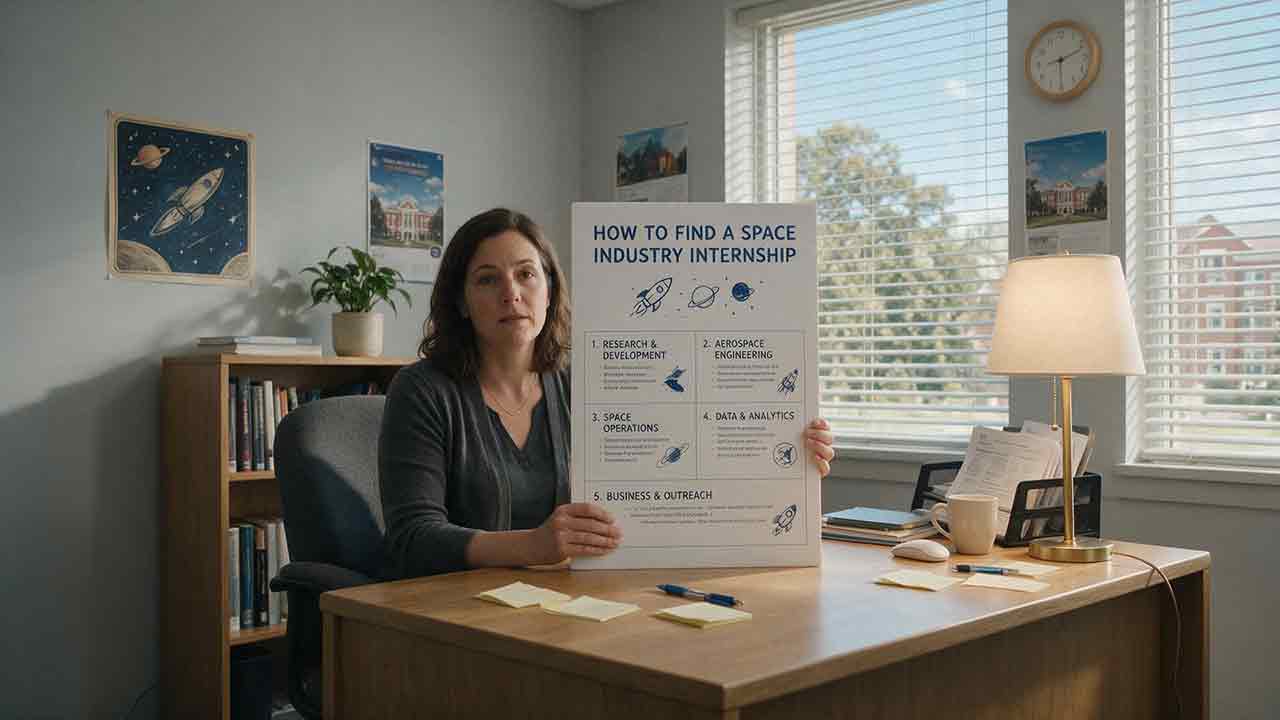
How to Find a Space Industry Internship
To find a space industry internship, search by job function and employer type rather than using only the word “space.” Build a target list spanning agencies, laboratories, spacecraft companies, suppliers, operators, research groups, and universities. Verify eligibility and deadlines on official pages, match each role to specific evidence, and track applications systematically instead of sending one generic résumé everywhere.
Key Takeaways
- Search for functions such as thermal, software, RF, robotics, data, test, finance, or communications—not only “space intern.”
- Track several opportunity channels because NASA, JPL, ESA, research programs, and private employers use different application systems.
- Check citizenship, enrollment, location, timing, and document requirements before spending hours on an application.
- Tailor evidence to the work described; a relevant calculation, project, test, or research example is stronger than a broad statement of enthusiasm.
- Diagnose the stage where your search is failing before changing your entire strategy.
This guide provides an original opportunity map, a five-gate application filter, a role-to-evidence method, a weekly search calculation, and a troubleshooting system for finding and applying to legitimate space-sector internships.
Where Should You Look for a Space Industry Internship?
Look across the full space economy, not only at space agencies or companies that build launch vehicles.
A space-related internship may involve spacecraft hardware, flight software, Earth-observation data, mission operations, communications, robotics, research, manufacturing, policy, finance, contracts, cybersecurity, or public engagement.
The role title may never use the word “space.”
The Space Internship Opportunity Map
| Employer layer | Examples of internship work | Search terms to try | Where opportunities usually appear |
|---|---|---|---|
| Government space agencies | Engineering, science, mission support, procurement, communications | student internship, Pathways, STEM engagement, student placement |
Official agency internship and career pages |
| Government research centers and laboratories | Research, instruments, computing, materials, controls, data | undergraduate research, laboratory internship, student researcher |
Official laboratory, agency, or program portals |
| Spacecraft and launch integrators | Systems, structures, propulsion, avionics, test, manufacturing | engineering intern, systems intern, test intern, manufacturing intern |
Employer career pages |
| Subsystem and component suppliers | Sensors, batteries, antennas, mechanisms, electronics, software | [subsystem] intern, product engineering intern, quality intern |
Supplier career pages and university recruiting portals |
| Satellite operators | Mission planning, ground systems, network operations, data products | mission operations intern, ground systems intern, network intern |
Operator career pages |
| Earth-observation and space-data companies | Remote sensing, geospatial analytics, machine learning, data engineering | geospatial intern, remote sensing intern, data science intern |
Employer career pages |
| Universities and observatories | Astronomy, planetary science, instrumentation, aerospace research | summer research, REU, research assistant, student researcher |
University, observatory, and funded-program pages |
| National laboratories | Computing, materials, detectors, energy systems, national-security research | laboratory internship, SULI, undergraduate researcher |
Official laboratory and federal program portals |
| Consulting and professional services | Program analysis, safety, cybersecurity, systems support, policy | aerospace analyst intern, systems engineering intern, space policy intern |
Employer career pages |
| Space-adjacent industries | Aviation, telecommunications, semiconductors, robotics, defense, weather | Role-specific terms without “space” | Employer and professional-society pages |
A student interested in satellite communications might find relevant work at a spacecraft manufacturer, antenna supplier, ground-network operator, telecommunications company, university laboratory, or government research center.
Which Official Internship Programs Should You Track?
Track programs that match your location, citizenship, academic level, and career goal. Their rules are not interchangeable.
The following comparison reflects official information reviewed on August 1, 2026. Always follow the current vacancy or program page because dates, eligibility rules, and required materials can change.
| Program or channel | Main purpose | Important eligibility pattern | Application pattern |
|---|---|---|---|
| NASA OSTEM Internships | Short-term, project-based experience connected to NASA missions | Current NASA guidance requires U.S. citizenship, a qualifying college enrollment status, minimum age 16, and a 3.0 cumulative GPA | Opportunities are offered across spring, summer, and fall sessions through NASA’s internship system |
| NASA Pathways | Multi-semester federal employment and development with possible post-graduation conversion | Current requirements include U.S. citizenship, minimum age 16, at least half-time enrollment, a degree or certificate program, a 2.9 cumulative GPA, and sufficient time to complete required work hours | Vacancies open during defined application windows and are posted through NASA and USAJOBS |
| JPL Internship Programs | STEM research and mission-project experience at NASA’s Jet Propulsion Laboratory | Requirements vary by program; the current summer program is for qualifying undergraduate and graduate STEM students and requires a minimum 3.0 GPA | Students apply to the relevant JPL program; mentors may search eligible applications and interview finalists |
| ESA Student Internships | Three- to six-month placements across technical and nontechnical ESA domains | Applicants must maintain student status and meet the nationality conditions listed in the vacancy; ESA prefers students in the final or second-to-last year of a master’s-level course | ESA normally publishes internship opportunities in November for approximately one month |
| NSF Research Experiences for Undergraduates | Intensive undergraduate research at universities, laboratories, observatories, and other research sites | NSF-supported participants must generally be undergraduates who are U.S. citizens, U.S. nationals, or permanent residents; individual sites may add criteria | Students apply directly to individual REU Sites or investigators rather than to NSF itself |
| DOE Science Undergraduate Laboratory Internships | Research experience at participating U.S. Department of Energy laboratories and facilities | Open to qualifying current undergraduates and some recent graduates; detailed academic, enrollment, citizenship, and program requirements apply | Applicants choose research interests and host facilities through the central SULI application |
| USAJOBS Student Opportunities | Federal internships across agencies, including technical and nontechnical roles | Students must meet the eligibility requirements in the specific announcement and hiring path | Use the Students hiring-path filter and review every announcement’s eligibility and document sections |
| USAJOBS Recent Graduate Opportunities | Developmental federal positions after completion of a qualifying program | The standard Recent Graduates window is generally two years after graduation, with a longer period for some veterans | Search using the Recent Graduates hiring-path filter |
As of August 1, 2026, NASA states that its International Internship (I2) program is not being offered. NASA still maintains an international internship information page describing the program’s participating-country structure, but students should not treat that page as an open application route. NASA says it will provide additional information if the program becomes available again.
JPL states that most of its internship programs require U.S. citizenship or lawful permanent resident status, while limited visiting-student research opportunities may use separate eligibility and funding rules. Read the program page rather than assuming that every JPL opportunity has the same requirements.
When Should You Begin Searching?
Begin building your opportunity list months before the expected internship period, but keep checking year-round.
Different programs follow different calendars. Commercial employers may post roles in batches, on a rolling basis, or only when a team receives hiring approval.
A Practical Annual Search Calendar
| Period | Useful actions |
|---|---|
| August–September | Prepare application materials; track spring programs, federal cycles, and laboratory opportunities |
| October–December | Monitor early summer postings, JPL programs, commercial employers, and ESA’s annual internship call |
| January–March | Apply to many summer research programs, NSF REU Sites, NASA summer opportunities, and later private-company postings |
| April–June | Watch for fall, academic-year, and year-round roles; prepare for interviews; continue applying to late-opening positions |
| July–August | Review results, improve project evidence, update target employers, and begin the next cycle early |
This is a planning pattern, not a universal schedule.
Current NASA Deadline Example
As of August 1, 2026, NASA lists these OSTEM application deadlines:
- Spring 2027: September 14, 2026
- Summer 2027: February 26, 2027
- Fall 2027: May 21, 2027
Use the current NASA internship page as the controlling source. A copied deadline in an old article, social post, or spreadsheet may no longer be reliable.
ESA states that its student internship opportunities are normally published in November and remain open for about one month. The NSF explains that most REU Sites operate in summer and commonly use January–March application deadlines, although each site controls its own schedule.
How Do You Search Without Missing Relevant Roles?
Build searches from job functions, systems, and outputs—not from industry branding alone.
Step 1: Search by Discipline
Examples:
mechanical engineering intern spacecraft
electrical engineering intern satellite
software engineering intern aerospace
thermal engineering intern
RF engineering intern satellite
robotics intern space
remote sensing intern
mission operations intern
Step 2: Search by Subsystem or Work Product
Examples:
avionics intern
flight software intern
propulsion test intern
guidance navigation control intern
ground systems intern
telemetry intern
satellite data intern
spacecraft structures intern
Step 3: Search by Employer Type
Examples:
national laboratory undergraduate internship
satellite operator student internship
aerospace supplier engineering intern
university space systems summer research
observatory undergraduate research
government Pathways engineering internship
Step 4: Search Alternative Program Labels
Useful labels include:
- Internship
- Co-op
- Student placement
- Student researcher
- Undergraduate researcher
- Summer research program
- Trainee
- Industrial placement
- Working student
- Student assistant
- Vacation program
- Pathways intern
A co-op may require a longer commitment than a summer internship. A research program may provide a stipend rather than wages. A “working student” role may be designed around part-time enrollment. Read the terms rather than treating these labels as synonyms.
Step 5: Search the Employer’s Official Site
A job board can help you discover an organization, but the official career page should be used to verify:
- Whether the role still exists
- Location
- Closing date
- Eligibility
- Compensation information
- Required documents
- Application channel
- Privacy terms
- Whether the listing is authentic
Do not send sensitive documents to an unverified email address or an unofficial application form.
How Can You Decide Which Internships Are Worth Applying To?
Use the following original five-gate filter.
The Five-Gate Internship Filter
An opportunity should pass all five gates before it receives substantial application time.
Gate 1: Formal Eligibility
Check:
- Citizenship or nationality
- Work authorization
- Enrollment status
- Degree level
- Major or field
- Graduation date
- Minimum age
- GPA
- Location
- Required availability
Failing a mandatory requirement is different from lacking a preferred qualification.
Gate 2: Work Content
Identify what the intern would actually do.
Look for:
- Technical tasks
- Research topic
- Software or hardware involved
- Expected deliverables
- Team or department
- Mission or product context
A famous employer does not automatically make an internship relevant.
Gate 3: Evidence Match
Find at least two pieces of evidence that connect you to the role:
- Course project
- Laboratory work
- Student team
- Research
- Personal project
- Employment
- Volunteer work
- Technical writing
- Relevant coursework
Enthusiasm is useful, but it should not be the only evidence.
Gate 4: Logistics
Confirm:
- Dates
- Weekly hours
- On-site, hybrid, or remote conditions
- Transportation
- Housing
- Travel support
- Compensation or stipend
- Academic credit
- Conflicts with courses or examinations
ESA, for example, states that its student internships are on-site, last three to six months, provide a monthly allowance, and leave accommodation, travel, and insurance responsibilities to the intern.
Gate 5: Learning Value
Ask whether the role offers:
- Defined work
- Technical mentorship
- Reviewable outputs
- Relevant tools or methods
- Exposure to interfaces
- A credible next step
- Skills transferable beyond one employer
A Simple Decision Rule
Apply when:
- Mandatory eligibility is satisfied.
- The work is meaningfully related to your target direction.
- You can provide relevant evidence.
- The logistics are feasible or can be resolved.
- The role offers useful technical or professional development.
Do not reject yourself merely because you lack every preferred qualification. Do not ignore an explicit mandatory requirement.
How Do Application Requirements Differ by Program?
The application system determines how your evidence must be presented.
A single résumé cannot be copied mechanically into every program.
| Application channel | Current material pattern | Important implication |
|---|---|---|
| NASA OSTEM | NASA’s FAQ states that applicants enter experience, skills, interests, and background into the application fields; a résumé upload and recommendation letters are not part of the standard application | Prepare concise, reusable evidence statements for form fields rather than relying on résumé formatting |
| NASA Pathways and other USAJOBS roles | USAJOBS currently requires a résumé of two pages or fewer, together with any transcript, questionnaire, eligibility evidence, and supporting documents specified in the announcement | Include enough detail to prove the required qualifications, but remain within the two-page limit; NASA states that longer Pathways résumés are automatically rejected |
| JPL Summer Internship Program | Current program guidance requests a résumé and unofficial transcript | Make the résumé technically specific and ensure transcript information is readable |
| ESA Student Internships | ESA requires a candidate profile, CV, and motivation letter; it limits applicants to a maximum of two internship vacancies in the call | Choose the strongest matches rather than applying indiscriminately |
| NSF REU Sites | Requirements vary; NSF notes that applications often request a résumé, interest statement, transcript, and reference letters | Read every site’s separate instructions and tailor the research-interest statement |
| DOE SULI | The central application includes profile fields, research interests, essays, transcripts, and two letters of support | Begin early enough for recommenders and remove prohibited personal identifiers from transcripts as instructed |
A federal résumé may require details such as employment dates, relevant duties, accomplishments, education, and hours worked per week, but those details must fit within the current USAJOBS two-page limit. Some announcements may explicitly request an accepted long-form CV or research résumé as a separate document; follow the exact instructions in the announcement’s How to Apply and Required Documents sections.
NASA’s current Pathways guidance also prohibits applicants from using artificial-intelligence or AI-assisted tools to draft application and assessment narrative responses. Applicants should create their own responses and follow the instructions in the current vacancy and agency application system.
The DOE SULI application currently requires applicants to redact Social Security numbers and full dates of birth from uploaded transcripts. This is a useful general reminder: submit only the personal information required by the official application system.
How Do You Match Your Evidence to a Role?
Use an evidence-to-role matrix before writing the application.
Evidence-to-Role Matrix
| Role requirement | Evidence you could use | What to explain |
|---|---|---|
| Python or data analysis | Research script, course project, personal data pipeline | Inputs, transformation, test, result, limitation |
| CAD or mechanical design | Student-team component, class assembly, personal design | Requirement, interface, drawing, tolerance, verification |
| Electronics | Laboratory circuit, embedded project, sensor integration | Power, signal, interface, fault behavior, measurement |
| Thermal analysis | Heat-transfer project, energy balance, simulation | Boundary conditions, assumptions, check, valid range |
| Controls or GNC | Controller, robotics project, dynamics simulation | Model, sensor input, actuator output, stability, test |
| RF or communications | Link-budget exercise, antenna project, network analysis | Data rate, losses, assumptions, margin, limitations |
| Research | Laboratory work, literature review, independent study | Question, method, data, result, uncertainty |
| Test engineering | Lab procedure, prototype test, automated test | Acceptance criteria, setup, anomaly, evidence |
| Mission operations | Robotics operations, observatory work, scheduling project | Procedure, telemetry, decision rule, recovery |
| Business or program support | Budget project, procurement analysis, event coordination | Stakeholder, constraints, process, measurable result |
For each application, select the evidence most closely related to the advertised work. Do not force a weak connection merely because a project has a space-themed title.
Convert tools and coursework into requirement-linked technical evidence by showing what you built, analyzed, tested, or verified and how that work relates to the target role.
What If You Have No Previous Space Experience?
Translate existing experience into relevant engineering or professional behavior without pretending it occurred in the space industry.
A robotics project may demonstrate:
- Sensors
- Embedded software
- State machines
- Control
- Integration
- Test
- Failure recovery
A weather-data project may demonstrate:
- Time-series processing
- Data quality
- Visualization
- Reproducibility
- Scientific interpretation
A Formula SAE, rocketry, drone, or engineering-design team may demonstrate:
- Interfaces
- Manufacturing
- Testing
- Configuration control
- Team coordination
- Safety practices
A retail, service, or administrative job may demonstrate:
- Reliability
- Scheduling
- Customer communication
- Documentation
- Process improvement
- Responsibility under time pressure
Use accurate language:
Built and tested a sensor-processing module for a university robotics project, including malformed-input handling and recorded test cases.
Do not write:
Developed flight-qualified autonomous navigation software.
Public-data and software projects can create relevant evidence without implying access to proprietary spacecraft programs; the strongest projects show clear inputs, methods, validation, and results.
Worked Example: Turning One Student Profile into a Search Plan
Consider a fictional second-year electrical-engineering student with:
- A microcontroller course project
- Basic Python
- A laboratory involving sensors
- No prior aerospace employment
- Availability for a summer internship
- A preference for satellite hardware or ground systems
Step 1: Define Two Role Families
Primary family:
- Avionics
- Electrical systems
- Integration and test
Secondary family:
- Ground systems
- Telemetry
- Test automation
Step 2: Build Search Terms
avionics engineering intern
electrical systems intern satellite
hardware test intern aerospace
telemetry software intern
ground systems engineering intern
embedded systems space internship
Step 3: Convert Existing Evidence
| Existing experience | Relevant evidence |
|---|---|
| Microcontroller project | Digital interfaces, timing, embedded programming |
| Sensor laboratory | Calibration, measurement, uncertainty, data collection |
| Python | Test automation, data parsing, plotting |
| Course teamwork | Interface coordination and documentation |
Step 4: Identify the Missing Proof
The student has not yet shown:
- Fault handling
- Version control
- A documented interface
- A repeatable test
A small improvement project could add:
- A defined sensor packet
- Input-range validation
- A saved test fixture
- A short interface diagram
- A Git repository
- A one-page verification note
The student does not need to build an entire satellite before applying.
Step 5: Apply Across Several Employer Layers
The search list could include:
- NASA or JPL programs, when eligible and currently available
- Satellite manufacturers
- Electronics and sensor suppliers
- Ground-station or communications companies
- University laboratories
- NSF REU Sites
- DOE laboratory programs
- Aviation, robotics, or semiconductor employers offering transferable work
This portfolio reduces dependence on a single famous organization.
How Many Applications Can You Prepare Well?
Estimate application capacity from available time rather than setting an arbitrary application count.
Consider a student with six hours per week for internship searching.
Planning assumptions:
- Opportunity discovery and verification: 1 hour
- Application tracking and document organization: 1 hour
- Role research and tailoring: 2 hours per application
Available tailoring time:
6 hours − 1 hour − 1 hour = 4 hours
Estimated weekly capacity:
4 hours ÷ 2 hours per tailored application = 2 applications
This is an editorial planning example, not an optimal universal rate.
A shorter application may require less time. A federal application, research statement, technical exercise, or recommendation process may require substantially more.
The useful question is not:
How many applications did I send?
It is:
How many eligible, relevant, complete applications did I submit through the correct channel?
How Should You Track Applications?
Use a spreadsheet or database with one row per opportunity.
Recommended fields:
| Field | Purpose |
|---|---|
| Employer | Identifies the organization |
| Role title | Preserves the exact title |
| Official link | Provides the controlling source |
| Employer type | Agency, laboratory, operator, supplier, university, or company |
| Role family | Software, thermal, GNC, data, business, and so on |
| Location | Supports logistics planning |
| Eligibility | Citizenship, enrollment, degree, GPA, or other gate |
| Deadline | Prevents missed submissions |
| Required materials | Résumé, transcript, essay, references, portfolio |
| Evidence selected | Records the projects used |
| Status | Researching, drafting, submitted, interview, closed |
| Follow-up date | Prevents unnecessary or premature contact |
| Result | Tracks response |
| Lesson | Supports later improvement |
Save a copy of the vacancy text or a personal summary when permitted. Public postings can disappear after closing.
Do not store passwords, identity documents, Social Security numbers, passport details, or other unnecessary sensitive data in an ordinary tracking spreadsheet.
Does Networking Help You Find Internships?
Networking is most useful for learning how work is organized, discovering appropriate search terms, and understanding application routes—not for bypassing formal requirements.
Useful contacts include:
- Faculty
- Laboratory supervisors
- Student-team advisers
- Alumni
- Career-center staff
- Professional-society members
- Conference presenters
- Employees at official recruiting events
Ask focused questions:
- Which entry-level job titles does this team use?
- Which skills are most important for this type of work?
- Does the organization recruit through a central internship program or separate vacancies?
- Which public projects would demonstrate relevant preparation?
- When are student opportunities normally posted?
A concise outreach message could be:
Hello [Name],
I am a [year/degree] student exploring [specific area]. Your work on [public topic] helped me understand how [specific technical issue] fits into the broader mission.
I am not asking you to review an application. Could you tell me which internship or student-role titles are most relevant to someone preparing for [target work]?
Thank you for your time,
[Name]
Do not request confidential project details, internal candidate information, or a referral from someone who does not know your work.
How Can You Tell Whether an Internship Listing Is Legitimate?
Verify the employer, domain, application process, and communication channel before sharing documents.
Warning signs include:
- An offer without a meaningful application or interview
- A request to pay for equipment, training, or access
- A request to deposit a check and return money
- Communication only through a personal messaging account
- A sender domain unrelated to the employer
- A request for banking or identity information before a legitimate hiring stage
- A role absent from the employer’s official careers site
- Pressure to act immediately without written terms
- An application form hosted on an unexplained domain
A legitimate employer may use an external applicant-tracking system. Confirm that the official employer site links to it.
Report suspected impersonation through the employer’s official security or recruiting contact and the appropriate consumer-protection or law-enforcement channel in your jurisdiction.
What Should International Students Do Differently?
Start with programs and employers whose published eligibility matches your status, and verify requirements through official sources.
Do not assume that:
- Every U.S. space role requires citizenship
- Every private employer can sponsor every student
- Enrollment in a country automatically satisfies an agency’s nationality rule
- A remote internship removes work-authorization requirements
- A public research project is free from export-control or access restrictions
- A page describing a historical or paused program means applications are open
Practical steps include:
- Read the official eligibility section.
- Confirm that the program is currently accepting applications.
- Check work-location requirements.
- Consult the university’s international-student or immigration office.
- Ask the employer’s authorized recruiting contact about application eligibility.
- Keep agency, employer, nationality, and visa rules separate.
- Maintain a wider target list that includes research, software, data, telecommunications, robotics, and commercial roles.
ESA bases internship eligibility on citizenship in specified participating countries, not merely residence or university location. NASA OSTEM and Pathways currently require U.S. citizenship, and NASA states that its International Internship (I2) program is not being offered as of August 1, 2026. JPL’s rules vary by program, with most programs requiring U.S. citizenship or lawful permanent resident status and limited visiting-research routes using separate conditions.
This article cannot determine an individual’s immigration, export-control, or employment eligibility.
What Common Mistakes Reduce Internship Search Results?
Searching Only for “Space Internship”
This misses roles titled:
- Software engineering intern
- Thermal analyst intern
- RF intern
- Test engineering intern
- Geospatial intern
- Research assistant
- Product-assurance intern
Search by function.
Applying Only to Famous Organizations
A narrow employer list creates unnecessary dependence on highly visible programs.
Include suppliers, laboratories, operators, research groups, and adjacent industries.
Ignoring Mandatory Eligibility
A strong résumé cannot replace a citizenship, enrollment, or degree-level requirement stated by the program.
Use the five-gate filter first.
Treating Every Application the Same
NASA OSTEM form fields, USAJOBS documents, ESA motivation letters, JPL résumés, and REU research statements require different forms of tailoring.
Adapt to the channel.
Ignoring Platform-Specific Résumé Limits
A detailed federal résumé still has to comply with the current USAJOBS two-page limit unless an announcement explicitly requests an accepted long-form document.
Do not upload an older multi-page federal résumé without checking current requirements.
Using Prohibited Assistance
Some programs restrict the use of AI or other outside assistance in application and assessment responses.
NASA’s current Pathways guidance prohibits AI-assisted drafting of narrative responses. Follow the instructions of each application system and submit your own work.
Writing Only About Passion
Statements such as “I have always loved space” do not show how you can contribute.
Connect motivation to evidence and the advertised work.
Waiting for a Perfect Portfolio
A student can apply while improving project evidence.
Do not delay every application until an ambitious project is complete.
Claiming Team Work as Individual Work
State what the team achieved and what you personally contributed.
When presenting team projects, identify your own responsibilities, decisions, and outputs without obscuring ownership or team boundaries.
Sending Unrequested Attachments
Do not email code archives, transcripts, identity documents, or technical files unless the official process requests them.
Publishing Restricted Material
Do not use employer-owned, sponsor-restricted, proprietary, export-controlled, classified, personal, or unreleased material as application evidence without formal authorization.
How Can You Troubleshoot an Internship Search?
Use the point of failure to decide what to change.
The Internship Funnel Diagnostic
| Symptom | Likely problem | Practical correction |
|---|---|---|
| You find almost no openings | Search language or employer range is too narrow | Add function terms, supplier categories, research programs, and adjacent industries |
| Most roles are ineligible | Eligibility is checked too late | Filter citizenship, enrollment, degree level, location, and dates before tailoring |
| You save roles but miss deadlines | Tracking system is weak | Record deadlines and review the tracker on a fixed schedule |
| Applications are rejected before review | Required documents, résumé length, or form fields may be noncompliant | Recheck submission instructions, page limits, and confirmation status |
| You receive no interviews | Evidence may not match the advertised work | Build an evidence-to-role matrix and revise the first third of the résumé |
| You get interviews but no offers | Technical explanations or project ownership may be unclear | Practice role-specific questions and evidence-based project stories |
| You reach final stages but cannot accept | Logistics were evaluated too late | Check dates, housing, travel, work location, and compensation before applying |
| One employer dominates your tracker | Target list is too concentrated | Set minimum employer-type diversity |
| Applications take too long | Each application is being rebuilt from zero | Maintain a verified evidence bank and reusable source documents |
| You cannot use your strongest project | Publication or ownership is restricted | Create a new public project using independent inputs |
A lack of response does not identify one certain cause. Use several applications and consistent records before drawing conclusions.
Space Industry Internship Search Checklist
Target Definition
- I have selected two or three role families.
- I can name the technical or professional work I want to practice.
- I have identified several employer types.
- My search does not depend on one organization.
Opportunity Discovery
- I search by function, subsystem, and program label.
- I check official employer career pages.
- I track NASA, JPL, ESA, federal, research, or laboratory programs relevant to my eligibility.
- I confirm that every program is currently open or has a stated future cycle.
- I use university and faculty sources where appropriate.
- I verify that listings remain active.
Eligibility and Logistics
- Citizenship or nationality requirements are understood.
- Enrollment and degree-level requirements are satisfied.
- Dates and weekly hours are feasible.
- Location, travel, housing, and compensation have been considered.
- The official posting controls my decision.
Application Evidence
- I can connect at least two experiences to the role.
- My contribution to team projects is explicit.
- Technical claims include methods or results.
- I do not claim experience I do not have.
- Restricted information is absent.
Submission Quality
- The required document format is correct.
- A USAJOBS résumé is no longer than two pages unless the announcement explicitly requests another accepted format.
- Every required question is answered.
- Transcripts and documents are readable.
- Personal identifiers have been removed where instructed.
- I have followed any restriction on AI or outside assistance.
- Recommenders have enough notice.
- I received or recorded submission confirmation.
Tracking and Improvement
- Every application is in one tracker.
- Closing dates and follow-up dates are recorded.
- I review outcomes by funnel stage.
- I update search terms when discovery is weak.
- I update evidence when interview conversion is weak.
- I continue searching after submitting a preferred application.
What Should Different Applicants Do Next?
- High-school student: look for local university programs, observatories, robotics, coding, research exposure, and agency programs specifically open to your age group.
- First- or second-year undergraduate: build foundational evidence through laboratories, student teams, faculty research, and broad technical internships.
- Upper-level undergraduate: target subsystem, software, test, research, and Pathways roles that match completed coursework.
- Graduate student: prioritize research alignment, advanced technical work, laboratory programs, and roles requiring deeper specialization.
- Recent graduate: search both internship programs that accept recent graduates and entry-level or Pathways Recent Graduates positions.
- International student: build a country-specific eligibility map, distinguish active programs from paused ones, and consult official university and employer resources.
- Non-STEM student: search space organizations for finance, communications, law, procurement, human resources, program support, policy, and business roles.
- Career changer: translate existing engineering, software, manufacturing, data, operations, or project experience into space-relevant functions without relabeling past work as aerospace experience.
What Should You Do This Week?
Complete these six actions:
- Choose two target role families.
- List at least five employer types.
- Create ten function-based search queries.
- Add relevant, currently available official programs to a deadline tracker.
- Build an evidence-to-role table for one opportunity.
- Submit one complete, eligible, carefully tailored application.
The most effective internship search is not a hunt for one perfect posting. It is a controlled process that repeatedly connects legitimate opportunities with accurate evidence.
Frequently Asked Questions
Is NASA the Best Place to Start a Space Internship Search?
NASA is an important source, but it should not be the only one. JPL, ESA, national laboratories, universities, observatories, spacecraft companies, satellite operators, suppliers, and adjacent technical industries can all provide relevant experience.
Can I Apply for a Space Internship Without an Aerospace Major?
Yes, when the program accepts your field and your evidence matches the work. Space organizations use mechanical, electrical, software, computer, materials, physics, mathematics, geospatial, business, communications, law, finance, and other disciplines.
Should I Apply if I Do Not Meet Every Preferred Qualification?
You may still be competitive if you meet the mandatory requirements and can demonstrate relevant evidence. Do not ignore an explicit requirement involving citizenship, enrollment, degree level, location, or availability.
Are Research Programs the Same as Company Internships?
No. Research programs may focus on a defined investigation, faculty mentorship, and academic outputs. Company internships may focus more directly on products, services, operations, or organizational deliverables. Both can produce valuable evidence.
Do I Need a Space-Themed Personal Project?
No. A well-documented robotics, software, electronics, thermal, data, manufacturing, or research project can demonstrate relevant skills. The connection should be based on the work performed rather than decorative space branding.
How Long Should I Continue Applying?
Continue until you have accepted a suitable written offer or the relevant application season has ended. Do not stop searching because one application appears promising, and follow any withdrawal obligations after accepting an offer.
Sources
The sources below support the current program, eligibility, application, timing, résumé, and privacy guidance in this article. The Space Internship Opportunity Map, Five-Gate Internship Filter, Evidence-to-Role Matrix, weekly-capacity calculation, and Internship Funnel Diagnostic are original editorial tools.
- NASA Internship Programs
- NASA Internship Frequently Asked Questions
- NASA Pathways Internships
- NASA International Internship Opportunities
- NASA Post-Secondary Student Hiring Path
- NASA Careers: How to Apply and Work With NASA
- JPL Internship Programs
- JPL Internship Overview
- JPL Summer Internship Program
- JPL Internship Frequently Asked Questions
- JPL Visiting Student Research Program
- European Space Agency Student Internships
- ESA Student Internship Frequently Asked Questions
- NSF Research Experiences for Undergraduates: Student Information
- NSF Research Experiences for Undergraduates
- DOE Science Undergraduate Laboratory Internships
- DOE SULI Eligibility
- DOE SULI Application Guidance
- DOE SULI Application Selection Process
- USAJOBS Student Opportunities
- USAJOBS Recent Graduate Opportunities
- USAJOBS Pathways Program Search Guidance
- USAJOBS Federal Internship Frequently Asked Questions
- USAJOBS: How to Write a Résumé for a Federal Job
- USAJOBS: Required Application Documents
More from Internships, Employers & Job Search
A Guide to Space Industry Employers and the Roles They Hire For
This guide maps the main types of space industry employers to the roles, outputs, customers, and constraints that define their work. It covers government agencies, intergovernmental organizations, research centers, space-relevant national laboratories, prime manufacturers, suppliers, launch providers, satellite operators, data companies, ground-system firms, contractors, universities, and professional-service organizations. Original tools include the Space Employer Output Map, ORBIT Employer Fit Test, Employer-Role Search Coverage calculation, and a worked geospatial career example. Readers learn why the same job title can mean different responsibilities across employer models, how to verify the legal employer, how to evaluate decision authority and contract conditions, and how to build a focused target list. The article also includes role comparisons, employer-type tradeoffs, eligibility guidance, troubleshooting advice, and a detailed research checklist.

How to Get a Space Industry Job With No Previous Aerospace Experience
This guide explains how to enter the space industry without previous aerospace employment by identifying transferable tasks, choosing realistic entry roles, and building evidence for the constraints that are genuinely new. It introduces the Aerospace Entry Distance Ladder, CLEAR Transfer Test, and Five-Part Bridge Project Standard to help readers distinguish direct task transfer, domain learning, evidence gaps, and formal eligibility barriers. A detailed industrial-automation example shows how test, software, instrumentation, and failure-analysis experience can be translated into spacecraft integration and test without exaggerating authority. The article also covers federal qualifications, contractors, internships, public data, NASA software release categories, résumé wording, interviews, networking, education choices, citizenship, clearance, export controls, and disclosure safety. Readers receive a decision tree, troubleshooting table, candidate-specific recommendations, and a final checklist for planning an accurate, legally safer career transition.
Government vs Commercial Space Careers
This guide compares government, contractor, and commercial space careers through the factors that most affect real career decisions: mission, legal employer, decision authority, technical work, pay structure, benefits, continuity risk, eligibility, publication rights, and long-term mobility. Original tools include the Three-Lane Space Career Model, Decision-Authority Test, Continuity Stack, SPACE Career Fit Matrix, and an offer-normalization worksheet. Worked examples show how to compare federal and commercial compensation while keeping guaranteed cash, target bonuses, estimated benefits, and equity separate. The article also explains contractor authority limits, citizenship, security clearance, export-control access, intellectual property, post-government ethics, and sector-to-sector skill translation. Readers receive interview questions, troubleshooting guidance, candidate-specific recommendations, and a detailed checklist for evaluating actual roles instead of relying on stereotypes about government stability or commercial speed.
Explore More Topics
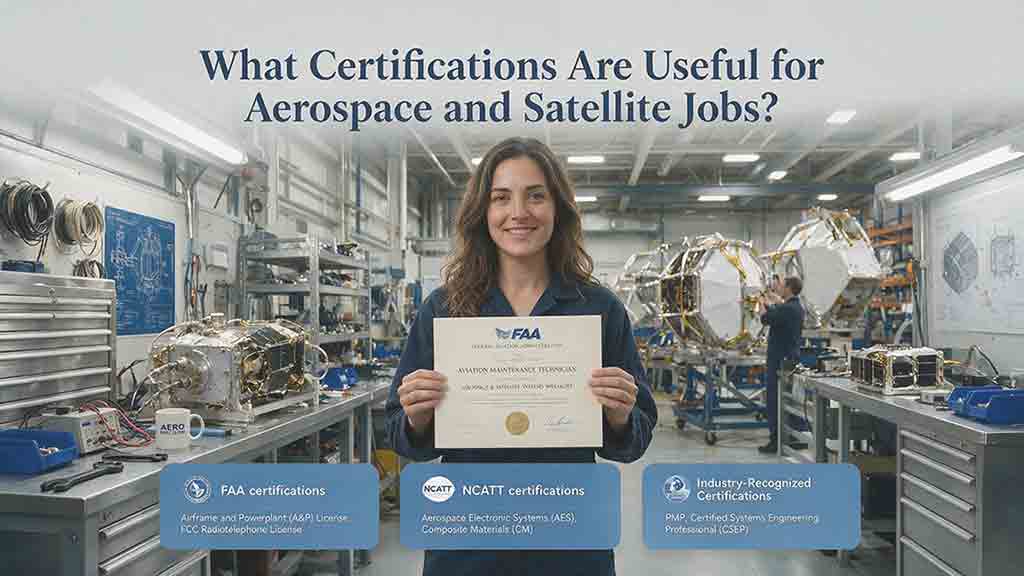
What Certifications Are Useful for Aerospace and Satellite Jobs?
This guide helps students and professionals identify which certifications are genuinely useful for aerospace and satellite jobs. It maps INCOSE, IPC, ASQ, PMI, ISC2, AWS, NCEES, FAA, AS9100-related training, and IAQG auditor authentication to specific work such as systems engineering, electronics assembly, quality, reliability, project leadership, cybersecurity, cloud infrastructure, licensure, and regulated aviation activities. The article clearly distinguishes professional certification, course completion, organizational AS9100 certification, auditor training, IAQG authentication, government certificates, licenses, and security clearances. Original tools—including the Credential Gate Test, Certification Utility Score, One-Gate Rule, Credential Commitment Ledger, employer-demand audit, and a 30-day decision plan—help readers compare role alignment, eligibility, evidence value, portability, maintenance, and rule-change exposure. It also explains the 2026 IAQG transition, PMI’s announced PMP training-provider change, renewal burdens, accurate résumé wording, and why no credential guarantees employment, salary, professional authority, or access.

Online Courses That Can Help You Prepare for a Space Career
This guide helps students and career changers choose online courses that support a specific space-career goal rather than collecting unrelated certificates. It compares NASA, MIT OpenCourseWare, Harvard CS50, University of Colorado Boulder, EPFLx, and other official resources across programming, remote sensing, spacecraft dynamics, mission design, systems engineering, signal processing, and research practice. The article clearly separates free course materials, completion certificates, CS50 Certificates, edX verified certificates, Coursera Career Certificates, university credit, professional certification, and professional licenses. Original tools—including the Role-to-Course Evidence Chain, Course Utility Score, Four-Layer Learning Stack, Evidence Conversion Protocol, and a 12-week study plan—show readers how to identify a skill gap, select a suitable course, build an inspectable project, verify results, and state limitations honestly. It also explains ARSET certificate eligibility, course-age limits, academic-integrity rules, publication safety, and why coursework cannot replace required degrees, supervised experience, work authorization, or professional authority.

Do You Need a Master’s Degree to Work in Space Technology?
This guide explains when a master’s degree is required, preferred, optional, or unnecessary for space-technology careers. It compares bachelor’s-, associate-, master’s-, and doctoral-level entry routes across engineering, software, hardware, analysis, research, project work, writing, and technical operations. Readers learn how to distinguish an absolute degree requirement from a stated preference or an education-and-experience substitution. Original tools—including the Master’s Necessity Ladder, Master’s Pressure Index, Role-Gap Ledger, Replacement Test, and Graduate Commitment Ledger—help applicants audit job postings, identify whether their real gap is knowledge, evidence, experience, or credentials, and make hidden costs visible. A fictional spacecraft thermal-analysis example demonstrates the calculation process without presenting it as a hiring probability. The article also compares graduate-program formats, explains NASA and astronaut exceptions, addresses accreditation and licensure, and separates education from work authorization, export controls, and security-clearance requirements.