How to Write a Resume for an Aerospace Job

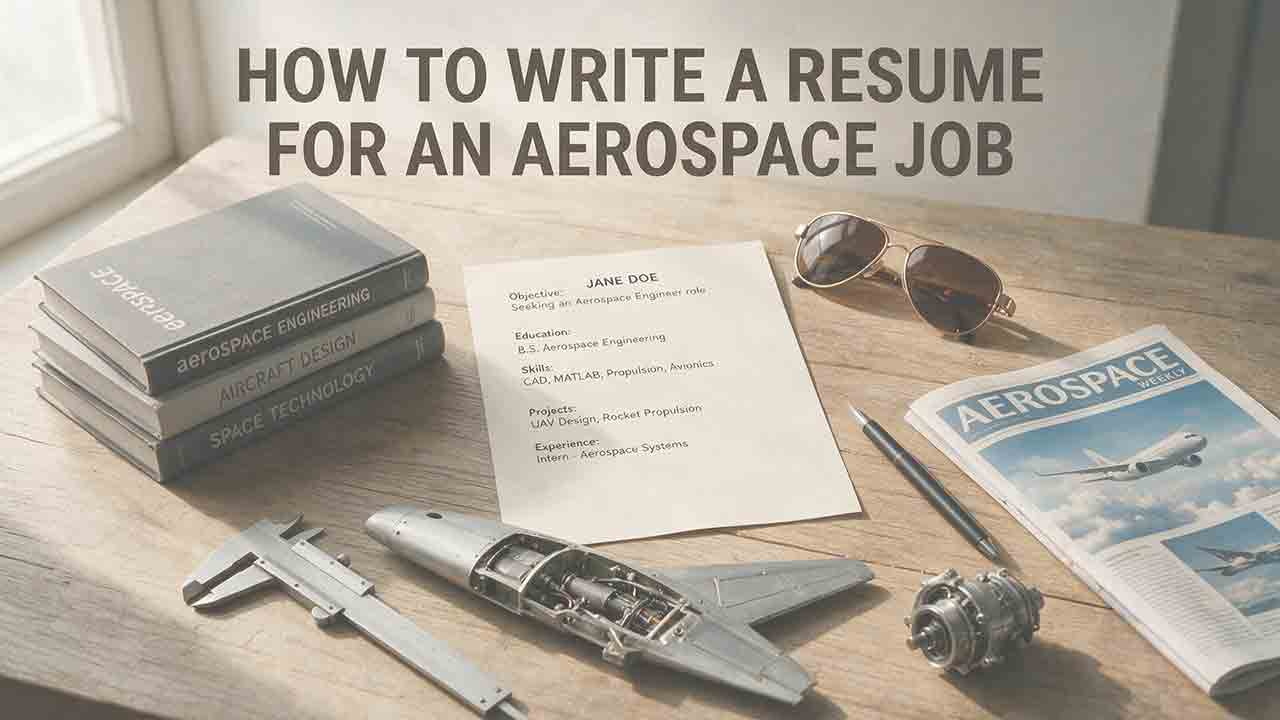
How to Write a Resume for an Aerospace Job
Write an aerospace resume by matching the job’s requirements to evidence you can defend: calculations, designs, code, tests, research, manufacturing work, technical reports, or operational results. Make personal ownership clear, identify the engineering method, and state outcomes without exaggeration. Use a concise private-sector format or the current federal format required by the vacancy, then verify every claim before submitting.
Key Takeaways
- Tailor the résumé to the work described, not merely to the employer’s aerospace branding.
- Show technical evidence through projects, tests, calculations, software, drawings, research, and documented decisions.
- A strong bullet establishes relevance, personal ownership, and a result that can be explained or verified.
- Use numbers only when they are accurate, meaningful, and based on a defensible comparison.
- Follow the application channel’s current rules; USAJOBS and NASA Pathways have requirements that differ from many private-sector applications.
This guide explains how to select aerospace-relevant evidence, organize the document, write stronger technical bullets, compare private and federal formats, handle limited experience, and troubleshoot a résumé that is not producing interviews.
What Must an Aerospace Resume Prove?
An aerospace resume should prove that you can contribute to the specific work described in the vacancy.
Aerospace engineering includes more than vehicle design. The U.S. Department of Labor’s updated 2026 O*NET profile for aerospace engineers includes activities such as:
- Developing mathematical or computer models
- Planning and conducting tests
- Creating conceptual designs
- Investigating technical problems
- Evaluating designs against requirements or standards
- Writing technical documentation
- Developing aerospace software
- Analyzing feasibility, cost, manufacturing, or production time
A résumé does not need to cover all of those activities. It should make the candidate’s relevant subset visible.
Five Questions a Reviewer Should Be Able to Answer
After reading the résumé, a reviewer should understand:
- Which aerospace role is this candidate prepared for?
- What technical work has the candidate personally performed?
- Which tools, methods, and engineering principles were applied?
- What result, artifact, or verification evidence exists?
- Where does the candidate’s experience stop?
The fifth question matters. A student simulation is not flight qualification. A course project is not professional certification. A team result is not automatically an individual achievement.
Should an Aerospace Resume Be One Page or Two Pages?
The correct length depends on the application channel, career stage, and instructions in the vacancy.
There is no universal aerospace résumé length.
| Application type | Practical format | Important limitation |
|---|---|---|
| Private-sector student or early-career role | One page is often the clearest starting point | Do not remove important technical evidence merely to satisfy an arbitrary rule |
| Experienced private-sector role | One or two pages may be appropriate | Relevance matters more than preserving every past position |
| Research or academic position | A résumé or longer curriculum vitae may be requested | Follow the requested document type rather than submitting both without permission |
| USAJOBS federal vacancy | Résumé of two pages or fewer | USAJOBS currently does not accept résumés longer than two pages |
| NASA Pathways vacancy | Résumé of two pages or fewer through USAJOBS | NASA states that longer Pathways résumés are automatically rejected |
The Massachusetts Institute of Technology’s résumé guidance recommends one page for many students and early-career applicants unless the candidate has extensive experience or an advanced degree. That is career guidance, not a legal or industry-wide rule.
As of August 1, 2026, USAJOBS requires federal résumés to be two pages or fewer. Its system will not save or upload a longer résumé. NASA repeats this limit in its current Pathways guidance.
How Do You Tailor a Resume to an Aerospace Job Description?
Translate the vacancy into a list of required evidence before editing the résumé.
Do not begin by changing colors, fonts, or the professional summary. Begin with the work.
Step 1: Identify the Role Family
Examples include:
- Structures
- Thermal engineering
- Propulsion
- Aerodynamics
- Guidance, navigation, and control
- Avionics
- Flight software
- Satellite systems engineering
- Communications
- Manufacturing
- Quality
- Integration and test
- Mission operations
- Data engineering
- Program support
A résumé for a thermal-analysis role should not allocate the same space as one for embedded flight software.
Step 2: Extract the Work Verbs
Look for verbs such as:
- Analyze
- Design
- Develop
- Model
- Simulate
- Integrate
- Test
- Verify
- Validate
- Manufacture
- Inspect
- Troubleshoot
- Document
- Present
- Coordinate
Each verb points toward a type of evidence.
For example:
| Vacancy verb | Evidence to show |
|---|---|
| Analyze | Calculation, model, assumptions, sensitivity, or conclusion |
| Design | Requirement, alternatives, drawing, interface, or trade decision |
| Develop | Code, hardware, method, process, or technical document |
| Integrate | Interface, configuration, compatibility test, or discrepancy resolution |
| Test | Procedure, instrumentation, acceptance criteria, result, or anomaly |
| Verify | Hand check, test, inspection, benchmark, or traceability record |
| Troubleshoot | Observed failure, diagnostic method, root cause, and corrective action |
| Document | Report, procedure, drawing, requirement, or review package |
Step 3: Separate Mandatory and Preferred Qualifications
A mandatory qualification may determine whether the application can proceed. A preferred qualification can guide prioritization without automatically disqualifying the candidate.
Examples of mandatory conditions may include:
- Degree or field
- Graduation date
- Work authorization
- Citizenship
- Location
- Availability
- Required certification
- Required clearance
- Minimum experience
Do not claim that a preferred tool is mandatory unless the posting says so.
Step 4: Build a Job-to-Evidence Grid
| Job requirement | Your evidence | Where it belongs |
|---|---|---|
| MATLAB or Python analysis | Flight-dynamics or data-analysis project | Project bullet and skills section |
| Mechanical design | CAD assembly with interface drawing | Project or experience section |
| Environmental testing | Laboratory vibration or thermal test | Experience bullet |
| Technical writing | Design report or test procedure | Experience or projects |
| Team integration | Student vehicle or robotics project | Project bullet |
| Requirements work | Requirement and verification matrix | Systems project |
| Failure investigation | Sensor, software, or test anomaly | Experience bullet |
| Manufacturing | Drawing release, machining, assembly, inspection | Experience or project section |
A relevant project should outrank an unrelated job simply because the unrelated job was paid.
What Is the ROV Resume Evidence Test?
Use the following original editorial framework to assess each technical bullet.
R — Relevance
Does the bullet connect to the target job?
O — Ownership
Does the bullet make your personal contribution clear?
V — Verifiability
Does the bullet contain an artifact, method, result, check, or defensible outcome?
Score each dimension from 0 to 2.
| Score | Relevance | Ownership | Verifiability |
|---|---|---|---|
| 0 | Unrelated or unclear | Personal contribution is absent | No evidence or result |
| 1 | Generally related | Contribution is partly clear | Output is named but not supported |
| 2 | Directly matches the target work | Personal action is explicit | Method, artifact, result, or check is clear |
A maximum score of six does not predict employer decisions. It is a revision tool for detecting weak bullets.
Example 1: Weak Project Bullet
Worked on a CubeSat project with a multidisciplinary team.
ROV assessment:
- Relevance: 1
- Ownership: 0
- Verifiability: 0
- Total: 1/6
The reader does not know what the candidate did.
Example 2: Improved Project Bullet
Developed a Python power-budget model for six spacecraft operating modes, documented load assumptions, and compared predicted eclipse energy use with the team’s battery allocation.
ROV assessment:
- Relevance: 2
- Ownership: 2
- Verifiability: 2
- Total: 6/6
The stronger bullet identifies:
- The engineering domain
- The candidate’s action
- The tool
- The scope
- The artifact
- The comparison
It does not claim that the model was flight-validated or that the candidate designed the entire electrical power system.
How Should You Structure an Aerospace Resume?
Lead with the sections that provide the strongest evidence for the target role.
Recommended Order for a Student or Recent Graduate
- Contact information
- Education
- Technical skills
- Relevant experience
- Technical projects
- Research, leadership, publications, or activities
Projects may appear before work experience when the projects are more relevant.
Recommended Order for an Experienced Engineer
- Contact information
- Optional targeted summary
- Technical experience
- Selected projects or programs
- Technical skills
- Education
- Certifications, publications, or patents when relevant
Recommended Order for a Research-Focused Candidate
- Contact information
- Education
- Research experience
- Technical skills
- Publications or presentations
- Selected projects
- Teaching, leadership, or professional service
The order should answer the vacancy’s most important question as early as possible.
What Contact Information Should You Include?
Include:
- Full professional name
- Current phone number
- Professional email address
- City and state, region, or country when useful
- Portfolio, GitHub, publication profile, or professional website when relevant
A full residential address is usually unnecessary unless the application requires it.
Do not place the following in a U.S. federal résumé or USAJOBS profile:
- Social Security number
- Photograph
- Age
- Sex
- Religious affiliation
- Classified information
- Government-sensitive information
USAJOBS explicitly instructs applicants to omit those categories.
Do not state that you hold a security clearance, citizenship, certification, license, or work authorization that you do not hold.
Should You Add a Professional Summary?
Use a summary only when it adds role-specific information that is not already obvious.
A summary can help when:
- You are changing industries.
- You have substantial experience.
- Your strongest qualifications span several positions.
- The target role is highly specialized.
- You need to clarify your engineering focus.
Weak:
Passionate aerospace engineer seeking a challenging position where I can use my skills.
Stronger:
Mechanical engineer with experience in structural analysis, environmental testing, and test-data automation for small electromechanical systems.
The stronger summary defines scope without making unsupported claims.
A student with a clear degree, project section, and targeted skills section may not need a summary.
How Should You Write the Education Section?
Include:
- Institution
- Degree
- Major
- Graduation date or expected graduation date
- GPA when required, requested, or beneficial
- Relevant concentration, minor, or certificate
- Selected coursework only when it adds evidence
When Is Relevant Coursework Useful?
Relevant coursework is useful when:
- The candidate has limited project experience.
- The role requires a specialized topic.
- The course title clarifies technical preparation.
- The posting explicitly requests academic background.
Examples:
- Orbital Mechanics
- Compressible Flow
- Spacecraft Dynamics
- Heat Transfer
- Control Systems
- Embedded Systems
- Structural Mechanics
- Digital Signal Processing
- Remote Sensing
- Numerical Methods
Do not fill half a page with standard courses that are already implied by the degree.
How Should You Handle GPA?
Follow the application instructions.
Do not:
- Round a GPA misleadingly
- Combine major and cumulative GPA without labels
- Present a projected GPA as completed
- Omit a required GPA field from an official application
Use labels such as:
Cumulative GPA: 3.42/4.00
Major GPA: 3.67/4.00
Include only accurate values that match the transcript or institutional record.
How Should You Write an Aerospace Technical Skills Section?
Organize technical skills by category and list only skills you can discuss.
Possible categories include:
| Category | Examples |
|---|---|
| Programming | Python, C, C++, MATLAB, SQL |
| Analysis and simulation | Simulink, finite-element analysis, computational fluid dynamics, orbital analysis |
| Mechanical design | CAD, drawings, tolerance analysis, configuration management |
| Electronics and embedded systems | Microcontrollers, digital interfaces, instrumentation, circuit analysis |
| Testing | Data acquisition, calibration, environmental testing, automated test |
| Data and computing | Linux, Git, databases, data visualization |
| Systems engineering | Requirements, interfaces, trade studies, verification matrices |
| Manufacturing | Machining, additive manufacturing, composite fabrication, inspection |
| Laboratory | Oscilloscopes, multimeters, sensors, vacuum equipment, optical instruments |
The 2026 ONET profile includes software categories spanning scientific analysis, CAD, development environments, requirements tools, configuration management, spreadsheets, and operating systems. ONET’s 2025 U.S. employer-posting data also identifies tools such as MATLAB, Python, C++, Excel, SolidWorks, Simulink, AutoCAD, C, and CATIA in aerospace-engineer postings.
That list is not a universal hiring ranking. A thermal role, manufacturing role, software role, and flight-test role require different evidence.
Avoid Unsupported Proficiency Labels
Terms such as these are difficult to interpret:
- Expert
- Advanced
- Proficient
- Familiar
- Basic
When possible, let the experience section demonstrate skill depth.
Instead of:
Python — Expert
use:
Programming: Python, C++
Data and tools: NumPy, pandas, Git, Linux
Then show how Python was used in a project or job.
How Do You Write Strong Technical Resume Bullets?
A technical bullet should identify the action, engineering object, method, and defensible outcome.
A useful structure is:
action + technical object + method or constraint + result or verification
Structures Example
Weak:
Helped with structural analysis.
Stronger:
Analyzed two aluminum bracket concepts under assigned static load cases, compared hand calculations with finite-element trends, and documented boundary-condition limitations.
Software Example
Weak:
Wrote Python scripts for satellite data.
Stronger:
Built a Python pipeline to parse timestamped telemetry files, flag malformed records, and generate repeatable subsystem summaries from versioned test fixtures.
Thermal Example
Weak:
Used thermal software to simulate a spacecraft.
Stronger:
Created a steady-state thermal model for an electronics enclosure, documented contact and radiation assumptions, and checked the predicted temperature trend with an independent energy balance.
Test Example
Weak:
Assisted with vibration testing.
Stronger:
Prepared instrumentation checks and post-test data plots for a vibration test, recorded the as-tested configuration, and identified a sensor-channel discontinuity for follow-up review.
Manufacturing Example
Weak:
Manufactured aerospace parts.
Stronger:
Produced and inspected machined student-vehicle components from released drawings, recording dimensional results and nonconforming features before assembly.
Systems Engineering Example
Weak:
Worked on requirements.
Stronger:
Converted stakeholder needs into 14 draft subsystem requirements and linked each requirement to a planned test, analysis, inspection, or demonstration method.
Do not use a more impressive verb than the work supports. “Supported,” “contributed,” and “assisted” are appropriate when they accurately describe ownership.
How Can You Quantify Results Without Inventing Metrics?
Use numbers that describe real scale, performance, comparison, or output.
Useful metrics may include:
- Number of test cases
- Number of operating modes
- Number of components or interfaces
- Data volume
- Runtime
- Error rate
- Mass
- Power
- Temperature range
- Frequency range
- Test duration
- Team size
- Drawing count
- Requirement count
- Manufacturing tolerance
- Number of defects identified
- Number of procedures automated
Valid Quantification
Reduced processing time from 18 minutes to 7 minutes for the defined test dataset by replacing repeated file reads with a single indexed data pass.
The comparison defines:
- Before
- After
- Scope
- Method
Weak Quantification
Improved efficiency by 80%.
This claim lacks:
- A definition of efficiency
- A baseline
- A measurement method
- A test condition
What If No Numerical Metric Exists?
Use another form of evidence:
- Produced a reviewable artifact
- Passed an assigned test
- Resolved a documented discrepancy
- Compared alternatives
- Established traceability
- Automated a manual process
- Identified a failure cause
- Improved reproducibility
- Clarified an interface
- Documented a limitation
Not every legitimate engineering contribution produces a percentage.
How Should You Describe Team Projects?
Separate the team outcome from your individual contribution.
Example:
The six-person team developed a high-altitude balloon payload. I owned the sensor-interface code, wrote packet-validation tests, and prepared the telemetry-format documentation used during integration.
This wording makes three boundaries clear:
- Team scope
- Personal ownership
- Technical evidence
Avoid:
Designed and built a complete balloon system.
That claim may be inaccurate when several people owned different subsystems.
Be prepared to explain every tool, decision, result, and acronym shown on the résumé. Each claim should be defensible with a concise explanation of the problem, your action, the result, and the evidence behind it.
Should Projects Be Included as Experience?
Include projects when they demonstrate work relevant to the target role.
Projects can include:
- Course projects
- Capstone work
- Research
- Student competitions
- Robotics
- Rocketry
- Drones
- CubeSats
- High-altitude balloons
- Personal software
- Public-data analysis
- Laboratory investigations
- Open-source contributions
A project does not need to have flown in space.
What Information Should a Project Entry Include?
Include:
- Project name
- Role
- Date
- Team context when relevant
- Technical objective
- Personal contribution
- Tools or methods
- Result or verification
- Important limitation when needed
Example:
Orbit Contact Analysis Project | Python | January–March 2026
- Implemented time and coordinate-frame checks for a public orbital dataset.
- Calculated contact windows for three ground locations under documented elevation assumptions.
- Compared selected outputs with an independent reference case and recorded unresolved model limitations.
Do not describe an educational tool as an operational mission system.
Public NASA, NOAA, USGS, and JPL datasets can support technically relevant projects when the résumé clearly explains the question, method, validation, and result.
How Can You Decide Which Projects to Keep?
Use this decision sequence:
- Does the project match an important task in the vacancy?
- Is your personal contribution clear?
- Can you explain the technical method?
- Does a result, artifact, test, or comparison exist?
- Are you permitted to discuss and publish the information?
- Is it stronger than another item competing for the same space?
Keep the project when most answers are yes.
Revise or remove the project when it depends on:
- Vague team language
- Decorative space branding
- Unsupported performance claims
- Software screenshots without engineering context
- Results you cannot explain
- Restricted or employer-owned material
What Is a Resume Evidence Coverage Calculation?
Use the following editorial planning tool to identify major gaps.
Suppose a vacancy contains eight high-priority requirements:
- Python
- Data analysis
- Testing
- Requirements
- Technical writing
- Team integration
- Linux
- Configuration control
Your résumé provides direct evidence for:
- Python
- Data analysis
- Testing
- Technical writing
- Team integration
Direct evidence coverage:
5 supported requirements ÷ 8 high-priority requirements
= 0.625
= 62.5%
This percentage is not an employer score or selection probability.
Its purpose is to expose gaps. In this example, the candidate should decide whether existing work can accurately demonstrate requirements, Linux, or configuration control.
Do not add keywords for unsupported skills merely to raise the percentage.
How Should You Allocate Space on the Resume?
Give the most space to the strongest evidence for the target role.
Consider a fictional one-page student résumé with room for 12 substantive bullets.
A practical allocation might be:
- 5 bullets for the most relevant project or internship
- 3 bullets for the second-strongest technical experience
- 2 bullets for research, laboratory, or student-team work
- 2 bullets for transferable employment or leadership
This is an editorial example, not a formatting standard.
The important principle is proportionality. A highly relevant propulsion test project should not receive one line while an unrelated campus job receives eight.
How Should You Format the Document?
Use a conservative, readable structure that preserves meaning when scanned or converted.
Recommended practices include:
- Standard section headings
- Consistent dates
- Clear hierarchy
- Readable font
- Adequate white space
- Conventional page size for the application region
- Selective bolding
- Simple bullets
- Consistent punctuation
- Accurate hyperlinks
MIT’s career guidance recommends readable fonts, at least half-inch margins, familiar formatting, and avoiding tiny text used only to force more content onto the page.
Avoid Formatting That Hides Evidence
Potential problems include:
- Multi-column layouts with unclear reading order
- Decorative rating bars
- Skill charts without definitions
- Dense icons
- Important text inside graphics
- Headers or footers containing essential qualifications
- Excessive color
- Very small fonts
- Unexplained abbreviations
- Tables that break during upload
No formatting choice guarantees compatibility with every applicant-tracking system. Review the uploaded or parsed version whenever the application platform provides a preview.
Which File Type Should You Use?
Follow the vacancy.
For USAJOBS, the current system accepts several formats and recommends PDF to preserve formatting and page count. USAJOBS also limits uploaded files and requires a résumé of two pages or fewer.
For private employers:
- PDF often preserves layout.
- DOCX may be requested by some systems.
- Plain text may be required for form fields.
- A portfolio should be submitted only when requested or clearly supported.
Open the final file on another device before submitting.
How Do Federal Aerospace Resumes Differ?
A federal résumé must prove qualification under the vacancy’s stated criteria while complying with the current two-page limit.
USAJOBS advises applicants to include, where relevant:
- Employer
- Job title
- Start and end dates
- Hours worked per week
- Duties demonstrating required qualifications
- Federal series and grade for federal employment
- Education, license, or certification information when required
Read these vacancy sections:
- Duties
- Requirements
- Qualifications
- Specialized experience
- How you will be evaluated
- How to apply
- Required documents
The hiring agency makes the qualification determination. It will not assume that an unexplained title or skill proves the required experience.
Federal Detail Does Not Mean Unlimited Length
Older federal-résumé advice may recommend long documents. Current USAJOBS rules require a résumé of two pages or fewer.
Use the available space to prove:
- Required duties
- Level of responsibility
- Relevant accomplishments
- Hours and dates
- Required education
- Specialized experience
Remove unrelated history before removing qualification evidence.
NASA Pathways Applicants Must Follow Current AI Rules
As of August 1, 2026, NASA’s Pathways application guidance prohibits candidates from using AI or AI-assisted tools to draft application and assessment narrative responses.
Applicants should write those responses themselves and follow the current vacancy instructions. Other employers and programs may have different rules.
How Should You Handle Keywords?
Use the employer’s accurate terminology when it describes your real experience.
Appropriate keyword use includes:
- Matching the official name of a tool
- Using the same subsystem term
- Identifying a required programming language
- Naming a relevant test method
- Using the correct engineering discipline
- Addressing the stated qualification
USAJOBS specifically advises applicants to use similar terms and address required qualifications.
Inappropriate keyword use includes:
- Copying the entire vacancy
- Listing tools never used
- Hiding keywords
- Repeating the same term unnaturally
- Changing a project title to imply experience you did not have
- Claiming standards compliance without evidence
There is no universal keyword density that guarantees an interview.
How Should You Handle Confidential or Controlled Work?
Use only information you are authorized and otherwise permitted to disclose.
Aerospace work may involve:
- Proprietary designs
- Customer data
- Unreleased test results
- Source code
- Technical drawings
- Controlled technical data
- Export-controlled software or technology
- Classified information
- Security-sensitive facilities or operations
- Contract-restricted information
The U.S. Bureau of Industry and Security explains that the Export Administration Regulations may apply to commodities, software, and technology. Determining whether particular information is controlled requires a fact-specific review.
Do not assume that information is safe because:
- A project name is omitted.
- A company logo is removed.
- The résumé is sent privately.
- The recipient works in aerospace.
- The information is described at a high level.
- The work was completed at a university.
Use public or formally approved descriptions. Ask the responsible legal, security, export-control, contracting, publication, or employer authority when uncertain.
A safe résumé may state:
Developed automated test analysis for an electromechanical subsystem, including configuration checks and anomaly reporting.
It should not expose restricted schematics, parameters, interfaces, vulnerabilities, or customer information.
What Common Aerospace Resume Mistakes Should You Avoid?
Listing Tools Without Evidence
A long software list does not prove engineering ability.
Connect important tools to work in the experience or project section.
Using “Worked On” Repeatedly
“Worked on” hides ownership.
Use an accurate verb such as:
- Analyzed
- Designed
- Implemented
- Tested
- Inspected
- Modeled
- Documented
- Compared
- Diagnosed
- Automated
- Supported
Claiming the Entire Team Result
State what the team delivered and what you personally owned.
Inventing Quantitative Impact
Do not create percentages because résumé advice says every bullet needs a number.
Use defensible scale, artifacts, comparisons, tests, or outcomes.
Calling Every Model Validated
A model is not validated merely because it runs or agrees with one expected output.
Use terms such as:
- Checked
- Compared
- Benchmarked
- Verified against a known case
- Correlated with test data
- Evaluated within defined conditions
Overstating Standards Experience
Reading a standard does not prove compliance.
Explain how the standard affected a requirement, test, process, drawing, or decision.
Hiding the Degree Behind a Summary
For student and early-career roles, education and graduation timing may be essential eligibility evidence.
Make them easy to find.
Using One Resume for Every Role
A résumé optimized for flight software may underperform for manufacturing or thermal analysis.
Maintain a master evidence document and create role-specific versions.
Ignoring Federal Page Limits
A résumé longer than two pages cannot be uploaded or saved in the current USAJOBS system.
NASA states that an overlength Pathways résumé will be automatically rejected.
Disclosing Restricted Work
Technical prestige does not justify unauthorized disclosure.
Replace restricted examples with approved descriptions or independently created public work.
How Can You Troubleshoot an Aerospace Resume?
| Symptom | Likely cause | Practical correction |
|---|---|---|
| The résumé could apply to any engineering job | Aerospace role family is unclear | Add role-specific methods, systems, tests, or projects |
| The skills section is long but unconvincing | Tools are not connected to evidence | Reference the important tools in project and experience bullets |
| Bullets sound passive | Ownership is hidden | Begin with an accurate personal action |
| Projects sound impressive but vague | Engineering method is missing | Add inputs, analysis, design choice, test, or verification |
| Every result is a percentage | Metrics may be forced | Replace weak percentages with real scale or technical evidence |
| The résumé has no interview conversion | Evidence may not match the vacancy | Build a job-to-evidence grid and rewrite the highest-priority bullets |
| Reviewers misunderstand a team project | Team and individual scope are mixed | State the team result and personal contribution separately |
| A federal application is rejected early | Format or required information may be noncompliant | Check the two-page limit, dates, hours, documents, and questionnaire |
| Important information is difficult to scan | Formatting is too dense or decorative | Simplify hierarchy, spacing, headings, and reading order |
| You cannot discuss your strongest work | Disclosure authority is unresolved | Use an approved public description or build an independent project |
| Different applications contradict each other | Master records are inconsistent | Maintain one verified source document for dates, titles, and claims |
| Interview questions expose weak claims | Resume language exceeds actual experience | Narrow the claim to what you can explain and defend |
Aerospace Resume Checklist
Targeting
- The résumé is tailored to one role family.
- Mandatory qualifications have been checked.
- The most relevant evidence appears early.
- Job terminology is used only when accurate.
- Unrelated history has been reduced.
Contact and Education
- Contact information is current.
- The email address is professional.
- Degree, institution, and graduation date are clear.
- GPA is accurate and included when required or helpful.
- Coursework is selective and relevant.
Skills
- Skills are grouped by category.
- Important tools appear in experience or project bullets.
- Unsupported proficiency labels have been removed.
- No skill is listed solely for keyword matching.
- Acronyms are understandable in context.
Experience and Projects
- Each bullet begins with an accurate action.
- Personal ownership is clear.
- Engineering methods or constraints are visible.
- Results are supportable.
- Team outcomes are separated from personal work.
- Simulations are not presented as physical tests.
- Educational work is not presented as flight-qualified hardware.
Metrics and Evidence
- Every number has a defensible source.
- Comparisons identify the baseline.
- Percentages define what changed.
- Non-numerical evidence is used where appropriate.
- Important claims can be explained in an interview.
Formatting
- Font size is readable.
- Margins and spacing are adequate.
- Section headings are consistent.
- Dates use one format.
- The document remains readable after upload.
- The requested file type is used.
- The page limit is satisfied.
Federal Applications
- The résumé is two pages or fewer for USAJOBS.
- Employer, title, dates, and hours per week are included where needed.
- Specialized experience is addressed directly.
- Required documents are attached.
- Federal series and grade are included for relevant federal work.
- Agency restrictions on AI or outside assistance have been followed.
Accuracy and Disclosure
- Job titles and dates are accurate.
- Team contributions are not presented as individual achievements.
- Clearance, citizenship, and work-authorization statements are accurate.
- No classified or government-sensitive information appears.
- Proprietary and controlled technical material has been removed.
- Links do not expose restricted repositories or files.
- Every claim can be defended.
What Should Different Applicants Prioritize?
- Student with limited experience: lead with education, technical projects, laboratory work, and relevant skills.
- Student with one strong internship: place the internship prominently and use projects to fill technical gaps.
- Recent graduate: emphasize role-specific evidence, graduation eligibility, and independently verifiable projects.
- Experienced engineer: prioritize recent, relevant decisions and outcomes rather than listing every historical duty.
- Research candidate: foreground methods, publications, instrumentation, models, and research contributions.
- Software candidate: show interfaces, tests, failure handling, configuration, and engineering context—not only applications.
- Manufacturing or test candidate: show drawings, processes, inspection, instrumentation, discrepancies, and controlled configurations.
- Federal applicant: prove specialized experience within the current two-page limit.
- Career changer: translate existing technical evidence into aerospace-relevant functions without relabeling past work as aerospace experience.
- International applicant: follow the employer’s location, nationality, work-authorization, and document conventions rather than assuming U.S. résumé rules apply everywhere.
What Should You Do Next?
Take one target vacancy and complete these steps:
- Extract its five to eight highest-priority requirements.
- Match each requirement to real evidence.
- Score the strongest bullets with the ROV test.
- Rewrite low-scoring bullets.
- Remove unsupported skills and claims.
- Check document length and application rules.
- Ask a technically informed reviewer to identify unclear statements.
- Compare the final résumé with the vacancy one more time.
A strong aerospace résumé is not a compressed autobiography. It is a controlled set of accurate technical claims selected for one hiring decision.
Frequently Asked Questions
Do I Need an Aerospace Degree to Apply for an Aerospace Job?
Not always. Aerospace employers hire candidates from mechanical, electrical, software, computer, materials, manufacturing, physics, mathematics, data, and other fields. The vacancy determines the required education and experience.
Should I Include Every Engineering Project?
No. Include projects that demonstrate the strongest evidence for the target role. A less impressive but directly relevant test, software, thermal, structures, or electronics project may be more useful than a large unrelated project.
Can I List a Tool I Used Only in Class?
Yes, when the description remains accurate. Do not imply professional or advanced proficiency. A related project bullet can show the actual depth of use.
Should I Put Citizenship or Security Clearance on My Resume?
Include such information only when it is accurate, relevant, and appropriate for the application. Never imply that you hold a clearance, work authorization, or citizenship status that you do not have. Follow the official vacancy instructions.
Do Aerospace Resumes Need an Objective Statement?
Usually not. A vague objective consumes space without adding evidence. A targeted professional summary may help an experienced candidate or career changer, but students with clear education and project sections may not need one.
Is a Portfolio Link Necessary?
No, but a portfolio can help when it contains concise, authorized, and technically relevant evidence. It should support the résumé rather than forcing the reviewer to search for basic qualifications. Organize it around the problem, requirements, your contribution, engineering decisions, verification, results, and limitations.
Sources
The sources below support the current federal résumé rules, aerospace occupational information, software examples, formatting guidance, and disclosure-safety recommendations. The ROV Resume Evidence Test, Job-to-Evidence Grid, Evidence Coverage Calculation, résumé-space example, and troubleshooting framework are original editorial tools.
- O*NET OnLine: Aerospace Engineers
- O*NET OnLine: Aerospace Engineers—Detailed Information
- O*NET OnLine: In-Demand Software Skills for Aerospace Engineers
- USAJOBS: How to Write a Résumé for a Federal Job
- USAJOBS: How to Add a Résumé to Your Profile
- USAJOBS: Required Application Documents
- NASA Pathways
- OPM: Applying for Federal Employment
- OPM: Federal Qualification Determinations
- OPM: Accomplishment Records
- MIT Career Advising: Résumés
- MIT Career Advising: Crafting an Effective Résumé
- MIT Career Advising: Writing About Your Skills
- MIT Career Advising: Résumé Checklist
- MIT Mechanical Engineering Communication Lab: CV and Résumé
- U.S. Bureau of Industry and Security: Export Administration Regulations
- BIS: Determine What Is Subject to the EAR
More from Internships, Employers & Job Search
A Guide to Space Industry Employers and the Roles They Hire For
This guide maps the main types of space industry employers to the roles, outputs, customers, and constraints that define their work. It covers government agencies, intergovernmental organizations, research centers, space-relevant national laboratories, prime manufacturers, suppliers, launch providers, satellite operators, data companies, ground-system firms, contractors, universities, and professional-service organizations. Original tools include the Space Employer Output Map, ORBIT Employer Fit Test, Employer-Role Search Coverage calculation, and a worked geospatial career example. Readers learn why the same job title can mean different responsibilities across employer models, how to verify the legal employer, how to evaluate decision authority and contract conditions, and how to build a focused target list. The article also includes role comparisons, employer-type tradeoffs, eligibility guidance, troubleshooting advice, and a detailed research checklist.

How to Get a Space Industry Job With No Previous Aerospace Experience
This guide explains how to enter the space industry without previous aerospace employment by identifying transferable tasks, choosing realistic entry roles, and building evidence for the constraints that are genuinely new. It introduces the Aerospace Entry Distance Ladder, CLEAR Transfer Test, and Five-Part Bridge Project Standard to help readers distinguish direct task transfer, domain learning, evidence gaps, and formal eligibility barriers. A detailed industrial-automation example shows how test, software, instrumentation, and failure-analysis experience can be translated into spacecraft integration and test without exaggerating authority. The article also covers federal qualifications, contractors, internships, public data, NASA software release categories, résumé wording, interviews, networking, education choices, citizenship, clearance, export controls, and disclosure safety. Readers receive a decision tree, troubleshooting table, candidate-specific recommendations, and a final checklist for planning an accurate, legally safer career transition.
Government vs Commercial Space Careers
This guide compares government, contractor, and commercial space careers through the factors that most affect real career decisions: mission, legal employer, decision authority, technical work, pay structure, benefits, continuity risk, eligibility, publication rights, and long-term mobility. Original tools include the Three-Lane Space Career Model, Decision-Authority Test, Continuity Stack, SPACE Career Fit Matrix, and an offer-normalization worksheet. Worked examples show how to compare federal and commercial compensation while keeping guaranteed cash, target bonuses, estimated benefits, and equity separate. The article also explains contractor authority limits, citizenship, security clearance, export-control access, intellectual property, post-government ethics, and sector-to-sector skill translation. Readers receive interview questions, troubleshooting guidance, candidate-specific recommendations, and a detailed checklist for evaluating actual roles instead of relying on stereotypes about government stability or commercial speed.
Explore More Topics
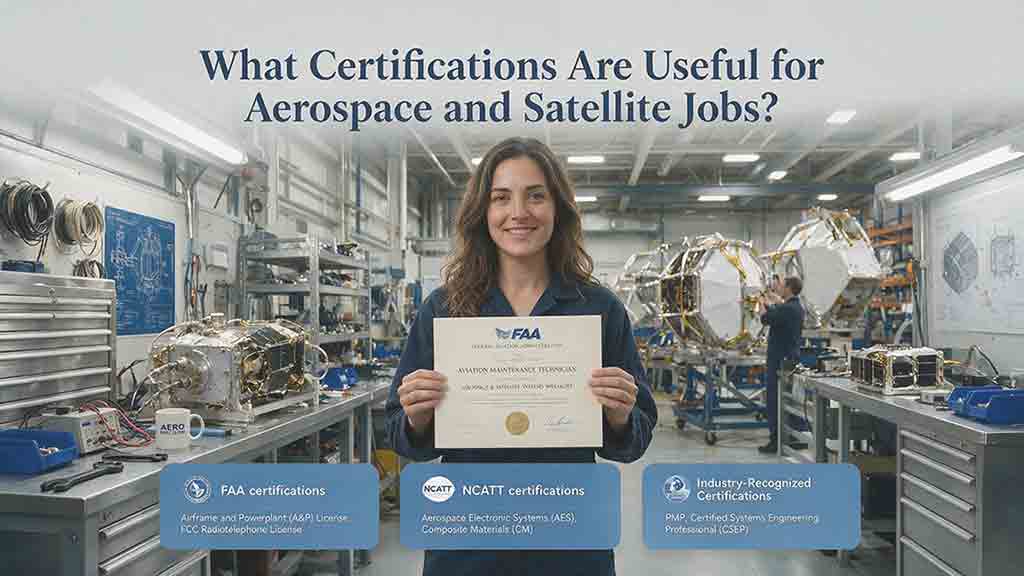
What Certifications Are Useful for Aerospace and Satellite Jobs?
This guide helps students and professionals identify which certifications are genuinely useful for aerospace and satellite jobs. It maps INCOSE, IPC, ASQ, PMI, ISC2, AWS, NCEES, FAA, AS9100-related training, and IAQG auditor authentication to specific work such as systems engineering, electronics assembly, quality, reliability, project leadership, cybersecurity, cloud infrastructure, licensure, and regulated aviation activities. The article clearly distinguishes professional certification, course completion, organizational AS9100 certification, auditor training, IAQG authentication, government certificates, licenses, and security clearances. Original tools—including the Credential Gate Test, Certification Utility Score, One-Gate Rule, Credential Commitment Ledger, employer-demand audit, and a 30-day decision plan—help readers compare role alignment, eligibility, evidence value, portability, maintenance, and rule-change exposure. It also explains the 2026 IAQG transition, PMI’s announced PMP training-provider change, renewal burdens, accurate résumé wording, and why no credential guarantees employment, salary, professional authority, or access.

Online Courses That Can Help You Prepare for a Space Career
This guide helps students and career changers choose online courses that support a specific space-career goal rather than collecting unrelated certificates. It compares NASA, MIT OpenCourseWare, Harvard CS50, University of Colorado Boulder, EPFLx, and other official resources across programming, remote sensing, spacecraft dynamics, mission design, systems engineering, signal processing, and research practice. The article clearly separates free course materials, completion certificates, CS50 Certificates, edX verified certificates, Coursera Career Certificates, university credit, professional certification, and professional licenses. Original tools—including the Role-to-Course Evidence Chain, Course Utility Score, Four-Layer Learning Stack, Evidence Conversion Protocol, and a 12-week study plan—show readers how to identify a skill gap, select a suitable course, build an inspectable project, verify results, and state limitations honestly. It also explains ARSET certificate eligibility, course-age limits, academic-integrity rules, publication safety, and why coursework cannot replace required degrees, supervised experience, work authorization, or professional authority.

Do You Need a Master’s Degree to Work in Space Technology?
This guide explains when a master’s degree is required, preferred, optional, or unnecessary for space-technology careers. It compares bachelor’s-, associate-, master’s-, and doctoral-level entry routes across engineering, software, hardware, analysis, research, project work, writing, and technical operations. Readers learn how to distinguish an absolute degree requirement from a stated preference or an education-and-experience substitution. Original tools—including the Master’s Necessity Ladder, Master’s Pressure Index, Role-Gap Ledger, Replacement Test, and Graduate Commitment Ledger—help applicants audit job postings, identify whether their real gap is knowledge, evidence, experience, or credentials, and make hidden costs visible. A fictional spacecraft thermal-analysis example demonstrates the calculation process without presenting it as a hiring probability. The article also compares graduate-program formats, explains NASA and astronaut exceptions, addresses accreditation and licensure, and separates education from work authorization, export controls, and security-clearance requirements.