How to Become an Astronomer

How to Become an Astronomer
To become an astronomer, build a strong foundation in physics, mathematics, programming, and scientific writing; earn a bachelor’s degree in astronomy, astrophysics, physics, or a related field; and complete research projects. Most independent research and university careers require a PhD, while bachelor’s and master’s graduates can pursue observatory, software, data, instrumentation, education, and research-support roles.
Key Takeaways
- A PhD is typically required to lead original astronomy research or compete for university research positions.
- A bachelor’s degree can still lead to technical, software, data, observatory, education, or research-support work.
- Professional astronomy involves far more coding, analysis, writing, and proposal preparation than looking through a telescope.
- Research evidence matters more than collecting course titles or software names.
- A strong PhD application explains research contributions, preparation, program fit, and readiness for open-ended work.
- No degree, internship, publication, application strategy, or career framework can guarantee admission or employment.
This guide will help you choose an education route, build credible research experience, prepare graduate applications, evaluate whether a PhD fits your goals, and plan for both astronomy research and astronomy-adjacent careers.
Scope: This guide focuses mainly on education and employment in the United States. University admissions, funding, work authorization, teaching licenses, research-program eligibility, and job requirements vary by institution, employer, country, and jurisdiction. This article provides general educational information, not legal, immigration, admissions, or employment advice.
What Is the Step-by-Step Path to Becoming an Astronomer?
The standard research path is:
- Build a strong mathematics, physics, and programming foundation.
- Earn a bachelor’s degree in astronomy, astrophysics, physics, or a related field.
- Complete at least one substantial research project.
- Develop scientific programming, statistics, and technical-writing skills.
- Apply to research-focused graduate programs if your target role requires a PhD.
- Complete doctoral research and communicate the results through papers, presentations, software, data products, or instrumentation.
- Often complete one or more postdoctoral research appointments.
- Apply for permanent research, observatory, government, laboratory, university, software, or technical positions.
That path is common, but it is not the only legitimate astronomy career route.
The American Astronomical Society notes that many faculty, postdoctoral, research, and advanced observatory positions require a PhD. It also describes technical and support careers—including telescope operations and software development—that may be accessible with a bachelor’s or master’s degree.
Which Kind of Astronomy Career Do You Want?
Before selecting a degree, decide what type of work product you want to create.
| Career direction | Main output | Common preparation | Strong evidence |
|---|---|---|---|
| Research astronomer | New scientific knowledge | PhD, research specialization, publications | Papers, presentations, reproducible analysis |
| University faculty | Research, teaching, and student supervision | PhD, often followed by postdoctoral training | Research record, teaching evidence, proposals |
| Observatory scientist | Telescope or instrument support plus research | Bachelor’s to PhD, depending on role | Instrument knowledge, observing support, calibration |
| Scientific software or archive work | Research software, pipelines, databases, and user tools | Bachelor’s, master’s, or PhD | Tested code, documentation, data systems |
| Instrumentation | Detectors, optics, electronics, and calibration systems | Physics, astronomy, or engineering | Laboratory work, hardware, calibration, error analysis |
| Data science or technical industry | Models, analytics, software, and automation | Astronomy or physics plus strong computing skills | Code portfolio, statistical analysis, technical projects |
| Planetarium or public outreach | Public programs and science communication | Requirements vary by employer | Presentation portfolio, educational programs |
| School teaching | Classroom instruction | Subject preparation plus applicable credentials | Teaching practice, certification, curriculum work |
| Science policy | Analysis, communication, and program support | Bachelor’s to PhD, depending on role | Policy writing, evidence synthesis, communication |
A Four-Question Career Route Filter
Ask yourself:
- Do I want to produce original research, or use astronomy skills in another setting?
- Do I enjoy coding, statistical uncertainty, and technical writing enough to do them repeatedly?
- Am I willing to complete a long training path that may include temporary appointments and relocation?
- Which role could I still enjoy if I spent little time looking through a telescope?
The fourth question prevents a common mismatch between the public image of astronomy and the daily work of astronomers.
What Do Astronomers Actually Do?
Astronomers observe, model, analyze, and interpret celestial phenomena. They may study stars, galaxies, planets, black holes, cosmology, solar activity, gravitational waves, astronomical surveys, or scientific instruments.
The U.S. Bureau of Labor Statistics describes work that can include:
- Developing scientific models and theories
- Conducting studies and analyzing astronomical data
- Writing software for modeling and data analysis
- Designing or contributing to scientific instruments
- Writing papers for publication
- Presenting research
- Preparing proposals for funding or observing resources
The O*NET profile for astronomers also identifies activities such as reviewing scientific proposals, calculating properties and motions of celestial objects, developing astronomy programs for public audiences, and collaborating with researchers.
The Telescope-Time Misconception
Professional astronomy is not a full-time version of recreational stargazing.
Many astronomers work primarily with archived, remotely collected, or automatically processed data. A working week may include:
- Programming
- Data cleaning
- Statistical analysis
- Simulation
- Literature review
- Proposal writing
- Documentation
- Meetings and collaboration
- Teaching or mentoring
- Preparing papers and presentations
Some observational astronomers conduct remote sessions or visit observatories, but telescope operation is only one part of the research process.
Which Degree Should You Choose?
Astronomy, astrophysics, and physics are the most direct undergraduate routes, but the degree title alone does not determine readiness for graduate school or employment.
| Undergraduate degree | Strongest preparation | Potential gap |
|---|---|---|
| Astronomy | Direct astronomy coursework and early domain exposure | Some programs may contain less advanced physics |
| Astrophysics | Integration of physics and astronomical applications | Program content varies significantly |
| Physics | Broad preparation for astronomy graduate programs | Astronomy electives or research may be needed |
| Mathematics | Theory, modeling, and quantitative reasoning | Physics laboratories and astronomy context may be missing |
| Computer science | Programming, algorithms, and software engineering | Advanced physics prerequisites may be missing |
| Engineering | Instrumentation, controls, optics, electronics, or systems | Theoretical physics and astronomy may need supplementation |
| Data science or statistics | Data processing, inference, and computation | Physics depth may be insufficient for research astronomy |
Astronomy vs. Physics: Which Is Better?
Neither degree is universally better.
Choose astronomy or astrophysics when the program includes:
- Rigorous mechanics, electromagnetism, thermodynamics, and quantum physics
- Calculus, differential equations, linear algebra, and statistics
- Laboratory courses
- Programming
- Access to faculty research
Choose physics when it offers the stronger technical foundation and you can add astronomy courses, research, or a minor.
The AAS identifies physics or astronomy as common undergraduate preparation for graduate study while recognizing that students can enter from engineering, computer science, mathematics, and other fields.
Do You Need a PhD to Become an Astronomer?
A PhD is usually required for careers centered on independent astronomy research, university faculty work, postdoctoral research, or competitive research-scientist positions.
The Bureau of Labor Statistics identifies a doctoral or professional degree as the typical entry-level education for the combined physicist and astronomer occupational profile. The AAS similarly describes doctoral training as standard preparation for many research-intensive careers.
A PhD may not be required for:
- Telescope operation
- Research or laboratory assistance
- Scientific programming
- Data-archive support
- Instrument testing
- Observatory technical work
- Planetarium education
- Science communication
- Some government or contractor roles
- Astronomy-adjacent data and software positions
Read the actual job requirements. A position located at an observatory or research institution does not automatically require a doctorate.
Degree Route Comparison
| Route | Typical outcome | Main advantage | Main tradeoff |
|---|---|---|---|
| Bachelor’s degree | Entry-level technical, software, education, assistant, or industry work | Fastest route into paid employment | Limited access to independent research positions |
| Master’s degree | Specialized technical work, research support, or preparation for PhD study | Additional depth and project experience | Often does not replace a PhD for research careers |
| PhD | Research scientist, postdoctoral, faculty, and advanced laboratory roles | Qualification for independent research pathways | Long training period and competitive permanent-job market |
| PhD plus postdoctoral training | Preparation for research-intensive permanent positions | Greater specialization and independence | Temporary appointments and possible relocation |
Which Courses Matter Most?
A strong astronomy foundation commonly includes the following subjects.
Mathematics
- Single-variable and multivariable calculus
- Linear algebra
- Differential equations
- Probability
- Statistics
- Numerical methods
Physics
- Classical mechanics
- Electricity and magnetism
- Thermodynamics
- Statistical mechanics
- Quantum mechanics
- Optics
- Laboratory methods
Astronomy
- Stellar structure and evolution
- Galactic astronomy
- Extragalactic astronomy
- Cosmology
- Planetary science
- Observational methods
- Radiative processes
- Astronomical instrumentation
Computing
- Python
- Data structures
- Scientific computing
- Version control
- Linux or Unix environments
- Numerical modeling
- Database queries
- Reproducible workflows
Graduate programs set their own prerequisites. Compare the current requirements of several target programs before choosing electives.
How Important Is Programming?
Programming is a core skill for many, but not necessarily every, astronomy position.
O*NET’s public employer-posting table for January through December 2025 lists four software technologies in postings linked to the astronomer occupation:
| Software technology | Share of linked unique postings mentioning it |
|---|---|
| Python | 23% |
| MATLAB | 11% |
| C++ | 9% |
| C | 6% |
Source: O*NET In-Demand Software Skills for Astronomers.
These figures require several limitations:
- They are mention rates among unique postings linked to the O*NET astronomer occupation.
- They are not measurements of daily software use.
- One posting can mention more than one technology.
- The percentages should not be added together.
- The public table does not establish that the postings represent every astronomy employer or career path.
- The public table does not display the underlying number of linked postings.
- Because astronomy is a small occupation, the percentages should be treated as a limited market signal rather than a universal ranking.
What Can You Conclude From the O*NET Table?
Within this specific 2025 linked-posting table, Python had the highest mention rate among the four displayed technologies.
That supports a narrow conclusion:
Python is a practical first language for general astronomy data work, but the appropriate language still depends on the research group, instrument, software system, or employer.
The table does not show that 23% of all astronomy jobs require Python, nor does it prove that Python is more important than every language or technical skill not shown in the table.
What Should You Be Able to Do With Code?
A credible astronomy programming project should demonstrate that you can:
- Import scientific data.
- Inspect metadata and units.
- Clean or filter data without concealing inconvenient results.
- Apply a documented method.
- Quantify uncertainty.
- Test important calculations.
- Visualize results clearly.
- Explain limitations.
- Make the work understandable and repeatable for another person.
A notebook that produces a graph is not automatically a research-quality analysis.
How Do You Get Astronomy Research Experience?
Start with a project small enough to complete.
Possible routes include:
- A faculty-supervised project
- A summer research program
- An observatory or laboratory internship
- A senior thesis
- A research assistant position
- A course-based research project
- A documented project using public astronomical data
The National Science Foundation Research Experiences for Undergraduates program supports undergraduate research sites, including astronomy programs.
NSF states that participants funded through NSF REU Sites or Supplements must be U.S. citizens, U.S. nationals, or permanent residents. This restriction applies to those NSF-funded participant positions; it should not be generalized to every university laboratory, institutional program, independently funded project, or astronomy internship.
What Counts as Meaningful Research Experience?
Meaningful research experience exposes you to uncertainty rather than only to a predetermined answer.
Useful evidence includes:
- A research question
- A documented dataset
- Code or calculations
- A method you can defend
- Unexpected, ambiguous, or null results
- Error or uncertainty analysis
- A poster, report, presentation, or repository
- A clear explanation of your individual contribution
The project does not need to produce a publication or discovery to be valuable.
A Realistic Public-Data Project Example
A student interested in exoplanets could use data and documentation from the official NASA Exoplanet Archive.
A manageable project could follow this sequence:
- Select one confirmed transiting exoplanet.
- Retrieve published system parameters or a public light curve.
- Record the source, units, and relevant metadata.
- Plot the observations.
- Apply a simple transit or period-analysis method.
- Compare the result with an archive value.
- Calculate the difference and discuss likely causes.
- Identify assumptions, noise sources, and limitations.
- Publish the code and a concise technical report.
A defensible conclusion might state that the analysis approximately reproduced a published quantity within the limitations of a simplified model.
It would not be appropriate to claim a new planet, independent confirmation, or research-grade precision without the required validation.
The Astronomy Research Loop Audit
The Astronomy Research Loop Audit is an original self-review framework developed for this guide. It is not a graduate-admissions rubric, employer assessment, or validated predictor of research ability.
Score one project from 0 to 2 in each category.
| Research stage | 0 points | 1 point | 2 points |
|---|---|---|---|
| Question | No defined question | General topic | Specific, testable question |
| Data | Source unclear | Source identified | Source, units, metadata, and selection documented |
| Method | Copied without explanation | Method described | Method justified and independently implemented |
| Uncertainty | Not discussed | Limitations mentioned | Errors, assumptions, sensitivity, or uncertainty evaluated |
| Reproducibility | Output only | Partial code or notes | Organized code, environment notes, and reproduction steps |
| Communication | Screenshots or vague summary | Basic report | Clear result, evidence, limitations, and next steps |
The maximum score is 12.
[\text{Research Loop Completion} =\frac{\text{Points earned}}{12}\times 100]
Worked Example
Suppose an undergraduate project earns:
| Research stage | Score |
|---|---|
| Question | 2 |
| Data | 2 |
| Method | 1 |
| Uncertainty | 1 |
| Reproducibility | 1 |
| Communication | 2 |
| Total | 9 / 12 |
[\frac{9}{12} \times 100 = 75%]
This does not mean that the student is “75% qualified” to become an astronomer.
It shows that the next improvement should probably involve methodological independence, uncertainty analysis, or reproducibility rather than another unrelated project.
How Should You Choose an Astronomy Graduate Program?
Choose a graduate program by research fit, advising environment, funding, and outcomes—not by university name alone.
| Factor | What to investigate | Warning sign |
|---|---|---|
| Research fit | Several faculty members work in areas you could pursue | Only one possible adviser |
| Funding | Stipend, tuition coverage, fees, insurance, and duration | Funding is described vaguely |
| Advising | Meeting frequency, mentoring style, and student independence | Students cannot discuss advising privately |
| Completion | Typical time to degree and attrition information | Only successful graduates are discussed |
| Research access | Data, instruments, computing, and collaborations | Facilities are advertised but unavailable to students |
| Placement | Academic and nonacademic destinations | Only faculty placements are treated as success |
| Cost of living | Housing, transport, healthcare, and local taxes | Stipends are compared without local costs |
| Culture | Work expectations, collaboration, leave, and conflict procedures | Excessive hours are treated as proof of commitment |
The AAS provides a broader list of questions in its guidance on what to look for in a graduate school.
How Should You Prepare an Astronomy PhD Application?
A strong astronomy PhD application should show academic preparation, research potential, clear contributions, communication ability, and a credible reason for choosing the program.
There is no universal application format. Requirements differ among universities and can change between application cycles.
A 2026 report from the AAS Working Group on Graduate Admissions recommends a more standardized application containing:
- Two recommendation letters
- One application essay
- A curriculum vitae
- Unofficial transcripts
The report presents recommendations rather than binding requirements, and the AAS notes that the recommendations were not yet an officially endorsed universal admissions standard.
Official program pages illustrate the variation:
- UC Berkeley Astronomy describes transcripts, reference letters, a statement of purpose, preparation courses, and other university requirements.
- Princeton Astrophysical Sciences lists a statement of purpose, transcript, curriculum vitae, recommendation letters, and applicable language-proficiency materials.
- Caltech Astronomy describes an application containing recommendation letters, a personal statement, and academic transcripts.
The current page for each program controls. Do not assume that another university uses the same number of letters, essay length, test policy, fee-waiver rules, or language requirements.
What Evidence Should Each Application Component Provide?
| Application component | Question it should help answer | Useful evidence |
|---|---|---|
| Transcript | Can the applicant handle the technical preparation? | Advanced physics, mathematics, astronomy, computing, and improvement over time |
| Curriculum vitae | What has the applicant actually done? | Research, projects, presentations, software, teaching, awards, employment |
| Statement or essay | How does the applicant think about research and program fit? | Questions pursued, contributions, methods, lessons, interests, goals |
| Recommendation letters | How has the applicant worked in a real academic or research setting? | Independence, persistence, technical growth, collaboration, communication |
| Research products, when requested | Can the applicant communicate or reproduce technical work? | Reports, posters, code, papers, data products, instrumentation |
| Program-specific section | Why does this department fit the applicant’s direction? | Multiple relevant faculty, facilities, methods, collaborations, or training resources |
The Research Contribution Ledger
Before writing application essays, make a private worksheet for each substantial project.
| Prompt | Evidence to record |
|---|---|
| What was the research question? | One precise sentence |
| What existed before you joined? | Starting data, code, instrument, or method |
| What did you personally do? | Analysis, coding, calibration, modeling, writing, or testing |
| Which decision did you make? | Method choice, filter, model, test, or interpretation |
| What failed or changed? | Error, null result, revised assumption, or new method |
| How was the work checked? | Comparison, review, test, sensitivity analysis, or replication |
| What did you learn? | Technical and research-process knowledge |
| What remains unresolved? | Limitations and next questions |
This ledger helps prevent vague claims such as “worked on an exoplanet project.” It also reduces the risk of attributing a group’s full output to one applicant.
Weak vs. Strong Research Description
Weak:
I conducted research on galaxy evolution and learned Python.
Stronger:
I cleaned and matched two catalog tables, tested how alternative quality cuts changed the sample, and documented the resulting selection bias before comparing the final distribution with the group’s reference analysis.
The stronger version does not need a dramatic discovery. It makes the applicant’s reasoning and contribution visible.
What Should You Give a Recommender?
Provide each recommender with:
- Your current curriculum vitae
- An unofficial transcript, when useful
- A draft or outline of your statement
- A one-page summary of work completed with that person
- The programs and deadlines
- Submission instructions
- A reminder of any specific contribution that may be difficult to recall
Ask early enough that the recommender can decline or prepare a substantive letter. A famous recommender who barely knows your work may be less useful than a research supervisor who can describe your growth and contributions precisely.
Astronomy PhD Application Checklist
- I checked every requirement on the current official program page.
- My research descriptions distinguish my work from the group’s work.
- My statement explains preparation, interests, and program fit.
- I identified several relevant faculty or research directions where appropriate.
- My curriculum vitae uses accurate labels for publications, submissions, posters, and work in progress.
- My recommenders have enough information to write specific letters.
- I verified language-test, transcript, fee, and deadline requirements.
- I did not assume that one program’s GRE or funding policy applies to another.
- I kept a copy of every submitted document.
- I removed unsupported claims about expertise, discoveries, or research impact.
How Should You Interpret Graduate Funding Data?
The American Institute of Physics published a 2026 report based on its follow-up survey of astronomy bachelor’s recipients from academic years 2021–22, 2022–23, and 2023–24.
Among recipients who were enrolled in a graduate program during the follow-up period:
- 65% reported support through a teaching or research assistantship.
- 22% reported support through a fellowship or scholarship.
- 13% reported no institutional support.
Because those categories account for the graduate-student group shown in the report:
[65% + 22% = 87%]
Within that surveyed graduate-student subgroup, 87% reported an assistantship, fellowship, or scholarship.
This calculation needs a clear denominator. It does not mean that:
- 87% of all astronomy bachelor’s recipients received graduate funding.
- Every admitted astronomy PhD student receives full funding.
- The reported support covered tuition, fees, insurance, and living costs.
- Funding continued for the full duration of the degree.
- Future applicants will receive the same outcome.
AIP reports that initial post-degree information was obtained for 33% of the degree recipients in the three academic-year groups, with most of that information coming directly from recipients and the remainder obtained through advisers.
The report is useful evidence about the surveyed group, but applicants still need to inspect the written funding terms of each offer.
Source: AIP, New Astronomy Bachelors: What Comes Next, published May 26, 2026.
What Should You Compare in a Funding Offer?
| Funding item | Question to ask |
|---|---|
| Stipend | What is the guaranteed annual amount? |
| Duration | For how many years is support promised? |
| Tuition | Is tuition fully covered? |
| Mandatory fees | Which fees remain the student’s responsibility? |
| Health insurance | What premiums, deductibles, or dependent costs apply? |
| Summer support | Is it guaranteed, competitive, or adviser-dependent? |
| Work duties | How much teaching, grading, or research assistance is required? |
| Conditions | What academic progress or appointment conditions apply? |
| Cost of living | What housing and transport costs are realistic locally? |
| International funding | Are there restrictions tied to citizenship, funding source, or visa status? |
Do not compare stipend numbers without accounting for tuition, fees, insurance, workload, and local living costs.
What Happens During an Astronomy PhD?
An astronomy PhD commonly combines coursework, qualifying requirements, research, teaching or assistantship duties, presentations, proposal writing, and a dissertation.
During doctoral training, students may:
- Analyze observational data
- Develop simulations
- Build or calibrate instruments
- Write observing proposals
- Apply for computing or funding resources
- Present at conferences
- Publish papers
- Teach or assist with courses
- Collaborate across institutions
- Defend a dissertation
The exact structure varies by department and country.
How Long Does the Research Route Take?
There is no universal timeline.
A realistic planning sequence may include:
- Approximately four years for a bachelor’s degree
- Several years of doctoral training
- One or more fixed-term postdoctoral appointments
- A competitive search for permanent positions
Those stages are not guaranteed and are not identical across institutions.
Do All Astronomers Complete Postdoctoral Training?
No, but postdoctoral training is common among people pursuing research-intensive academic or institute careers.
A postdoctoral appointment is a temporary research position completed after a PhD. It is generally intended to develop specialization, independence, publications, collaborations, and proposal experience.
Advantages and Tradeoffs of Postdoctoral Training
| Potential advantage | Corresponding tradeoff |
|---|---|
| Time focused on research | Appointment is usually temporary |
| Access to new collaborators and facilities | Relocation may be required |
| Opportunity to build a publication record | Permanent employment is not guaranteed |
| Increased research independence | Funding may depend on a specific project |
| Preparation for faculty or scientist roles | Career and family planning may become difficult |
A postdoc is not automatically necessary for software, industry, policy, education, or many technical careers.
What Can You Do With a Bachelor’s Degree in Astronomy?
An astronomy bachelor’s degree does not limit you to jobs titled “astronomer.”
AIP’s May 2026 report combined recipients from academic years 2021–22, 2022–23, and 2023–24. Among the recipients for whom initial outcomes were obtained, the report states that:
- About half entered the workforce.
- 42% were enrolled in graduate programs.
- 7% were seeking employment.
- Among employed respondents, 60% worked in STEM fields.
- The private sector was the largest single employment sector, employing 40% of the working respondents.
The report also identifies titles such as engineer, research assistant, technician, and analyst among employed astronomy graduates.
These percentages describe the surveyed outcome group, not every astronomy graduate in the United States.
The practical conclusion is:
The career outcomes of astronomy graduates are broader than the formal occupation of astronomer.
Source: AIP, New Astronomy Bachelors: What Comes Next.
The Two-Market Portfolio Strategy
Students who are uncertain about completing a PhD can build a portfolio that remains useful in two markets:
- Astronomy research
- Transferable technical work
| Artifact | Astronomy value | Transferable value |
|---|---|---|
| Reproducible data-analysis project | Demonstrates scientific reasoning | Demonstrates programming, statistics, and documentation |
| Instrument or sensor project | Supports observational astronomy | Supports hardware, testing, and engineering roles |
| Research poster or report | Demonstrates scientific communication | Demonstrates concise analytical writing |
| Database or archive project | Supports survey science | Supports data engineering and information systems |
| Simulation project | Supports theoretical research | Supports modeling and quantitative software work |
| Public presentation | Supports outreach and teaching | Supports communication and stakeholder-facing work |
This strategy does not require abandoning the goal of becoming an astronomer. It reduces the risk of treating one narrow job title as the only successful outcome.
How Much Do Astronomers Earn?
The U.S. Bureau of Labor Statistics reported a median annual wage of $132,170 for astronomers in May 2024.
BLS reported these median annual wages for major astronomy employment sectors:
| Employment sector | Median annual wage, May 2024 |
|---|---|
| Federal government, excluding postal service | $174,370 |
| Scientific research and development services | $128,450 |
| State colleges, universities, and professional schools | $95,450 |
These are national occupational medians, not starting salaries or guaranteed offers.
Compensation varies by:
- Degree level
- Career stage
- Employer
- Appointment type
- Location
- Research funding
- Teaching responsibilities
- Technical specialization
- Contract length
Graduate stipends and postdoctoral salaries should not be compared directly with permanent-career occupational medians.
What Is the Job Outlook for Astronomers?
BLS reported approximately 1,800 astronomer jobs in 2024 and projected 2% employment growth from 2024 to 2034.
Astronomy is therefore a small occupation in official U.S. labor statistics.
The BLS Denominator Warning
BLS also reports approximately 1,800 annual openings for physicists and astronomers combined.
That figure should not be interpreted as 1,800 astronomer openings per year.
The combined category includes the much larger physicist occupation. The astronomer-specific table reports about 1,800 jobs in 2024 and approximately 2% projected growth, but the main BLS profile does not present the combined annual-openings figure as an astronomer-only estimate.
This distinction matters because figures with different occupational denominators cannot be substituted for one another.
Source: BLS Physicists and Astronomers.
Is Astronomy Too Competitive?
Some astronomy career paths are highly competitive, particularly permanent university research positions.
Competition does not mean that studying astronomy is irrational. It means students should distinguish among:
- A degree in astronomy
- A research career using astronomy
- A permanent university faculty position
- A job formally classified as “astronomer”
- Technical careers that use astronomy training
These are not the same outcome.
The most resilient plan is to develop research depth and transferable technical evidence at the same time.
What Should International Students Know?
International students may apply to astronomy degree programs and research opportunities, but eligibility and funding must be checked separately for every institution and position.
Four different questions are often confused:
- Can the student apply or be admitted?
- Is institutional funding available to the student?
- Is a particular fellowship or research program restricted by citizenship or residency?
- Does the student have authorization for the proposed employment?
A program may admit international students while a separate fellowship, internship, government project, or funding source uses different eligibility rules.
For example:
- NSF states that participants funded through NSF REU Sites or Supplements must be U.S. citizens, U.S. nationals, or permanent residents.
- Individual graduate programs may set English-language, transcript, funding, and documentation requirements.
- U.S. Citizenship and Immigration Services states that F-1 students may work only under the applicable authorization and conditions.
See the official USCIS guidance on student employment for general federal information. Students should also consult their institution’s designated school official regarding their own status and procedures.
A practical review sequence is:
- Check the current admissions page.
- Check the department’s funding page.
- Check the specific fellowship or research-program rules.
- Ask whether the stated funding applies to international students.
- Verify English-language and financial-document requirements.
- Discuss employment authorization with the designated school official.
- Obtain qualified legal advice when an individual immigration question requires it.
Do not infer universal eligibility from another student’s experience, a discussion forum, or the general reputation of a university.
What Common Mistakes Should You Avoid?
Choosing Astronomy Only Because You Enjoy Looking at the Sky
Interest in the night sky is a good starting point, but professional astronomy also requires mathematics, physics, programming, statistics, and writing.
Test your interest through a real data-analysis project.
Avoiding Programming
Modern astronomy produces large and complex datasets. Weak programming skills can restrict both research and nonacademic options.
Learn one scientific language deeply enough to build and test a complete project.
Waiting Too Long to Try Research
Graduate applications often benefit from evidence that you understand research uncertainty and can work through an open-ended problem.
Begin with a small faculty project, summer program, thesis, or public-data analysis.
Listing Research Without Explaining Your Contribution
A project title does not show what you did.
Record your decisions, methods, revisions, checks, and limitations while the work is still fresh.
Treating a Famous University as the Only Selection Criterion
Research fit, funding, advising, department culture, and placement may affect your experience more directly than general institutional prestige.
Assuming a PhD Guarantees a Permanent Research Job
A PhD qualifies you to compete for research positions. It does not guarantee a faculty appointment, permanent contract, preferred location, or salary.
Publishing Unverified Results as Discoveries
Public astronomical data can support excellent student work, but a graph or fitted model does not automatically establish a new scientific result.
Clearly separate replication, exploration, and original discovery claims.
Building Only an Academic Resume
Technical employers may not know how to interpret a list of astronomy topics.
Translate projects into evidence of programming, statistics, modeling, documentation, collaboration, and problem-solving.
How Can You Troubleshoot a Stalled Astronomy Career Path?
| Problem | Likely cause | Practical response |
|---|---|---|
| You enjoy classes but dislike research | Career image and daily work do not match | Explore observatory, education, instrumentation, or technical roles |
| You cannot find an astronomy major | Degree title is too narrow a constraint | Study physics and add astronomy coursework or research |
| You have high grades but weak applications | Limited research evidence or recommendations | Complete a sustained project with faculty supervision |
| Your research statement sounds generic | Contributions and program fit are unclear | Complete the Research Contribution Ledger before rewriting |
| Your projects contain attractive plots but weak conclusions | Method and uncertainty are underdeveloped | Use the Research Loop Audit to strengthen the weakest stage |
| You cannot obtain an astronomy internship | Search is limited to famous programs | Apply to physics, data, software, instrumentation, and university research roles |
| You are unsure about a PhD | Career target is undefined | Compare three research jobs and three technical jobs |
| You have a PhD but want to leave academia | Skills are described only in academic language | Rewrite experience around analysis, code, ownership, and communication |
| You struggle with coding | Practice is disconnected from a real question | Complete one small end-to-end public-data project |
| You cannot relocate repeatedly | Academic pathway conflicts with personal constraints | Prioritize stable technical, government, education, or local industry routes |
A One-Year Astronomy Evidence Plan
This plan is a practical framework, not an admissions or employment guarantee.
Months 1–2: Choose a Direction
- Compare research, observatory, software, instrumentation, education, and industry roles.
- Identify the education level required by real listings.
- Select one primary path and one backup path.
Deliverable: A one-page career route comparison.
Months 3–4: Build Technical Foundations
- Learn or strengthen Python.
- Practice arrays, tables, plotting, statistics, and version control.
- Reproduce a documented scientific example.
Deliverable: A clean repository with a repeatable analysis.
Months 5–7: Complete a Research Loop
- Define a narrow question.
- Use public or supervised data.
- Document assumptions and uncertainty.
- Present the result.
Deliverable: A report, poster, or presentation assessed with the Research Loop Audit.
Months 8–9: Add Human Evidence
- Work with a faculty member, mentor, research group, observatory, or technical team.
- Ask for feedback on reasoning and documentation.
- Clarify your individual contribution.
Deliverable: A revised project and a mentor who understands your work.
Months 10–11: Compare Next-Step Options
- Review graduate programs or target jobs.
- Compare funding, prerequisites, duties, location, and outcomes.
- Identify missing coursework or evidence.
- Prepare the Research Contribution Ledger for each major project.
Deliverable: A ranked application list and an evidence-based statement outline.
Month 12: Prepare Applications
- Tailor the resume or curriculum vitae.
- Write a clear account of research preparation and interests.
- Prepare accurate project summaries.
- Request recommendations early.
- Verify every deadline and eligibility rule on the official page.
Deliverable: Complete application materials with no unsupported claims.
Astronomy Career Readiness Checklist
Education
- I have completed or planned the necessary mathematics courses.
- I have a strong physics foundation.
- I have checked the prerequisites of target programs or jobs.
- I understand whether my target role normally requires a PhD.
Research
- I have completed at least one open-ended project.
- I can explain the research question in one sentence.
- I can identify my individual contribution.
- I can explain the assumptions and uncertainty.
- I have communicated the work in writing or a presentation.
Computing
- I can analyze scientific data with code.
- I use version control or another documented revision process.
- My project includes reproduction instructions.
- I can test or independently check important calculations.
- I understand the units and metadata in my dataset.
Graduate Applications
- I have checked every requirement on the official program page.
- My statement explains preparation, contribution, interests, and fit.
- My recommenders can describe my work specifically.
- I understand the complete funding terms of each offer.
- I have verified language, transcript, fee, and eligibility requirements.
Career Planning
- I have compared research and nonresearch astronomy roles.
- I have examined actual job descriptions rather than relying on titles.
- I understand the temporary nature of many early research appointments.
- I have considered location, finances, family needs, and work authorization.
- I am building skills that remain useful outside one narrow occupation.
What Should You Do Next?
The right next step depends on where you are now.
High school students should prioritize mathematics, physics, programming, writing, and affordable universities with active research opportunities.
Undergraduate students should complete one substantial research loop instead of collecting many disconnected activities.
Students preparing PhD applications should document their individual research contributions, compare current program requirements, request specific recommendation letters, and evaluate funding terms carefully.
Bachelor’s or master’s graduates should search for scientific software, observatory, data, instrumentation, laboratory, education, and technical roles—not only positions titled “astronomer.”
Career changers should compare their existing skills with a specific astronomy function. Software engineering, statistics, electronics, optics, scientific communication, and project management can provide relevant entry points.
The central principle is simple:
Become capable of asking a precise question, working with evidence, evaluating uncertainty, and communicating a defensible result.
That ability is valuable in astronomy and beyond it.
Frequently Asked Questions
Can You Become an Astronomer Without an Astronomy Degree?
Yes. Physics is a common route, and some graduate students begin in mathematics, engineering, computer science, or related fields. Additional physics, mathematics, laboratory, or astronomy coursework may be needed for a particular graduate program or job.
Can You Become an Astronomer Without a PhD?
You can work in astronomy-related technical, observatory, software, data, education, or support roles without a PhD. Most careers centered on independent research, postdoctoral work, or university faculty research require doctoral training.
Do You Need Publications to Enter an Astronomy PhD Program?
Not universally. Programs evaluate applications differently, and undergraduate research does not always produce a paper. A clear explanation of your question, contribution, method, challenges, and growth may provide meaningful evidence even without a publication.
Do Astronomers Use Telescopes Every Night?
No. Many astronomers work primarily with archived data, simulations, software, proposals, papers, and collaborative projects. Observing may occur remotely or during limited scheduled periods.
Is Astronomy or Astrophysics the Better Major?
The title matters less than the curriculum. Choose the program that offers stronger physics, mathematics, computing, laboratory work, and research access.
Can an Astronomy Degree Lead to a Data Science Career?
Yes, when the graduate can demonstrate programming, statistics, data cleaning, modeling, documentation, and communication. Astronomy coursework alone may not prove production-level data skills, so a transferable project portfolio is valuable.
Sources
U.S. Bureau of Labor Statistics. Physicists and Astronomers. Occupational Outlook Handbook. Includes May 2024 wages, 2024 employment, and 2024–2034 projections. Accessed August 1, 2026.
O*NET OnLine. Astronomers, 19-2011.00. Occupational tasks, work activities, education, skills, and technologies. Updated 2026. Accessed August 1, 2026.
O*NET OnLine. In-Demand Software Skills for Astronomers. Lightcast U.S. unique job-posting data covering January 1 through December 31, 2025. Accessed August 1, 2026.
American Astronomical Society. About a Career in Astronomy. Education, research, academic, observatory, technical, policy, and international career guidance. Accessed August 1, 2026.
AAS Working Group on Graduate Admissions. Recommendations for the Astronomy Graduate Admissions Process. Published May 6, 2026. The recommendations are discussed as proposals rather than universal program requirements.
AAS Graduate Admissions Task Force. Final Report and Recommendations. Graduate-admissions research and recommendations. Accessed August 1, 2026.
American Astronomical Society. What to Look for in a Graduate School. Program-comparison guidance. Accessed August 1, 2026.
American Institute of Physics. New Astronomy Bachelors: What Comes Next. Outcomes for recipients from academic years 2021–22, 2022–23, and 2023–24. Published May 26, 2026.
U.S. National Science Foundation. Research Experiences for Undergraduates. Program structure and participant-eligibility information. Accessed August 1, 2026.
U.S. National Science Foundation. Astronomy Research Experiences for Undergraduates Sites. Astronomy-specific REU information. Accessed August 1, 2026.
NASA Exoplanet Archive. NASA Exoplanet Archive. Public exoplanet data, documentation, queries, and analysis services. Accessed August 1, 2026.
UC Berkeley Department of Astronomy. How to Apply. Example of program-specific preparation and application requirements. Accessed August 1, 2026.
Princeton Department of Astrophysical Sciences. Graduate Admissions. Example of program-specific application materials. Accessed August 1, 2026.
California Institute of Technology Astronomy. Graduate Program. Example of program-specific preparation and application materials. Accessed August 1, 2026.
U.S. Citizenship and Immigration Services. Policy Manual, Chapter 6: Employment. General information about authorized student employment. Accessed August 1, 2026.
More from Space Career Paths
Non-Engineering Careers in the Space Industry
This guide explains how professionals without engineering roles can contribute directly to space missions through program management, procurement, finance, logistics, technical writing, communications, human resources, training, market research, legal support, policy, customer operations, and education. It compares relevant degrees and national salary benchmarks, clarifies the difference between non-engineering, nontechnical, and non-STEM work, and shows how each function manages a mission constraint such as money, time, suppliers, information, workforce, trust, or customer adoption. Original tools—including the Mission Enablement Ledger, Role Output Test, Mission Support Evidence Audit, and Six-Artifact Entry Plan—help readers choose a role, create realistic portfolio evidence, and evaluate career fit. The article also provides practical guidance on NASA and ESA career paths, internships, resumes, technical literacy, work authorization, export controls, background investigations, security clearances, and safe portfolio practices without promising employment or other outcomes.
Space Careers That Do Not Require a PhD
Space Careers That Do Not Require a PhD explains how readers can enter the space sector through engineering, software, operations, data, manufacturing, technician, logistics, communications, and project roles. It distinguishes a space employer from an occupation, preserves official BLS job titles and salary denominators, and compares routes from apprenticeships and certificates through associate, bachelor’s, and master’s degrees. The guide introduces the Mission Contribution Map, the Occupation–Employer–Task Test, the Role Proof Packet, and an Evidence Coverage self-audit to help readers choose a realistic role and build verifiable work samples. It also explains NASA internships, astronaut education requirements, ABET accreditation, security clearances, export controls, and work authorization without implying universal eligibility. Readers receive practical career tables, a physics-graduate example, a 90-day action plan, troubleshooting advice, and a readiness checklist. The article emphasizes that a PhD is not required for many space careers, but role-specific training and credible evidence remain essential.

How to Become a Satellite Systems Engineer
This guide explains how to become a satellite systems engineer by combining technical depth in one spacecraft subsystem with the systems-engineering skills needed to connect mission needs, requirements, interfaces, technical budgets, risks, verification, and operations. It compares suitable engineering degrees, maps common satellite subsystems to practical project evidence, and shows how to build a portfolio without access to flight hardware. Original tools include the Subsystem Anchor and Integration Spine Framework, the Tool-to-Decision Rule, the Mission Thread Portfolio Audit, and an educational satellite power-margin example. The article also covers software choices, entry-level job searches, interviews, INCOSE certification, professional licensure, salary data, international-student considerations, common mistakes, troubleshooting, and a 12-month career plan. Readers gain a practical method for turning coursework and projects into traceable engineering evidence while understanding the limits of occupational statistics, certifications, legal guidance, and publicly available technical standards.
Explore More Topics
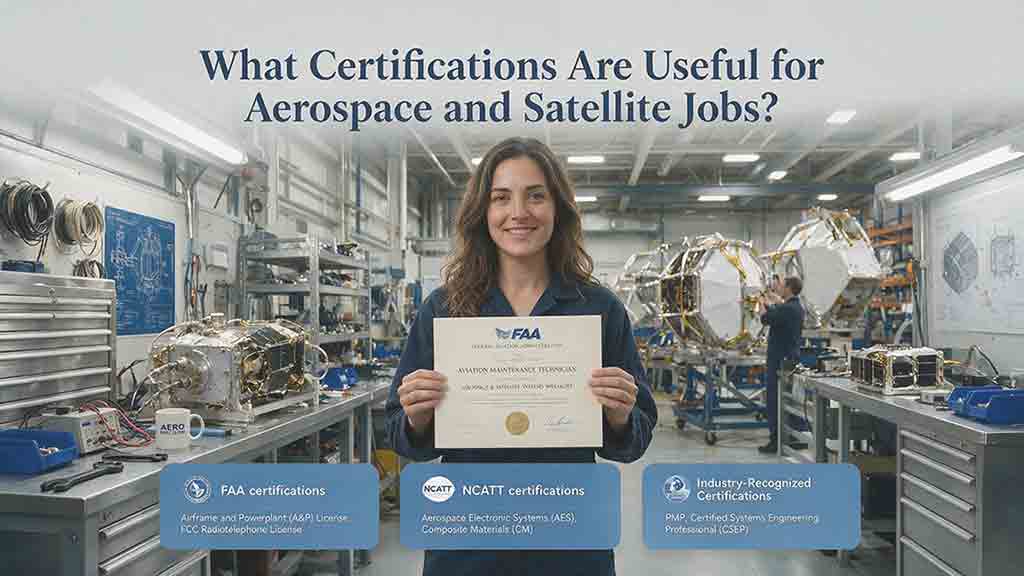
What Certifications Are Useful for Aerospace and Satellite Jobs?
This guide helps students and professionals identify which certifications are genuinely useful for aerospace and satellite jobs. It maps INCOSE, IPC, ASQ, PMI, ISC2, AWS, NCEES, FAA, AS9100-related training, and IAQG auditor authentication to specific work such as systems engineering, electronics assembly, quality, reliability, project leadership, cybersecurity, cloud infrastructure, licensure, and regulated aviation activities. The article clearly distinguishes professional certification, course completion, organizational AS9100 certification, auditor training, IAQG authentication, government certificates, licenses, and security clearances. Original tools—including the Credential Gate Test, Certification Utility Score, One-Gate Rule, Credential Commitment Ledger, employer-demand audit, and a 30-day decision plan—help readers compare role alignment, eligibility, evidence value, portability, maintenance, and rule-change exposure. It also explains the 2026 IAQG transition, PMI’s announced PMP training-provider change, renewal burdens, accurate résumé wording, and why no credential guarantees employment, salary, professional authority, or access.

Online Courses That Can Help You Prepare for a Space Career
This guide helps students and career changers choose online courses that support a specific space-career goal rather than collecting unrelated certificates. It compares NASA, MIT OpenCourseWare, Harvard CS50, University of Colorado Boulder, EPFLx, and other official resources across programming, remote sensing, spacecraft dynamics, mission design, systems engineering, signal processing, and research practice. The article clearly separates free course materials, completion certificates, CS50 Certificates, edX verified certificates, Coursera Career Certificates, university credit, professional certification, and professional licenses. Original tools—including the Role-to-Course Evidence Chain, Course Utility Score, Four-Layer Learning Stack, Evidence Conversion Protocol, and a 12-week study plan—show readers how to identify a skill gap, select a suitable course, build an inspectable project, verify results, and state limitations honestly. It also explains ARSET certificate eligibility, course-age limits, academic-integrity rules, publication safety, and why coursework cannot replace required degrees, supervised experience, work authorization, or professional authority.

Do You Need a Master’s Degree to Work in Space Technology?
This guide explains when a master’s degree is required, preferred, optional, or unnecessary for space-technology careers. It compares bachelor’s-, associate-, master’s-, and doctoral-level entry routes across engineering, software, hardware, analysis, research, project work, writing, and technical operations. Readers learn how to distinguish an absolute degree requirement from a stated preference or an education-and-experience substitution. Original tools—including the Master’s Necessity Ladder, Master’s Pressure Index, Role-Gap Ledger, Replacement Test, and Graduate Commitment Ledger—help applicants audit job postings, identify whether their real gap is knowledge, evidence, experience, or credentials, and make hidden costs visible. A fictional spacecraft thermal-analysis example demonstrates the calculation process without presenting it as a hiring probability. The article also compares graduate-program formats, explains NASA and astronaut exceptions, addresses accreditation and licensure, and separates education from work authorization, export controls, and security-clearance requirements.