Non-Engineering Careers in the Space Industry

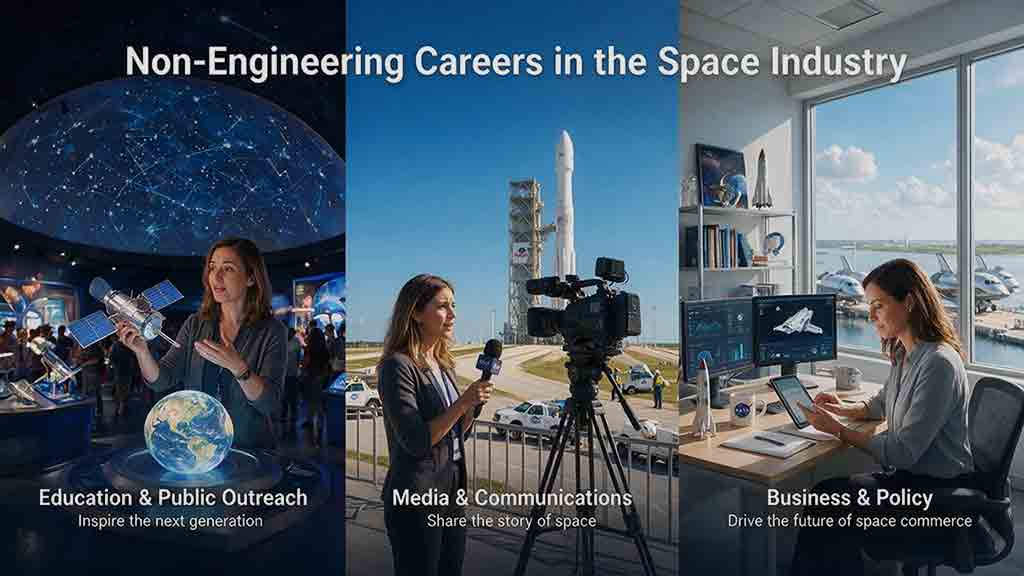
Non-Engineering Careers in the Space Industry
Non-engineering careers in the space industry include program management, procurement, finance, accounting, logistics, technical writing, communications, human resources, training, market research, legal support, policy, customer operations, and education. These professionals may not design spacecraft, but they manage the money, people, suppliers, information, contracts, schedules, customers, and public trust that allow missions and space businesses to function.
Key Takeaways
- Space organizations hire business, communication, legal, administrative, workforce, and customer-facing professionals—not only engineers and scientists.
- “Non-engineering” does not mean “nontechnical”; many roles require enough mission knowledge to make accurate decisions and communicate with specialists.
- The strongest applicants show a role-specific work product, such as a controlled procedure, budget analysis, supplier evaluation, training module, or stakeholder brief.
- National salary data describe broad occupations across all industries, not guaranteed starting pay at space companies.
- Citizenship, work authorization, export controls, background investigations, and security clearances are separate concepts that must be checked for each position.
This guide will help you choose a non-engineering function, understand how it contributes to a mission, compare education and salary benchmarks, create credible work samples, and search for roles without relying on vague phrases such as “I want to work in space.”
Scope: This article focuses mainly on careers and education in the United States while including selected European Space Agency examples. Job qualifications, professional licenses, work authorization, export-control obligations, citizenship rules, background-investigation requirements, and security-clearance requirements vary by employer, position, country, and jurisdiction. This article provides general educational information, not legal, immigration, licensing, export-control, personnel-security, or employment advice.
Do Space Organizations Really Hire Non-Engineers?
Yes. Space agencies and companies need people who manage resources, contracts, workforce systems, documentation, public information, facilities, suppliers, customers, and organizational decisions.
NASA’s Business Services careers page identifies roles involving human resources, accounting, writing, contracts, and media relations. NASA explains that these professionals provide resources and processes that help mission teams perform their work.
The European Space Agency career-domain page lists business and administration fields that include:
- Law
- Finance and controlling
- Commercialisation
- Communications and public relations
- International relations
- Human resources
- Information technology
- Facility management
- Procurement
These examples do not mean that every role is continuously available or has the same education requirement. They demonstrate that non-engineering functions are an established part of major space organizations.
What Does “Non-Engineering” Mean in the Space Industry?
A non-engineering role does not carry primary responsibility for engineering design, analysis, or technical approval.
That does not make the role unimportant or nontechnical.
A procurement specialist evaluating a spacecraft supplier may need to understand delivery risks, quality requirements, and technical dependencies. A technical writer preparing an operations procedure must understand the process well enough to represent it accurately without inventing engineering instructions.
A useful distinction is:
| Term | Meaning |
|---|---|
| Engineering role | Creates, analyzes, verifies, or approves an engineered system or technical design |
| Non-engineering technical role | Uses substantial technical knowledge without holding primary engineering-design responsibility |
| Mission-support role | Manages resources, people, information, contracts, schedules, customers, or institutional processes |
| Non-STEM role | Does not normally require a science, technology, engineering, or mathematics degree |
| Non-engineering role | May be STEM or non-STEM, but engineering is not the primary occupational function |
For example, a data analyst, cybersecurity specialist, or mission operator may be highly technical without being an engineer. A contract specialist or accountant may not be a STEM professional but may still need strong space-program literacy.
Which Non-Engineering Careers Exist in the Space Industry?
Common role families include:
- Program and project management
- Project controls and scheduling
- Procurement and purchasing
- Contract administration
- Supply-chain management
- Logistics
- Accounting
- Budget and financial analysis
- Technical writing
- Configuration and document control
- Public affairs and media relations
- Internal communications
- Human resources
- Talent acquisition
- Training and workforce development
- Market research
- Commercial strategy
- Business development
- Customer success and account support
- Legal services
- Paralegal and legal operations
- Policy and international relations
- Regulatory and export-compliance support
- Education and public outreach
- Facility and workplace management
- Administrative and executive support
Job titles are not standardized. “Program analyst” at one employer may focus on schedules, while the same title elsewhere may involve budgets, policy, data, or performance reporting.
Read the responsibilities and work products rather than relying on the title alone.
How Do Non-Engineering Roles Create Mission Value?
Non-engineering professionals usually own a constraint or resource that technical teams cannot manage effectively by themselves.
The Mission Enablement Ledger
The Mission Enablement Ledger is an original framework developed for this guide. It connects each organizational constraint to a role family, a concrete work product, and the failure that the work is intended to reduce.
| Mission constraint | Role family | Typical work product | Failure the work helps prevent |
|---|---|---|---|
| Money | Finance, accounting, budget analysis | Budget baseline, forecast, variance report | Untracked cost growth or unavailable funds |
| Time | Program management, project controls | Integrated schedule, decision log, status report | Missed dependencies or unmanaged delay |
| Suppliers | Procurement, contracts, supply chain | Supplier evaluation, purchase record, contract file | Missing hardware, services, or commitments |
| Materials | Logistics, inventory, facilities | Shipment plan, inventory record, facility schedule | Parts arriving late, damaged, or unavailable |
| People | Human resources, workforce planning | Staffing plan, role profile, hiring process | Critical skills remaining unfilled |
| Competence | Training and development | Training plan, assessment, qualification record | Personnel performing work without adequate preparation |
| Information | Technical writing, records, configuration control | Controlled procedure, revision history, release record | Teams using incorrect or outdated information |
| Permission | Legal, policy, compliance | Legal analysis, policy brief, compliance record | Unauthorized or improperly documented action |
| Trust | Communications, public affairs | Approved message, media brief, stakeholder update | Inaccurate or inconsistent public communication |
| Demand | Market research, commercial strategy | Customer-needs analysis, market assessment | Building a service without a validated user need |
| Adoption | Customer success, education, outreach | User guide, onboarding plan, education program | A technically successful product going unused |
The ledger is a planning framework, not an official occupational standard. A real position may own several constraints or only one narrow portion of a row.
Which Roles Are Closest to the Space Mission?
Mission proximity depends on how frequently a role interacts with hardware, operations, technical reviews, or mission decisions.
| Desired proximity | Roles to investigate | What creates the proximity |
|---|---|---|
| Daily contact with mission teams | Program coordination, project controls, technical writing, configuration management | Continuous work with schedules, requirements, reviews, and technical records |
| Contact with hardware and suppliers | Procurement, supply chain, logistics, contract administration | Component orders, supplier performance, shipping, and delivery dependencies |
| Contact with mission operations | Operations coordination, training, procedure development, customer support | Procedures, staffing, handovers, user support, and operational readiness |
| Contact with executive decisions | Finance, strategy, policy, legal, program management | Funding, risk, commitments, governance, and organizational priorities |
| Contact with customers and markets | Business development, market research, customer success | User needs, proposals, partnerships, and service adoption |
| Contact with the public | Communications, public affairs, education, outreach | Public information, media, events, educational programs, and stakeholder trust |
A role close to the mission is not automatically more valuable than a role farther from daily operations. A delayed contract, unavailable facility, inaccurate procedure, or unfilled position can affect a project even when the responsible professional never touches flight hardware.
Which Degrees Fit Non-Engineering Space Careers?
The degree should prepare you for the occupational function, not merely contain the word “space.”
| Target role family | Commonly relevant fields of study |
|---|---|
| Program or project management | Business, public administration, economics, operations, project management |
| Finance or accounting | Accounting, finance, economics, business administration |
| Procurement or contracts | Supply chain, business, finance, public administration, contract management |
| Logistics or supply chain | Logistics, supply-chain management, operations, business analytics |
| Technical writing | Technical communication, English, journalism, communications, or a technical subject |
| Public affairs | Communications, journalism, public relations, media studies |
| Human resources | Human resources, business, psychology, organizational studies |
| Training and development | Education, instructional design, communications, organizational development |
| Market research | Marketing, economics, statistics, communications, social science |
| Business development | Business, finance, economics, marketing, international relations |
| Policy or international relations | Public policy, political science, economics, international relations |
| Legal services | Law, paralegal studies, legal studies, or another path appropriate to the role |
| Education and outreach | Education, science communication, museum studies, communications |
| Facility management | Business, facility management, construction management, operations |
The exact degree requirement varies.
A technical writer may major in English and build technical knowledge through projects. Another may study physics and develop professional writing skills. Both routes can be valid when the candidate can produce accurate, usable documentation.
Which Careers Have Established Salary Benchmarks?
The following figures come from May 2024 national data published by the U.S. Bureau of Labor Statistics.
They cover broad occupations throughout the U.S. economy. They are not space-industry salary estimates, starting salaries, or guaranteed offers.
| BLS occupation | Typical entry education reported by BLS | May 2024 median annual pay | Possible space-sector output |
|---|---|---|---|
| Management Analysts | Bachelor’s degree; related experience is commonly expected | $101,190 | Process analysis, organizational recommendations |
| Project Management Specialists | Bachelor’s degree | $100,750 | Schedule, budget, staffing, and project coordination |
| Technical Writers | Bachelor’s degree | $91,670 | Procedures, manuals, reports, and user documentation |
| Accountants and Auditors | Bachelor’s degree | $81,680 | Financial records, controls, reporting, and audits |
| Logisticians | Bachelor’s degree | $80,880 | Supply-chain and material-flow coordination |
| Market Research Analysts | Bachelor’s degree | $76,950 | Customer, market, pricing, and demand analysis |
| Buyers and Purchasing Agents | Bachelor’s degree is typical, although requirements vary | $75,650 | Supplier selection, purchasing, and commercial evaluation |
| Human Resources Specialists | Bachelor’s degree | $72,910 | Recruiting, employee relations, and workforce processes |
| Public Relations Specialists | Bachelor’s degree | $69,780 | Media relations, public information, and organizational messaging |
| Training and Development Specialists | Bachelor’s degree | $65,850 | Workforce training and skills-development programs |
| Paralegals and Legal Assistants | Associate degree | $61,010 | Legal research, records, and lawyer-supervised support |
| Lawyers | Doctoral or professional degree | $151,160 | Legal advice, transactions, disputes, and regulatory matters |
How Should You Interpret the Salary Table?
The figures do not establish:
- What a particular space employer will pay
- Whether a vacancy is entry-level
- Whether bonuses, equity, overtime, or government benefits are included
- Whether the position requires space-industry experience
- Whether the role is available in your location
- Whether professional licensing or citizenship restrictions apply
A national occupational median includes workers with different experience levels and employers across many industries.
A legal career is also a reminder that “non-engineering” does not necessarily mean a shorter education path. Lawyers typically need a professional law degree and must satisfy jurisdiction-specific licensing requirements.
Do You Need Technical Knowledge for a Non-Engineering Space Career?
Usually, yes—but the required depth depends on the role.
You may not need to perform orbital analysis or design avionics. You may need enough technical literacy to understand:
- The difference between a spacecraft, payload, launch service, and ground segment
- Major mission phases
- The purpose of technical reviews
- Requirements, risks, interfaces, and configuration changes
- Why schedule dependencies matter
- Why a supplier delay may affect testing or launch readiness
- Why public release of some information requires review
- How technical uncertainty should be communicated
A Practical Space-Literacy Foundation
A non-engineering applicant can build useful context by learning:
- Mission architecture: What elements create the complete service?
- Lifecycle: How does work move from concept to design, test, launch, and operations?
- Interfaces: Which teams, organizations, systems, or contracts depend on one another?
- Risk: What could prevent the objective from being achieved?
- Configuration: Which version of a document, product, or plan is authoritative?
- Operations: Who uses the product, and what happens when something goes wrong?
- Information boundaries: What is public, proprietary, controlled, personal, or classified?
The NASA Systems Engineering Handbook can provide useful public context about mission lifecycles, reviews, risk, requirements, and technical management. Reading it does not make someone a systems engineer, but it can improve cross-functional communication.
What Does Each Career Actually Produce?
A useful career choice begins with the output, not the title.
Program and Project Management
Program and project professionals may produce:
- Integrated schedules
- Milestone plans
- Decision logs
- Status reports
- Risk and action registers
- Resource forecasts
- Review packages
- Cross-team coordination plans
A project professional coordinates work. The role does not automatically carry authority to approve engineering decisions.
Project Controls
Project-controls work often focuses on the relationship among:
- Cost
- Schedule
- Scope
- Resources
- Performance
- Forecasts
Useful skills can include spreadsheets, scheduling systems, variance analysis, data visualization, and concise status reporting.
Procurement and Purchasing
Procurement professionals may:
- Clarify purchasing needs
- Evaluate suppliers
- Request and compare proposals
- Coordinate commercial terms
- Maintain purchasing records
- Track delivery commitments
- Support negotiations
- Document supplier performance
The procurement professional does not independently replace technical, legal, quality, or financial reviewers. Complex purchases require coordinated decisions.
Contract Administration
Contract professionals help establish and administer documented commitments between organizations.
Work may involve:
- Solicitation support
- Contract files
- Deliverables
- Modifications
- Terms and conditions
- Performance tracking
- Invoices
- Closeout records
Government and commercial contracting use different authorities, procedures, and terminology. A general course should not be treated as authorization to interpret a specific contract.
Finance, Budget, and Accounting
Finance and accounting professionals may produce:
- Budget plans
- Cost forecasts
- Variance analyses
- Financial statements
- Invoice reviews
- Internal controls
- Audit support
- Management reports
In a space program, financial information must often be connected to milestones, contracts, staffing, and technical risk.
Logistics and Supply Chain
Logistics professionals coordinate the movement and availability of material, equipment, and information.
Possible responsibilities include:
- Inventory planning
- Shipping
- Warehousing
- Customs coordination
- Spare parts
- Material status
- Supplier tracking
- Launch-site or test-site deliveries
A technically complete component has little immediate value if it is at the wrong facility or arrives after its integration window.
Technical Writing
Technical writers may create:
- Test procedures
- Assembly instructions
- Operations manuals
- User guides
- Training materials
- Interface documentation
- Technical reports
- Release notes
- Knowledge-base articles
The writer’s task is not to make technical language sound impressive. It is to make information accurate, usable, controlled, and appropriate for the intended reader.
Configuration and Document Control
Configuration and document-control specialists help teams identify and maintain the authoritative versions of records and approved products.
Possible outputs include:
- Release records
- Revision histories
- Change packages
- Approval workflows
- Document indexes
- Configuration-status reports
- Controlled repositories
These roles may sit within engineering, quality, operations, or program organizations even when the work is not engineering design.
Communications and Public Affairs
Communications professionals may create:
- Media releases
- Public statements
- Executive speeches
- Social content
- Web articles
- Stakeholder briefings
- Frequently asked questions
- Crisis-communication materials
- Event programs
Accuracy matters. A message that is clear but technically wrong can damage public trust.
Human Resources and Talent Acquisition
Human resources professionals support:
- Recruiting
- Position descriptions
- Interview processes
- Workforce planning
- Employee relations
- Benefits
- Compensation
- Organizational policy
- Onboarding
A space organization cannot execute a mission without people whose skills match the work.
Training and Development
Training specialists may build:
- Courses
- Qualification plans
- Instructor guides
- Assessments
- Simulations
- Onboarding programs
- Refresher training
- Learning records
An attractive presentation is not enough. Training should connect to an observable capability or required behavior.
Market Research and Commercial Strategy
Market research professionals may investigate:
- Customer problems
- Competing services
- Market segments
- Purchasing behavior
- Pricing
- Adoption barriers
- User satisfaction
- Product demand
Commercial space organizations must connect technical capability to a customer problem someone is willing and able to solve.
Business Development
Business-development professionals may support:
- Opportunity identification
- Partnerships
- Proposals
- Customer relationships
- Pipeline management
- Market entry
- Strategic accounts
A business-development role may require substantial technical fluency because customers may be agencies, satellite operators, researchers, telecommunications companies, or defense organizations.
Customer Success and Account Support
Customer-facing professionals help users adopt and obtain value from a product or service.
In the space sector, customers may use:
- Satellite imagery
- Launch services
- Communications capacity
- Ground-station access
- Mission software
- Space-weather products
- Data platforms
Customer success is different from sales. It often focuses on onboarding, usage, issue coordination, retention, and feedback after a commercial relationship begins.
Legal, Policy, and Regulatory Work
Space-sector legal and policy work may involve:
- Commercial agreements
- Intellectual property
- Procurement
- Employment matters
- Insurance
- Regulatory filings
- International cooperation
- Spectrum or communications issues
- Export controls
- Government policy
Lawyers provide legal advice within their professional authority. Paralegals and legal assistants perform supervised support work and should not be presented as independent legal advisers.
Policy analysis is also distinct from legal advice. A policy professional may evaluate institutional options without determining a party’s legal rights.
Education and Outreach
Education and outreach professionals connect space activities with:
- Students
- Teachers
- Museums
- Planetariums
- Community organizations
- Visitors
- Public audiences
Possible outputs include lessons, demonstrations, exhibits, educator resources, public programs, and audience evaluations.
Which Career Fits Your Interests?
Use the following decision table as a starting point.
| You prefer to work with | Roles to investigate |
|---|---|
| Timelines, dependencies, and decisions | Program coordination, project management, project controls |
| Budgets, records, and financial accuracy | Accounting, finance, budget analysis |
| Vendors, terms, and deliveries | Procurement, contracts, supply chain |
| Procedures and precise language | Technical writing, document control, configuration management |
| People and organizational systems | Human resources, recruiting, workforce planning |
| Teaching and skill development | Training, instructional design, education, outreach |
| Public information and storytelling | Public affairs, communications, media relations |
| Customers and market needs | Market research, business development, customer success |
| Rules, policy, and institutional authority | Legal services, policy, regulatory support |
| Facilities, inventory, and physical coordination | Logistics, facility management, workplace operations |
The Role Output Test
Before choosing a career, answer five questions:
- What does this role produce every week?
- Who uses that output?
- Which error or delay does the output help prevent?
- How is the quality of the output checked?
- Would I still enjoy the work if the employer were not associated with space?
The fifth question is important.
A person who dislikes accounting is unlikely to enjoy space accounting merely because the budget supports a satellite. Sustainable interest usually comes from both the mission and the occupational function.
A Realistic Cross-Functional Example
Consider a fictional Earth-observation company preparing a satellite and its ground service for launch.
A supplier reports that an important ground-system component will arrive later than planned.
The engineering team evaluates technical alternatives, but non-engineering professionals also have distinct responsibilities.
| Role | Example response |
|---|---|
| Project management | Updates the dependency plan and identifies affected reviews or operational milestones |
| Procurement | Confirms supplier commitments, alternatives, and documented commercial actions |
| Contracts | Reviews applicable obligations and coordinates authorized changes |
| Finance | Estimates the cost effect of delay, replacement, or expedited delivery |
| Logistics | Revises transportation, receiving, storage, and site-access plans |
| Technical writing | Updates affected controlled procedures after authorized decisions are made |
| Training | Revises operator or support-team training if the process changes |
| Communications | Avoids publishing an unsupported date and prepares accurate approved messaging |
| Customer success | Coordinates approved updates for customers whose service may be affected |
| Human resources | Addresses additional staffing or shift requirements if the schedule changes |
This example is educational and does not describe a real company or legal response.
Its purpose is to show that non-engineering work is not separate from mission execution. Each function handles a different consequence of the same event.
How Can You Build Experience Without Working for a Space Company?
Create a work sample using public or fictional information.
Do not imitate confidential documents or represent an educational project as approved operational material.
Program Management Project
Create a project plan for a public astronomy event, student payload, museum exhibit, or satellite-data workshop.
Include:
- Scope
- Milestones
- Dependencies
- Risks
- Decision log
- Status report
- Lessons learned
Procurement Project
Create a fictional supplier-selection exercise.
Compare publicly available options using:
- Requirement
- Cost category
- Delivery assumption
- Quality evidence
- Support
- Risk
- Decision rationale
Do not claim to have performed legal or technical qualification.
Finance Project
Build a fictional budget and variance report for an educational mission.
Explain:
- Original assumptions
- Changes
- Forecast
- Uncertainty
- Management decision supported
Technical-Writing Project
Write a controlled procedure for a harmless laboratory or data-processing task.
Include:
- Purpose
- Prerequisites
- Inputs
- Steps
- Expected output
- Error handling
- Revision history
- Approval placeholder clearly marked as unapproved
Communications Project
Use a completed public mission as the subject of a communication package.
Create:
- Public summary
- Media questions and answers
- Stakeholder message map
- Social post
- Correction procedure
- Source list
Do not present yourself as speaking for the organization.
Human Resources Project
Create a fictional competency-based hiring package for a mission-support role.
Include:
- Role output
- Required competencies
- Structured interview questions
- Evaluation rubric
- Onboarding plan
Avoid using real applicant information.
Training Project
Create a short learning module based on public information.
Add:
- Learning objective
- Lesson
- Practice activity
- Assessment
- Answer key
- Revision after user feedback
Market Research Project
Study a public space-data service or education product.
Use:
- Public documentation
- Clearly identified secondary research
- A fictional or consent-based interview plan
- Market segments
- User needs
- Limitations
- Recommendation
Do not claim customer interviews that did not occur.
The Mission Support Evidence Audit
The Mission Support Evidence Audit is an original self-review framework developed for this guide.
Score one work sample from 0 to 2 in each category.
| Dimension | 0 points | 1 point | 2 points |
|---|---|---|---|
| Mission connection | No clear mission use | General connection stated | Specific user, team, or decision identified |
| Source traceability | Sources absent | Some sources listed | Claims and inputs traceable to reliable sources |
| Work-product realism | Generic school assignment | Resembles part of the work | Matches a recognizable professional deliverable |
| Quality control | No review method | Basic proofreading or check | Defined review, test, reconciliation, or approval logic |
| Handoff clarity | Only the creator can use it | Basic instructions provided | Inputs, outputs, ownership, revision, and next action are clear |
| Boundary discipline | Claims are overstated | Some limitations stated | Authority, limitations, assumptions, and nonclaims are explicit |
The maximum score is 12.
[\text{Mission Support Evidence Score} =\frac{\text{Points earned}}{12}\times 100]
Worked Example
Suppose a technical-writing sample earns:
| Dimension | Score |
|---|---|
| Mission connection | 2 |
| Source traceability | 2 |
| Work-product realism | 2 |
| Quality control | 1 |
| Handoff clarity | 1 |
| Boundary discipline | 2 |
| Total | 10 / 12 |
[\frac{10}{12}\times100=83.3%]
The score does not mean the candidate has an 83.3% chance of being hired.
It suggests that the next revision should strengthen quality-control and handoff details rather than adding decorative graphics or another unrelated certificate.
What Should a Non-Engineering Portfolio Contain?
A useful portfolio does not need to resemble an engineering design repository.
Include three to five strong examples that match your role family.
Recommended Structure
For each sample, explain:
- Context: What problem or decision existed?
- User: Who needed the output?
- Constraints: What limited the work?
- Contribution: What did you personally create?
- Control: How was accuracy or quality checked?
- Result: What decision or next step did the output support?
- Boundary: What does the sample not prove?
Safe Portfolio Rules
Do not publish:
- Employer-owned material without permission
- Confidential customer information
- Personally identifiable employee or applicant data
- Proprietary pricing or contract terms
- Export-controlled technical data
- Classified information
- Documents that falsely imply organizational approval
- Legal advice presented without authority
Use public, fictional, anonymized, or properly authorized information.
How Should You Search for Non-Engineering Space Jobs?
Search for the occupational function plus a space-sector term.
Examples include:
- Space program coordinator
- Aerospace project controls analyst
- Satellite procurement analyst
- Space contracts specialist
- Aerospace buyer
- Space supply-chain analyst
- Satellite logistics specialist
- Aerospace technical writer
- Space configuration management specialist
- Space document control specialist
- Space communications specialist
- Aerospace public affairs
- Space human resources specialist
- Space training specialist
- Satellite market research analyst
- Space business development analyst
- Satellite customer success manager
- Space policy analyst
- Aerospace paralegal
- Space education coordinator
Also search employers whose main business supports space indirectly, such as:
- Aerospace suppliers
- Ground-network providers
- Software contractors
- Data companies
- Logistics providers
- Universities
- Research institutes
- Museums and planetariums
- Consulting firms
- Government contractors
Do not assume that every useful role includes “space” or “satellite” in the title.
How Should You Analyze Job Postings?
Compare postings within one role family.
A contracts role, public-relations role, and technical-writing role should not be placed in one combined qualification list.
Record:
| Field | What to capture |
|---|---|
| Role output | What the employee must create or maintain |
| Mission context | Launch, satellite, data, research, facilities, education, or corporate work |
| Education | Required and preferred fields or degrees |
| Experience | Type and duration |
| Technical literacy | Systems, software, hardware, data, or regulatory context |
| Tools | Scheduling, finance, content, procurement, learning, or document systems |
| Communication | Writing, presenting, negotiating, or stakeholder coordination |
| Eligibility | Work authorization, citizenship, clearance, or export language |
| Work conditions | Travel, shifts, on-site access, deadlines |
| Evidence gap | What your current portfolio cannot demonstrate |
A job advertisement is evidence about one vacancy, not a universal industry rule.
How Should You Write Your Resume?
Lead with role outputs and decisions.
Weak:
Passionate about space and experienced in communication.
Stronger:
Produced a six-page public briefing from 14 authoritative mission sources, reconciled conflicting dates against the primary documentation, and created a correction log for future updates.
Weak:
Helped manage a university project.
Stronger:
Maintained the milestone schedule and action register for a 12-person student project, identified two unresolved dependencies before the readiness review, and documented the approved recovery plan.
Use only facts and numbers you can support.
NASA Civil-Service Applications
NASA civil-service vacancies are submitted through USAJOBS.
As of August 1, 2026, NASA’s How to Apply page states that resumes submitted through USAJOBS must be two pages or fewer. Applicants should follow the current vacancy and NASA instructions because federal application rules may change.
A commercial employer may use a different resume format. Do not apply federal formatting rules universally.
Can Non-STEM Students Get NASA Internships?
NASA states that its internship programs include opportunities across multiple academic and occupational disciplines.
The current NASA Pathways page displays two top-level internship groupings:
- Engineering, Science, and Technology
- Business
Under the page’s Business heading, NASA currently lists OPM trainee classifications for:
- Safety and Occupational Health
- Social Sciences
- Human Resources
- Administration and Program Management and Analysis
- Accounting and Budget
- Communication and Public Relations
- Procurement and Contracts
- Mathematics and Statistics
- Information Technology
For this article, the most directly relevant non-engineering business and administrative classifications are human resources, administration and program management, accounting and budget, communications and public relations, and procurement and contracts.
Mathematics and Statistics and Information Technology also appear under NASA’s displayed Business heading, but they remain distinct technical occupational fields and should not be reclassified as ordinary business functions merely because of the page layout.
Individual vacancies may limit eligible majors, locations, grade levels, or occupational series. The current vacancy controls.
As of August 1, 2026, NASA lists U.S. citizenship as an eligibility requirement for Pathways. NASA also currently requires applicants to meet enrollment, age, grade-point, work-hour, and other program conditions.
NASA’s OSTEM internship information also describes opportunities beyond traditional engineering majors. Project requirements, academic eligibility, deadlines, and available disciplines can change, so applicants should verify the current official pages.
Do You Need a Master’s Degree?
Not universally.
Many occupations in this guide list a bachelor’s degree as the typical entry education in BLS data. Paralegal and legal-assistant roles commonly use associate-degree preparation, while lawyers need a professional law degree.
A master’s degree may be useful for:
- Public policy
- International relations
- Business administration
- Advanced communications
- Organizational development
- Specialized finance
- Senior program work
- Career transitions
Before enrolling, compare the degree against actual target postings.
Ask:
- Is it required, preferred, or absent?
- Will it produce relevant work samples?
- Does it provide employer access or internships?
- What is the total cost?
- What experience could you gain in the same period?
A graduate degree does not automatically compensate for unclear occupational direction.
Are Certifications Useful?
Certifications may help when they match the role and employer.
Possible areas include:
- Project management
- Procurement
- Contract management
- Supply chain
- Accounting
- Human resources
- Technical communication
- Training and instructional design
- Records or configuration management
- Information security
Before paying for one, check:
- Whether it appears in target postings
- Whether it is required or merely preferred
- Whether experience is also necessary
- Whether the issuing organization is recognized
- Whether renewal and continuing-education costs apply
- Whether you already have stronger evidence through work
A certificate may organize knowledge. It does not grant authority to approve contracts, provide legal advice, classify exports, adjudicate security eligibility, or make technical decisions outside your role.
What Should International Applicants Know?
International applicants may qualify for many commercial, university, nonprofit, or international space roles, but eligibility is position-specific.
Separate the following questions:
- Do you have authorization to work?
- Will the employer provide sponsorship?
- Does the position require citizenship?
- Does the position involve export-controlled technology?
- Does the position require a security clearance?
- Is the role with a government agency, contractor, university, or commercial employer?
The U.S. Bureau of Industry and Security explains that releasing certain controlled technology or source code to a foreign person in the United States may be treated as a deemed export.
This does not mean that every space-industry position is restricted to U.S. citizens. It also does not mean that work authorization, export authorization, citizenship, and security-clearance eligibility are interchangeable.
USCIS states that F-1 students may work only under applicable authorization and conditions. Consult the official USCIS student-employment guidance and your designated school official regarding individual procedures.
NASA civil-service and internship requirements do not automatically apply to NASA contractors, commercial employers, universities, ESA, or other organizations.
Do Non-Engineering Space Jobs Require Security Clearances?
Not universally.
The Defense Counterintelligence and Security Agency defines a security clearance as a personnel-vetting determination that a person is eligible for access to national-security information or assignment to designated national-security-sensitive duties.
DCSA explains several important limits:
- Clearance requirements are job-based.
- An individual cannot independently apply for a clearance.
- The employing or sponsoring organization determines whether the position requires access and initiates the process when necessary.
- Eligibility for a clearance does not by itself grant access to every classified item.
- Access also depends on authorization and a need to know.
A clearance is therefore different from:
- Citizenship
- Work authorization
- Export eligibility
- A routine identity check
- Suitability for federal employment
- Public-trust or other position-risk determinations
- Facility access
- Access to controlled unclassified information
DCSA’s investigations and clearance guidance also explains that a position may require a background investigation even when it does not require access to classified national-security information.
Applicants should read the vacancy carefully for language concerning:
- Whether a clearance is required
- Whether the applicant must already hold one
- Whether the employer can sponsor the process
- Whether the position is national-security sensitive
- Whether a separate suitability or fitness determination applies
- Whether citizenship or other eligibility conditions are listed
Do not claim that a candidate is eligible for a clearance or likely to receive one. Security determinations are made by authorized government adjudicative organizations under the applicable process.
What Are the Advantages and Tradeoffs?
| Potential advantage | Corresponding tradeoff |
|---|---|
| You can contribute without an engineering degree | You still need role-specific expertise |
| Many academic backgrounds may be relevant | Career titles are inconsistent |
| Skills often transfer from other industries | Space employers may prefer domain familiarity |
| Roles can influence budgets, schedules, customers, and strategy | You may not work directly with spacecraft hardware |
| Communication and business skills are valuable | Errors can still have technical or legal consequences |
| Commercial roles can be close to customers | Revenue pressure and deadlines may be significant |
| Government roles can support public missions | Hiring and eligibility procedures may be complex |
| Technical writing can provide close mission access | Accuracy, revision control, and deadlines are demanding |
| Policy and legal careers can shape major decisions | Some roles require advanced degrees or licenses |
What Common Mistakes Should You Avoid?
Treating Non-Engineering Work as Easier Work
The difficulty is different, not necessarily lower.
A contract error, inaccurate public statement, flawed hiring process, or missed supplier commitment can have serious consequences.
Applying With Space Enthusiasm but No Occupational Evidence
Employers hire accountants, writers, buyers, analysts, and communicators to perform those functions.
Show that you can produce the relevant work.
Avoiding All Technical Vocabulary
You do not need to imitate an engineer. You should understand the mission context well enough to communicate accurately.
Pretending to Have Technical Authority
A project manager coordinates technical work but does not automatically approve a design. A writer documents a procedure but does not independently invent engineering instructions.
State your role precisely.
Treating a Short Course as Legal, Export, or Security Authority
Export control, contracting, employment law, privacy, licensing, and personnel security can involve fact-specific legal or governmental determinations.
Refer individual decisions to authorized organizational specialists, government security personnel, or qualified counsel.
Treating Every Pathways Classification as a Business Profession
NASA’s current Pathways page places Mathematics and Statistics and Information Technology under a displayed Business heading.
That page organization does not convert those technical occupational classifications into ordinary finance, procurement, human-resources, or communications roles.
Publishing Confidential Work in a Portfolio
A strong portfolio does not justify violating an agreement, privacy requirement, export rule, security obligation, or employer policy.
Create a sanitized or fictional version when permission is unavailable.
Using National Median Pay as an Entry-Level Salary
BLS occupational medians cover workers across employers, industries, and career stages.
Applying to Every Non-Engineering Role With One Resume
Procurement, communications, finance, and human resources require different work products and vocabulary.
Choosing a Role Only Because It Is Close to Space Hardware
Occupational fit matters more than proximity.
A person who enjoys market analysis may build a more sustainable space career in commercial strategy than in a technical-document role selected only for access to engineers.
Assuming Every Space Job Requires a Clearance
Some positions do; many do not.
The requirement belongs to the position, and candidates cannot obtain a clearance independently simply to improve a resume.
How Can You Troubleshoot a Stalled Career Search?
| Problem | Likely cause | Practical response |
|---|---|---|
| You find mostly engineering vacancies | Search terms are too broad | Search by procurement, finance, writing, HR, policy, logistics, or communications |
| You receive no interviews | Resume shows enthusiasm rather than work products | Build one role-specific sample and lead with its result |
| Employers say you lack space experience | Your transferable experience lacks mission context | Learn the lifecycle and rewrite examples around relevant constraints |
| Your portfolio looks like schoolwork | No user, control, or handoff is defined | Apply the Mission Support Evidence Audit |
| You want mission proximity but lack STEM training | Target role is too technically specialized | Explore project controls, technical writing, logistics, training, or customer operations |
| You have strong writing skills but weak technical confidence | Samples cover only marketing copy | Build a sourced procedure, briefing, or user guide |
| You have a business degree but no clear direction | “Business” is too broad | Select finance, procurement, HR, project work, market research, or logistics |
| You keep earning certificates | Credentials are not connected to vacancies | Audit ten target postings before buying another credential |
| You are restricted from some roles | Search is concentrated in controlled work | Investigate civil, commercial, university, data, education, and international employers |
| You dislike the daily work | Mission interest is masking occupational mismatch | Apply the Role Output Test without considering employer prestige |
A Six-Artifact Entry Plan
This plan is an educational framework, not an employment guarantee.
Artifact 1: Role Map
Choose one primary role family and one adjacent alternative.
Document:
- Typical titles
- Main output
- Users
- Education
- Common tools
- Work conditions
Artifact 2: Mission-Literacy Brief
Write a two-page explanation of one public mission or space service.
Cover:
- Objective
- Stakeholders
- Major elements
- Lifecycle
- Risks
- Your target role’s contribution
Artifact 3: Core Work Sample
Create one realistic deliverable:
- Schedule
- Budget analysis
- Supplier matrix
- Procedure
- Training module
- Communications package
- Market analysis
- Policy brief
Artifact 4: Quality Record
Show how you checked the work.
Examples:
- Reconciliation
- Source review
- Peer feedback
- Revision history
- Test
- Approval workflow
- Sensitivity analysis
Artifact 5: Handoff Note
Explain how another person should use, maintain, or revise the work.
Include ownership, inputs, outputs, assumptions, and next actions.
Artifact 6: Targeted Application
Create a resume and project summary for one role family.
Connect each major claim to evidence from the first five artifacts.
Non-Engineering Space Career Checklist
Direction
- I have selected a specific occupational function.
- I know the output that the role creates.
- I understand who uses that output.
- I would still consider the occupation outside the space industry.
Mission Literacy
- I can explain the mission at a nonexpert level.
- I understand the role of hardware, software, ground systems, and users.
- I can identify major schedule, supplier, information, or customer dependencies.
- I know when to defer to technical, legal, contracting, export, or security authority.
Evidence
- I have at least one realistic work sample.
- The sample uses traceable sources.
- I have documented how quality was checked.
- I can explain my individual contribution.
- I have stated assumptions, limitations, and nonclaims.
Applications
- My resume is tailored to one role family.
- I describe outputs rather than enthusiasm.
- I separate required and preferred qualifications.
- I use only numbers that I can support.
- I have checked the employer’s current application instructions.
Safety and Eligibility
- I have removed confidential and proprietary information.
- I have not published personal applicant or employee data.
- I have checked work-authorization requirements.
- I have checked citizenship, export, background-investigation, and clearance language separately.
- I understand that individuals cannot independently apply for security clearances.
- I do not present educational work as legal, technical, contractual, security, or organizational approval.
What Should You Do Next?
Your next step should match your existing strengths.
Business and finance students can compare project management, accounting, budget, procurement, logistics, and market-analysis roles.
Communications and English students can build technical-writing, public-affairs, education, or internal-communications samples using authoritative space sources.
Psychology and human-resources students can focus on recruiting, workforce planning, organizational development, and training.
Public-policy and international-relations students can study space governance, agency programs, international cooperation, and regulatory institutions while remaining careful not to present policy analysis as legal advice.
Law students and legal professionals can investigate contracts, intellectual property, regulatory work, government procurement, and export-control practice under appropriate professional supervision.
Educators can explore training, museum programs, public outreach, curriculum development, and user education.
Career changers should begin with the work they already perform. A reliable budget, controlled procedure, supplier analysis, training program, or public briefing can become relevant space-sector evidence when it is connected accurately to a mission need.
The practical conclusion is:
You do not need to design a spacecraft to contribute to a space mission. You need a defined professional function, enough mission literacy to perform it accurately, and evidence that other people can rely on your work.
Frequently Asked Questions
Can You Work in the Space Industry With a Business Degree?
Yes. Business graduates may pursue program management, finance, accounting, procurement, contracts, logistics, market research, commercial strategy, human resources, and related roles. The appropriate route depends on the concentration and work evidence.
Can You Work at NASA Without an Engineering Degree?
Yes. NASA employs professionals in business services, communications, accounting, human resources, contracts, information technology, project work, and other fields. Each civil-service vacancy has its own education, experience, citizenship, and personnel-vetting requirements.
Which Non-Engineering Career Is Closest to a Space Mission?
Program coordination, project controls, technical writing, configuration management, procurement, logistics, training, and operations support often interact closely with mission teams. Actual proximity depends on the employer and assignment.
Do Non-Engineering Space Careers Require STEM Knowledge?
Not always at degree level, but many benefit from technical literacy. A communications, procurement, finance, or project professional should understand enough mission context to avoid inaccurate assumptions and communicate effectively with specialists.
Do Non-Engineering Space Jobs Require Security Clearances?
Not universally. DCSA states that clearance requirements are job-based and that the employing organization initiates the process when access is required. Individuals cannot independently apply for a clearance.
Is Technical Writing a Good Route Into the Space Industry?
It can be. Space programs need accurate procedures, manuals, reports, user guides, and controlled documentation. Strong candidates combine writing skill with source discipline, revision control, audience awareness, and enough technical understanding to ask the right questions.
Sources
NASA. Careers at NASA. Career families and agency workforce information. Accessed August 1, 2026.
NASA. Careers in Business Services. Human resources, accounting, writing, contracts, media relations, and other business-support roles. Accessed August 1, 2026.
NASA. How to Apply and Work With NASA. Current civil-service application process and federal resume guidance. Accessed August 1, 2026.
NASA. NASA Internship Programs. OSTEM and Pathways program information. Accessed August 1, 2026.
NASA. NASA Pathways. Current occupational classifications, eligibility requirements, application guidance, and resume requirements. Page last updated June 23, 2026. Accessed August 1, 2026.
NASA. Internship Frequently Asked Questions. Current OSTEM and Pathways eligibility information. Accessed August 1, 2026.
NASA. NASA Systems Engineering Handbook. Public lifecycle, technical-management, requirements, risk, and review context. Accessed August 1, 2026.
European Space Agency. Join Us. ESA career fields and participation routes. Accessed August 1, 2026.
European Space Agency. Who Are We Looking For?. Business and administration domains including law, finance, communications, international relations, human resources, facility management, and procurement. Accessed August 1, 2026.
U.S. Bureau of Labor Statistics. Management Analysts. Education, duties, May 2024 wages, and occupational outlook. Accessed August 1, 2026.
U.S. Bureau of Labor Statistics. Project Management Specialists. Education, duties, and May 2024 wage data. Accessed August 1, 2026.
U.S. Bureau of Labor Statistics. Technical Writers. Education, duties, and May 2024 wage data. Accessed August 1, 2026.
U.S. Bureau of Labor Statistics. Accountants and Auditors. Education, duties, licensing context, and May 2024 wage data. Accessed August 1, 2026.
U.S. Bureau of Labor Statistics. Logisticians. Education, supply-chain duties, and May 2024 wage data. Accessed August 1, 2026.
U.S. Bureau of Labor Statistics. Purchasing Managers, Buyers, and Purchasing Agents. Education, supplier-evaluation duties, and May 2024 wage data. Accessed August 1, 2026.
U.S. Bureau of Labor Statistics. Market Research Analysts. Education, analytical duties, and May 2024 wage data. Accessed August 1, 2026.
U.S. Bureau of Labor Statistics. Human Resources Specialists. Education, workforce duties, and May 2024 wage data. Accessed August 1, 2026.
U.S. Bureau of Labor Statistics. Public Relations Specialists. Education, communication duties, and May 2024 wage data. Accessed August 1, 2026.
U.S. Bureau of Labor Statistics. Training and Development Specialists. Education, workforce-development duties, and May 2024 wage data. Accessed August 1, 2026.
U.S. Bureau of Labor Statistics. Paralegals and Legal Assistants. Education, supervised legal-support duties, and May 2024 wage data. Accessed August 1, 2026.
U.S. Bureau of Labor Statistics. Lawyers. Professional education, licensing context, duties, and May 2024 wage data. Accessed August 1, 2026.
Defense Counterintelligence and Security Agency. Trust Decision Adjudications Frequently Asked Questions. Definition of a security clearance, job-based requirements, employing-organization sponsorship, need-to-know, and adjudication information. Accessed August 1, 2026.
Defense Counterintelligence and Security Agency. Investigations and Clearance Process. Background investigations, suitability, fitness, security determinations, and sponsoring-agency responsibilities. Accessed August 1, 2026.
U.S. Bureau of Industry and Security. What Is a Deemed Export?. General EAR guidance concerning releases of controlled technology or source code to foreign persons. Accessed August 1, 2026.
U.S. Citizenship and Immigration Services. Policy Manual, Chapter 6: Employment. General information about authorized student employment. Accessed August 1, 2026.
More from Space Career Paths

Space Careers That Do Not Require a PhD
Space Careers That Do Not Require a PhD explains how readers can enter the space sector through engineering, software, operations, data, manufacturing, technician, logistics, communications, and project roles. It distinguishes a space employer from an occupation, preserves official BLS job titles and salary denominators, and compares routes from apprenticeships and certificates through associate, bachelor’s, and master’s degrees. The guide introduces the Mission Contribution Map, the Occupation–Employer–Task Test, the Role Proof Packet, and an Evidence Coverage self-audit to help readers choose a realistic role and build verifiable work samples. It also explains NASA internships, astronaut education requirements, ABET accreditation, security clearances, export controls, and work authorization without implying universal eligibility. Readers receive practical career tables, a physics-graduate example, a 90-day action plan, troubleshooting advice, and a readiness checklist. The article emphasizes that a PhD is not required for many space careers, but role-specific training and credible evidence remain essential.

How to Become a Satellite Systems Engineer
This guide explains how to become a satellite systems engineer by combining technical depth in one spacecraft subsystem with the systems-engineering skills needed to connect mission needs, requirements, interfaces, technical budgets, risks, verification, and operations. It compares suitable engineering degrees, maps common satellite subsystems to practical project evidence, and shows how to build a portfolio without access to flight hardware. Original tools include the Subsystem Anchor and Integration Spine Framework, the Tool-to-Decision Rule, the Mission Thread Portfolio Audit, and an educational satellite power-margin example. The article also covers software choices, entry-level job searches, interviews, INCOSE certification, professional licensure, salary data, international-student considerations, common mistakes, troubleshooting, and a 12-month career plan. Readers gain a practical method for turning coursework and projects into traceable engineering evidence while understanding the limits of occupational statistics, certifications, legal guidance, and publicly available technical standards.

How to Become an Astronomer
This guide explains how to become an astronomer through a practical, evidence-based education and career path. It covers degree options, core physics and mathematics courses, programming, research experience, PhD preparation, graduate funding, postdoctoral training, salaries, job outlook, international-student considerations, and astronomy-related careers outside traditional research. Original tools include the Astronomy Research Loop Audit, Research Contribution Ledger, Two-Market Portfolio Strategy, BLS Denominator Warning, and a one-year evidence plan. The article shows readers how to turn coursework and research into credible proof of skill, compare graduate programs and funding offers, prepare accurate application materials, and avoid common mistakes such as overstating discoveries or confusing combined labor statistics with astronomer-only data. It uses authoritative sources from BLS, O*NET, AAS, AIP, NSF, NASA, leading universities, and USCIS, while clearly explaining the limits of each dataset and avoiding guarantees about admission, funding, employment, or salary.
Explore More Topics
What Certifications Are Useful for Aerospace and Satellite Jobs?
This guide helps students and professionals identify which certifications are genuinely useful for aerospace and satellite jobs. It maps INCOSE, IPC, ASQ, PMI, ISC2, AWS, NCEES, FAA, AS9100-related training, and IAQG auditor authentication to specific work such as systems engineering, electronics assembly, quality, reliability, project leadership, cybersecurity, cloud infrastructure, licensure, and regulated aviation activities. The article clearly distinguishes professional certification, course completion, organizational AS9100 certification, auditor training, IAQG authentication, government certificates, licenses, and security clearances. Original tools—including the Credential Gate Test, Certification Utility Score, One-Gate Rule, Credential Commitment Ledger, employer-demand audit, and a 30-day decision plan—help readers compare role alignment, eligibility, evidence value, portability, maintenance, and rule-change exposure. It also explains the 2026 IAQG transition, PMI’s announced PMP training-provider change, renewal burdens, accurate résumé wording, and why no credential guarantees employment, salary, professional authority, or access.

Online Courses That Can Help You Prepare for a Space Career
This guide helps students and career changers choose online courses that support a specific space-career goal rather than collecting unrelated certificates. It compares NASA, MIT OpenCourseWare, Harvard CS50, University of Colorado Boulder, EPFLx, and other official resources across programming, remote sensing, spacecraft dynamics, mission design, systems engineering, signal processing, and research practice. The article clearly separates free course materials, completion certificates, CS50 Certificates, edX verified certificates, Coursera Career Certificates, university credit, professional certification, and professional licenses. Original tools—including the Role-to-Course Evidence Chain, Course Utility Score, Four-Layer Learning Stack, Evidence Conversion Protocol, and a 12-week study plan—show readers how to identify a skill gap, select a suitable course, build an inspectable project, verify results, and state limitations honestly. It also explains ARSET certificate eligibility, course-age limits, academic-integrity rules, publication safety, and why coursework cannot replace required degrees, supervised experience, work authorization, or professional authority.

Do You Need a Master’s Degree to Work in Space Technology?
This guide explains when a master’s degree is required, preferred, optional, or unnecessary for space-technology careers. It compares bachelor’s-, associate-, master’s-, and doctoral-level entry routes across engineering, software, hardware, analysis, research, project work, writing, and technical operations. Readers learn how to distinguish an absolute degree requirement from a stated preference or an education-and-experience substitution. Original tools—including the Master’s Necessity Ladder, Master’s Pressure Index, Role-Gap Ledger, Replacement Test, and Graduate Commitment Ledger—help applicants audit job postings, identify whether their real gap is knowledge, evidence, experience, or credentials, and make hidden costs visible. A fictional spacecraft thermal-analysis example demonstrates the calculation process without presenting it as a hiring probability. The article also compares graduate-program formats, explains NASA and astronaut exceptions, addresses accreditation and licensure, and separates education from work authorization, export controls, and security-clearance requirements.